
Blood is one of the most sensitive products in the entire medical supply chain. It cannot be manufactured, replaced overnight, or stored casually. Every shipment carries donor time and effort, patient need, and a narrow window where safety is guaranteed.
This is where an active blood transport box becomes essential. Unlike passive coolers that depend on melting ice, an active blood transport box uses a powered refrigeration system to actively regulate temperature throughout the journey. This keeps blood and its components safe from the moment they leave a blood bank to the moment they reach a hospital or patient.
In this blog we explore what an active blood transport box is, why active cooling is important for blood products, the key features that make an active blood transport box reliable, how it works, technical specifications, applications beyond blood products and the difference between active and passive cooling boxes. At last we explore why Lisaline Asia, a leading supplier of cold chain monitoring devices should be your preferred choice for sourcing an active blood transport box in India.
What is an Active Blood Transport Box?
An Active Blood transport box is a refrigeration unit, portable and powered, used to move blood products from source to destination. These cooling boxes are used to move blood and its components (like whole blood, red blood cells (RBCs), plasma, platelets, etc) between blood banks, hospitals, and collection centers while keeping them within a strict temperature range.
An active blood transport box differs from passive cooling boxes that rely on pre-frozen ice or gel packs for cooling items and insulation. It uses a built in compressor and electronic controls to actively regulate the internal temperature of the unit throughout the journey. As it uses powered cooling, the blood products inside can be kept within regulated temperature ranges to maintain their potency and prevent them from the heat outside.
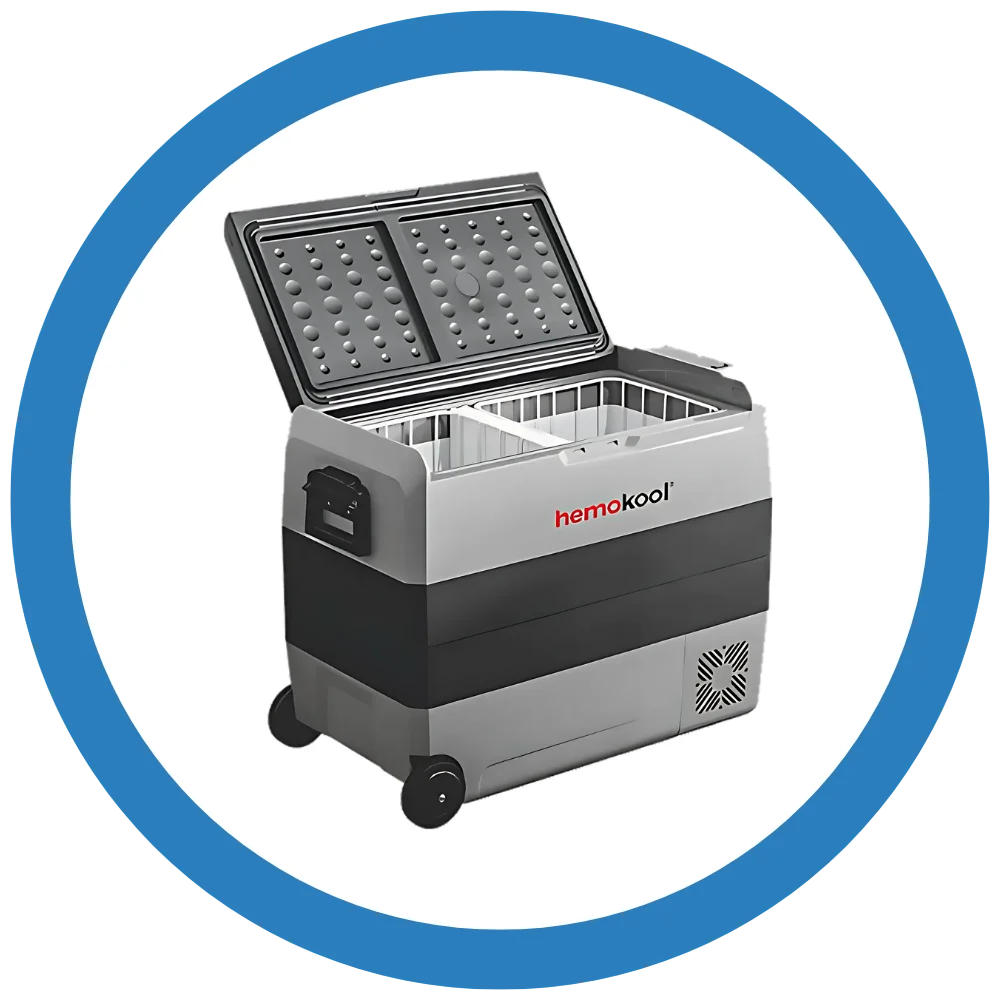
Lisaline Asia is the official supplier of Hemokool Active and Passive Cooling Boxes in India. Both of these are designed to ensure that temperature sensitive products like blood products, vaccines, pharmaceuticals and biologics remain within their safe temperature ranges during shipping and transport. However, the mechanism on which both of these operate differs.

Why do blood products need Active Cooling during transport?
Blood products like white blood cells, red blood cells, plasma, platelets, and whole blood require active cooling during transport. This is because their potency and effectiveness depends entirely on staying within a strict temperature range. Even a short deviation can render the product ineffective and make it harmful for patient use. Here’s why blood products need active cooling than passive cooling during transport:
1. Blood components are biologically fragile
Blood is a living, cellular product. Red cells, platelets, and plasma proteins all begin to degrade once they move outside their required temperature range. Red cells can hemolyze (break down) if too warm, plasma proteins and clotting factors lose potency if not kept frozen, and platelets lose function if not kept in constant gentle motion at the right temperature. This isn’t a quality preference, it’s a biological limit.
2. Different components need very different, specific temperatures
Red cells need 2°C to 6°C. Plasma needs -18°C or colder. Platelets need 20°C to 24°C. These aren’t rough guidelines, they’re the exact conditions under which the product remains clinically usable. Active cooling allows precise, adjustable control to hit and hold these specific bands rather than approximate them.
3. Even brief temperature excursions can make blood unusable
Unlike many other pharmaceutical products, blood components have very little tolerance for temperature swings. A short period outside the required range, even 20 to 30 minutes in some cases, can be enough to compromise red cells or platelets to the point where the unit must be discarded. Active systems continuously regulate temperature to prevent this.
4. Blood is irreplaceable and cannot be simply reordered
Blood comes only from donors, not manufacturing. If a shipment is compromised in transit, it cannot be replaced overnight. This raises the stakes on transport reliability far higher than for most other cold chain products, making tight, continuous temperature control a clinical necessity rather than a convenience.
5. Patient safety depends directly on product integrity
Blood transfusions are given to critically ill, injured, or surgical patients. A compromised unit isn’t just wasted, it’s a direct patient safety risk if it goes undetected and gets used. This is why blood transport carries some of the strictest temperature compliance requirements in the cold chain industry.
6. Regulatory and blood bank standards mandate continuous temperature control
Blood banking guidelines (from bodies overseeing blood transfusion services) require that blood products remain within validated temperature ranges from collection to transfusion, with documented proof. This makes continuous, active regulation and monitoring a compliance requirement, not just a quality measure.
In short, blood products require active cooling because they are biologically sensitive, have almost no tolerance for temperature deviation, cannot be replaced if compromised, and are subject to strict regulatory standards that demand continuous, provable temperature control throughout transport.
What are the key features that make an active blood transport box reliable?
An active blood transport box is a reliable device for maintaining the temperature of blood and its components during transport. Lisaline Asia provides advanced active blood transport box units under the product Hemokool Active Cooling Boxes. The features of these boxes are as follows:
Portable refrigerators
An active blood transport box is a portable refrigerator that can be handled easily during shipment. These have a built in handle and polyurethane wheels that makes the box easier to carry, move and position wherever you want to.
Precise Electric Controls
To meet the different temperature ranges suitable for different blood products, an active blood transport box has precise electric controls.The temperature of the box can be adjusted according to the suitable range. This ensures that the temperature of the blood products remains regulated and within safe ranges throughout the transit.
An advanced R134a refrigerant
An active blood transport box features an R134a refrigerant which is effective at producing stable low temperatures. This advanced refrigerant supports the wide operating range active blood transport boxes need to cover, from deep-freeze conditions for plasma down to controlled cool storage for red cells, all within one system. R134a doesn’t contain chlorine and has zero ozone depletion potential. This makes it a safer, more environmentally responsible choice.
A R134a refrigerant maintains consistent performance even as ambient temperatures shift during transport, whether the box is in a vehicle, on a loading dock, or moving between climates. Ultimately, the refrigerant’s job is to help the compressor maintain a steady internal environment. Since blood components have almost no tolerance for temperature swings, a refrigerant that performs consistently under load directly supports safe transport.
Dual Chamber Setting
An active blood transport box unit supplied by Lisaline Asia has a dual chamber setting. This lets a single active blood transport box operate as two independently controlled cooling zones instead of one. Blood components need different temperature bands. Red cells need 2°C to 6°C, plasma needs -18°C or colder. A dual chamber setup allows one compartment to be set for one range and the other compartment for a different range, so both can be transported together without either one being held at the wrong temperature.
Without a dual chamber option, moving red cells and plasma together would either require two separate boxes or compromise one component’s ideal temperature to accommodate the other.
Since each chamber is separately controlled, temperature-sensitive products in one compartment aren’t affected by heat exchange, condensation, or airflow from the other. This keeps each component’s storage environment stable and isolated.
The dual chamber setting also comes with a removable partition. If your shipment doesnt need two cooling zones, you can remove the partition and your active blood transport box can function as a single cooling zone.
Rather than maintaining separate boxes for separate temperature ranges, a facility can rely on one dual chamber unit to cover more transport scenarios. This can simplify logistics, reduce equipment costs, and make routine transfers between hospitals or blood banks more efficient.
Built in Digital LCD display
The Active Blood Transport Box supplied by Lisaline Asia features a built in digital LCD display. It shows the current temperature and operating status at a glance which helps staff confirm that the blood products inside are safe without opening the box. Opening the box risks heat exposure and an active blood transport box avoids it.
AC and DC Power Supply with a Battery backup
An active blood transport box operates on both AC and DC power supply. This gives it the flexibility to operate in different stages of a blood transport journey. A shipment typically moves through multiple stages: sitting in a facility (AC available), loaded into a vehicle (DC available), and possibly transferred between vehicles or handed off at a midpoint. Having both AC and DC compatibility means the box doesn’t lose cooling power during any of these transitions. Staff can simply switch the power source depending on where the box is, plug it into a wall socket at the facility, then into the vehicle’s DC line for the road, without powering down or risking a temperature gap in between.
This dual power supply also works alongside the box’s battery backup (3 to 6 hours), which bridges any short gap between switching power sources or during a temporary power interruption, so the internal temperature doesn’t start rising even for a few minutes.
Durability
An active blood transport box is built with a sturdy metal exterior, designed to withstand the handling involved in hospital logistics and blood bank transport.
Interior LED Light
The interior LED light improves visibility inside the active blood transport box. Without opening the box, the staff can clearly see if the items are properly kept.
How does an Active Blood transport Box work?
The Active Blood Transport Box has a simple application and anyone without technical knowledge can operate it. Here’s how an active blood transport box supplied by Lisaline Asia operates:
Step 1: Loading the blood products
Blood units or blood components are placed inside the box. If the dual chamber option is being used, products requiring different temperatures, such as red cells and plasma, are placed in their respective compartments, separated by the removable partition. The interior LED light helps staff see clearly while placing items correctly, keeping the door-open time short.
Step 2: Setting the required temperature
Once loaded, staff use the digital LCD display to set the target temperature for the chamber (or each chamber, in a dual setup). Since blood components need different ranges, red cells around 2°C to 6°C, plasma at -18°C or colder, the required temperature is set based on what’s inside.
Step 3: The compressor starts actively cooling
As soon as the target temperature is set and the box is powered on, the DC compressor begins running, using R134a refrigerant to draw heat out of the interior. This isn’t a one-time cool-down, the compressor keeps cycling continuously to hold the interior at the set temperature for the entire journey.
Step 4: Running on AC power while stationary
Before the box is moved, it typically stays connected to AC mains power (110-220V), such as at a blood bank or hospital facility. During this stage, the compressor draws power directly from the wall socket, maintaining the set temperature while the box is being prepped for transport.
Step 5: Switching to DC power once loaded for transit
When the box is loaded into a vehicle, ambulance, or delivery van, it switches to the vehicle’s DC power supply (12/24V). This switch from AC to DC ensures that the compressor keeps running uninterrupted. Therefore, cooling continues throughout the actual road journey, not just before it.
Step 6: Battery backup takes over during power gaps
If there’s a brief interruption, say, during a vehicle stop, a handover between vehicles, or a delay in reconnecting to a power source, the built-in battery backup (3 to 6 hours) automatically keeps the compressor running. This prevents any temperature rise during short gaps when neither AC nor DC power is actively connected. The 3-level battery protection also ensures the box doesn’t excessively drain the vehicle’s own battery while drawing DC power.
Step 7: Continuous monitoring via the display
Throughout the journey, the digital LCD display keeps showing the real-time internal temperature, so staff can check status at any point without opening the box. If the temperature needs adjusting mid-transit, it can be done directly from the display.
Step 8: Alarm kit flags any deviation (if fitted)
If the box has the retrofitted alarm kit, it continuously tracks the temperature against the safe range and alerts staff if it drifts outside that range. It also logs this data, which can be downloaded later for a full temperature history of the trip.
Step 9: Unloading at the destination
Once the box reaches the blood bank, hospital, or delivery point, staff open it to remove the blood products. The interior LED light again supports quick, accurate handling during unloading, and the LCD display can confirm the final temperature reading at handover