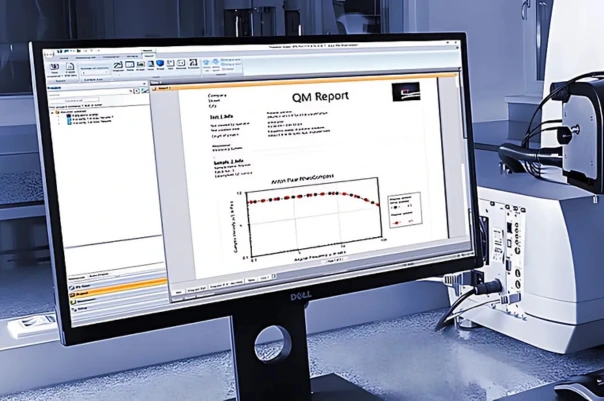

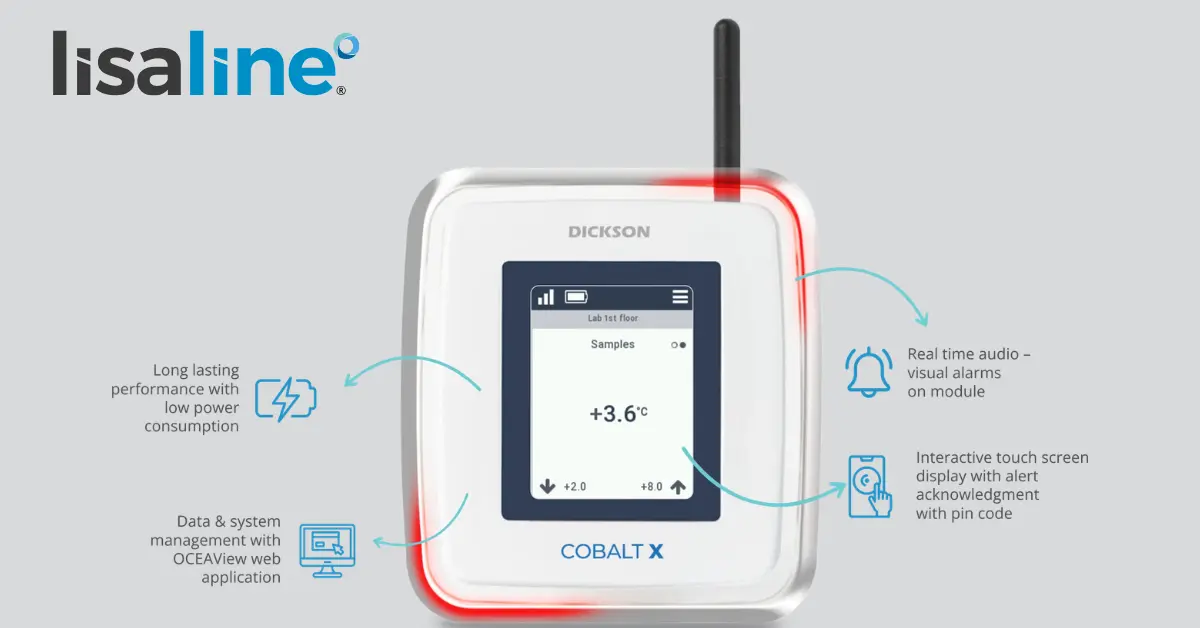
In the fast-paced world of cold chain logistics, a wireless data recording system ensures uninterrupted oversight of critical conditions. Wireless temperature loggers form the backbone of remote temperature monitoring, capturing the real time data on temperature, humidity and more without the hassle of cables.
Lisaline Asia is the official supplier of Dickson’s Cobalt Series wireless data recording system. In this blog, we learn what a wireless data recording system is, how it actually works, key benefits and how to choose one. We also discuss the types of wireless temperature loggers we supply and their unique features.
What is a wireless data recording system in cold chain monitoring?
A wireless data recording system in cold chain monitoring is a series of wireless temperature loggers. They are placed with sensitive products during storage and shipment to monitor parameters like temperature, humidity, CO2, etc. They offer remote monitoring, so you get real-time readings for your products. With cloud integration, these wireless temperature loggers send the readings to a cloud dashboard and can be viewed on your mobile or computer device.
Lisaline Asia offers a wireless data recording system comprising Dickson’s wireless data loggers. We are the official supplier of Cobalt Series data loggers. These are wireless dataloggers with cloud integration that send the readings to OCEAView, where you can view the data in real time. With advanced wireless temperature sensors, these data loggers offer accurate monitoring and real-time alerts in case of excursions.
How wireless temperature loggers work?
A wireless data recording system comprises several wireless temperature loggers. Wireless temperature loggers are small, compact data logger devices that do not require a wire or cable for setup. These mobile wireless data loggers can be placed along with sensitive products like vaccines, pharmaceuticals, blood bags, etc. With advanced wireless temperature sensors, these data loggers record parameters like temperature, humidity, etc., at set regular intervals.
The readings are stored in the logger’s internal memory and sent through a network- Wi-fi, cellular, LoRaWAN or any other wireless connection to a cloud platform. From here, you can view the readings, get real-time alerts in case excursions happen, etc. This helps you act in time and prevent temperature excursions and protect the potency of your temperature-sensitive products.
The wireless temperature loggers supplied by Lisaline Asia are Dickson’s Cobalt series wireless data loggers. These data loggers offer multi-point wireless temperature monitoring. They record temperature readings at regular intervals and send the readings with the LoRaWAN network to the OCEAView platform. From here you can view detailed readings, download reports and get real time alerts in case of excursions.
Wired vs wireless data recording system: Which is ideal for your cold chain applications?
When it comes to monitoring the temperature of sensitive products like vaccines, pharmaceuticals, or blood bags, choosing the right system matters. Both wired and wireless data recording systems get the job done — but they differ significantly in how they do it.
Wired Monitoring Systems
A wired temperature monitoring system uses physical cables and wires to connect temperature sensors to a central data logger or control panel. The sensors are fixed in place and transmit readings through the cable network to a display unit or local software.
This setup works well in controlled, static environments where sensors do not need to be moved. However, the installation process can be time-consuming and costly. Running cables across a large facility — through walls, ceilings, or cold storage units — requires significant infrastructure. Any damage to the cables can also disrupt the entire monitoring chain, putting your temperature-sensitive products at risk.
Wireless data recording systems
A wireless data recording system, on the other hand, eliminates the need for cables. Small, compact wireless temperature loggers are placed directly alongside sensitive products and record parameters like temperature and humidity at set regular intervals. The readings are stored in the logger’s internal memory and transmitted through a wireless network—Wi-Fi, cellular, LoRaWAN, or similar—to a cloud platform.
From here, you can view real-time readings, download detailed reports, and receive instant alerts the moment an excursion occurs. This allows you to act quickly and protect the potency of your products before any damage is done.
Why wireless data recording system is better?
For most modern applications — especially in pharmaceuticals, healthcare, and food storage — a wireless data recording system is the smarter choice. It is easier to install, far more flexible, and gives you remote visibility over your entire cold chain from a single platform.
Wired systems may still suit small, fixed setups where infrastructure is already in place. But if you need scalable, real-time monitoring across multiple locations or storage units, wireless is the way to go.
The wireless temperature loggers supplied by Lisaline Asia are Dickson’s Cobalt series wireless data loggers. These devices offer multi-point wireless temperature monitoring, recording readings at regular intervals and transmitting them via the LoRaWAN network to the OCEAView platform. From here, you can view detailed readings, download reports, and get real-time alerts in case of excursions — keeping your products safe at all times.
What are the key benefits of a wireless data recording system?
A wireless data recording system offers several benefits for cold chain facilities:
Easy Setup
A wireless data recording system can be set up easily, as no wires or cables are involved. You can just turn the wireless data logger on, connect the sensors and set up cloud integration with OCEAView. Then your wireless data logger is ready to start continuous temperature monitoring.
Remote real-time monitoring
A wireless data recording system offers real-time remote monitoring of temperature, humidity and other parameters. This means that you do not need to physically access the data logger to view the readings. Instead, it remotely records the readings and sends them in real time to a cloud platform like OCEAView. With OCEAView integration, you can receive real-time alerts on your mobile device in case of excursions and view the data as it is sent from the logger without any delay.
Immediate alerts
A wireless data recording system triggers alarms when the parameters go beyond the set thresholds. You can get these alerts on your mobile device through the OCEAView mobile app. With immediate real-time alarms, you can act fast and fix the issue before product potency and quality are irreversibly affected. Thus, it helps to reduce product loss due to excursions, which can be prevented fast.
Compliance and audit-readiness
When it comes to compliance, a wireless data recording system is the best choice. It provides time-stamped data of the readings through the cloud platform or app like OCEAView. These can be downloaded into PDF/ CSV reports. This creates a permanent digital record of readings so that you can prove what happened and when. This helps during audits by keeping all the proof in one digital system, saving time, and making the audit more organised.
Support Better Decision Making
As continuous temperature monitoring takes place and time-stamped readings are recorded, you can spot patterns over time. For eg, you may experience that a certain truck, route or cold room regularly experiences small temperature spikes. In this way, a wireless data recording system helps you make changes so that excursions are avoided.
Where are wireless temperature loggers used?
Wireless temperature loggers are used to conduct continuous temperature monitoring in cold chain facilities, pharmaceutical and biological labs, and warehouses. They also offer monitoring during transport of vaccines, medicines, blood products, and other temperature-sensitive goods.
What is an IoT-based real-time wireless data recording system?
An IoT-based real-time wireless data recording system is a setup where wireless temperature sensors collect readings automatically. Then these readings are sent wirelessly to a cloud or web platform for live viewing, alerts, and reporting.
The wireless temperature loggers supplied by Lisaline Asia, Cobalt Series, have wireless temperature sensors that collect readings about temperature, humidity, and other parameters automatically. Then these readings are stored in the logger’s onboard memory and sent wirelessly over LoRaWAN to a gateway. The gateway forwards them to OCEAView for live viewing, alerts, and historical data.
OCEAView is an IoT-based real-time wireless monitoring platform where you can view live data and previous data, and get real-time email, SMS or app alerts in case of breaches.
What are the features to look for in wireless temperature loggers?
While choosing wireless temperature loggers for your wireless data recording system, you need to look at a combination of features. These include accuracy, ease of use and connectivity, battery life, storage and reporting. Here are the factors you should consider while choosing wireless temperature loggers for your warehouse or cold chain facility:
Accurate temperature monitoring
Accuracy is one of the most important features in a wireless temperature logger. If a data logger gives incorrect readings, it can lead to wrong decisions and missed temperature excursions. In cold chain applications, this can be especially serious because affected products may still be used or administered to patients without knowing they were exposed to unsafe conditions. That is why it is essential to choose a logger that delivers highly accurate and reliable temperature monitoring.
The wireless data loggers supplied by Lisaline Asia, including Dickson’s Cobalt Series, support up to 4 advanced temperature sensors. This allows for more precise temperature measurement and supports multi-point wireless temperature monitoring, helping reduce the chance of inaccurate data and improving overall confidence in the readings.
Real-time data viewing and alerts
The wireless data logger should be connected to a network like LoRaWAN as in the case of Cobalt data loggers. It should send the data directly via this network to an app or cloud-based platform like OCEAView. Here, the data should be available for viewing in real time. The wireless temperature loggers should also trigger alarms or alerts immediately in case a temperature excursion occurs. This will notify you when the parameters exceed or fall below the set thresholds, helping you take quick action and reduce further loss.
If the wireless temperature loggers you choose do not support real-time data viewing, you may not know the temperature status as it changes. If they do not trigger immediate alerts, you may only find out after the excursion has already occurred. By then, the product potency may already be affected.
Battery Life
While choosing wireless temperature loggers, battery life matters a lot because these data loggers run for long periods without being touched. Moreover, the data logger should retain the data in case of sudden battery drains. For remote sites or during transport, this is especially important because changing batteries is inconvenient and can affect monitoring.
Cobalt X wireless data loggers, supplied by Lisaline Asia, typically offer around 1 year or more of battery life under normal use. The data logger gives a low battery warning on both the device screen and the app when the battery level falls below 20%. Moreover, the Cobalt X data logger has battery backup support, and it can also run on AC power. If one power source drops, the other can keep the logger operating. The data is stored in the onboard memory, so even if the battery suddenly drains, it is not lost.
Data Storage Capacity
The logger should have enough storage for your monitoring period. If the memory is too small, older data may be removed before you can review it.
Cobalt X wireless temperature loggers have a local storage capacity of 4000 readings per measurement point, which is roughly 4 weeks of data at a 10-minute logging interval. The uploaded data is stored without limit on the OCEAView monitoring platform. The cloud platform can retain the uploaded records for much longer.
Reporting or Export options
A good wireless data logger should help you export data in formats like PDF or CSV. It makes it easier for you to share reports with quality teams, customers, and auditors. This helps in compliance and future decision-making.
Cobalt X wireless data loggers share real-time readings with the OCEAView app on mobile or web-based platforms. The platform allows you to export time-stamped data, along with downloading reports in PDF/CSV formats. This helps in audit compliance and analysis.
Sensor Compatibility
Some wireless temperature loggers record temperature only, while others monitor other parameters like humidity, pressure, vibration, and other inputs. If you need to monitor parameters other than temperature, you should choose wireless data loggers that monitor those parameters.
Cobalt X, supplied by Lisaline Asia, supports a wide range of data loggers, not just temperature. It supports up to 4 external sensors that can monitor multiple parameters, including temperature, humidity, pressure, CO₂, etc. This gives versatility of use in multiple cold chain products.
Communication range
The range of your wireless data recording system should match your requirements. Bluetooth is good for short-range use, Wi-fi works well where a connection is available, and cellular or LoRa, is better for large or more remote areas. Choose the wireless range for your wireless temperature loggers based on where the logger will be used.
The Cobalt series of wireless temperature loggers supplied by Lisaline Asia uses LoRaWAN long range wireless connectivity. This supports line-of-sight range up to about 15 km. A wireless data logger that uses LoRaWAN to send data is worth choosing because data can be sent over long distances while using very little power.
Durability
The wireless temperature loggers you choose should be strong externally. It should handle the external conditions it will be exposed to like moisture, vibration or low temperatures. If the logger is not built for the environment in which it will operate, it will fail even if the sensor is accurate.
Cobalt X comes with IP30 standard protection. An optional IP67 external case is available for environments that need better protection against moisture, vibration, and cleaning. This makes it suitable for standard cold chain environments.
How wireless data recording system help in remote monitoring of humidity and temperature?
A wireless data recording system helps in remote monitoring of temperature, humidity and other parameters. The data logger is placed in the product itself to measure temperature and humidity. It measures parameters like humidity and temperature continuously at regular intervals, which can be adjusted. The readings are sent to a web-based platform or an app called OCEAView through LoRaWAN wireless connectivity in real time.
The readings can be viewed, and data can be exported in the form of PDF and CSV files. The wireless data recording system also triggers immediate alarms and alerts when the parameters go beyond the set thresholds. These alarms are sent to the user’s mobile device through the OCEAView app.
The user does not have to physically access the data logger at any point in time to get the temperature, humidity, or other readings. Hence, it is useful for remote monitoring of sensitive cold chain products like vaccines, pharmaceuticals, etc.
What are LoRaWAN based wireless temperature loggers?
Lisaline Asia supplies Dickson’s Cobalt series wireless data loggers. These wireless temperature loggers monitor temperature, humidity, and other parameters at regular intervals. They send the readings to a web-based platform where the data can be viewed in real time, and alerts or alarms can be sent in case of breaches.
The network through which these readings are sent from the wireless temperature sensor to the OCEAView platform is LoRaWAN. It is a low-power, long-range network, which makes it useful for cold chain monitoring.
The wireless temperature loggers first broadcast data over LoRaWAN rather than directly connecting to the cloud or web-based platform. The wireless data logger connects to LoRaWAN by joining a gateway/network. Then the readings are sent as small encrypted wireless packets to the LoRaWAN network. From there, the gateway forwards the packets to OCEAView, where they are decoded, stored, and shown on the dashboard.
What are the different types of alarms a wireless data recording system can provide?
A wireless data recording system with cloud integration can provide real-time alerts when the conditions do not meet the set parameters. This is because the readings are sent in real time to a cloud platform like OCEAView through LoRaWAN connectivity for long-distance data transmission. The platform compares the readings with the set parameters, and if they do not match (exceed or go below), then the system triggers alarms.
Local Device Alerts
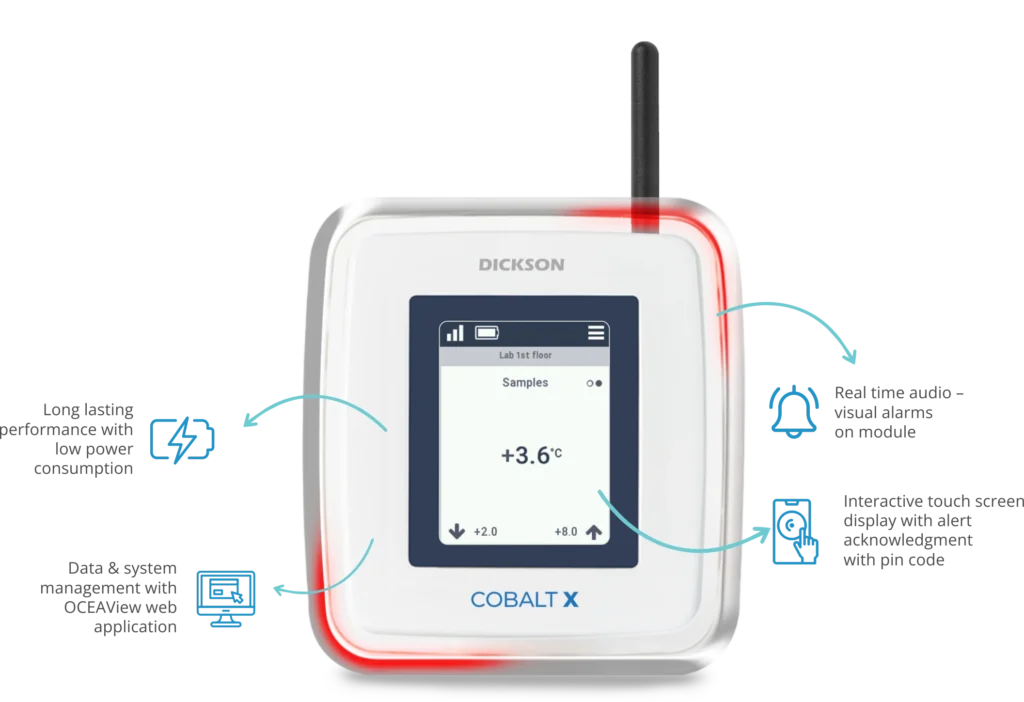
On the device, alerts are shown with flashing LED indicators which give visual alerts. A green light usually means normal operation, while a red or flashing light generally indicates an alarm or excursion.
On the touchscreen display which shows current readings and battery level, alarm messages, icons, or colour changes show temperature excursions. These can be acknowledged by users through PIN protected screen.
The wireless data logger device can also alert users with buzzer sound alerts only when the device is running on AC power and not on battery.
Each Cobalt X sensor supports 3 high and 3 low programmable alarm limits (6 total per sensor), with customizable delays for each to reduce nuisance alerts. Devices handle up to 4 sensors simultaneously (X2 model), so up to 24 limits total, but alarms trigger independently per limit/sensor.
Mobile/Cloud based alerts
The remote alerts on a mobile device are handled by OCEAView cloud based platform. It provides real time alerts which help in remote monitoring during shipments and storage. Here are the different types of alerts a wireless data recording system can provide:
Email Alerts
The wireless data recording system provides detailed notifications which are sent instantly to predefined recipients upon threshold breaches. These include timestamps, current readings, graphs of excursions, and return-to-normal confirmations for compliance records. Email alerts are ideal for team distribution and logging, with support for multiple severity levels (up to 3 high/3 low per sensor) and optional delays to filter transients.
SMS/Text Alerts
SMS alerts are concise, immediate text messages delivered directly to mobile phones (e.g., “High temp: 5°C at Sensor X”) without needing internet or apps. These ensure quick response in low-connectivity areas; rule-based for escalation, multilingual, and testable prior to deployment, complementing emails for urgency.
Phone Call Alerts
Phone call alerts include automated voice calls dialing assigned users with spoken breach details. These start with one call per rule, but if “repeat on unacknowledged” is enabled and excursion persists, calls repeat every 30 minutes to all recipients until acknowledged via app/device or corrected. The phone call alerts stop across channels upon acknowledgment even if unresolved.
App Notifications
Push notifications via OCEAView Mobile app (iOS/Android) appearing as banners with live data, alarm lists, graphs, and one-tap acknowledgment. These support real-time dashboards, unlimited concurrent views, and multi-device management for remote oversight, integrating seamlessly with other methods for hybrid rules.
Yes, users must configure the specific types of alarms and notifications they want to receive for the Cobalt X system in OCEAView, and they will only get those selected alert types—no alerts are sent by default for unconfigured channels. Alarm rules are set up manually in OCEAView (cloud or on-premises) by defining thresholds (3 high/3 low per sensor with delays), selecting notification methods (email, SMS, phone calls, or app push notifications), recipients, and options like repetition or acknowledgment requirements; local device alerts (LED/buzzer/display) are always active but remote ones depend entirely on these user-defined rules.
What are the wireless temperature loggers offered by Lisaline Asia?
Lisaline offers Dickson’s Cobalt Series wireless data loggers for cold chain monitoring. The main variants we provide are Cobalt X and Cobalt XS. These wireless data loggers are used for real-time temperature monitoring. Some models also support humidity, pressure, CO2 and other parameters depending on the sensor setup. These can be integrated with OCEAView to access live data on mobile and get real-time alerts in case of excursions.
Cobalt X
Cobalt X is a multi-parameter wireless data logger. It is a smart temperature-humidity data logger that keeps checking conditions continuously and sends the readings wirelessly to a platform like OCEAView. It stores the data not just locally but also records the readings in onboard memory. Cobalt X shares the data through LoRaWAN so you can view the data remotely.
This wireless data logger supports up to 4 external sensors simultaneously, so one device can monitor multiple points. It has a touchscreen interface, visible alert indicators, and support for alarm acknowledgement directly on the device. Alarms can also be sent to the cloud platform as email, phone, text, or other notifications, depending on the setup.
The Cobalt X series has Cobalt X1 and X2 variants. Cobalt X1 supports up to 4 external sensors while X2 supports up to 2 sensors.
Cobalt XS
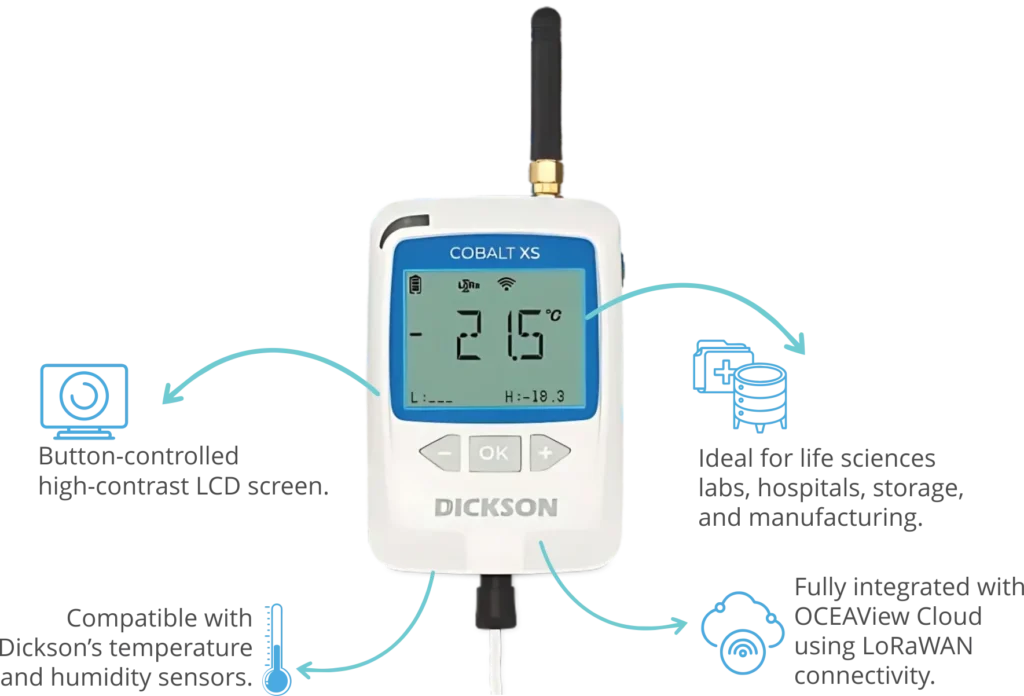
Cobalt XS is a compact wireless data logger designed for simple, reliable monitoring of temperature and humidity. Like Cobalt X, it records temperature and relative humidity continuously and sends the readings wirelessly to OCEAView.
Cobalt XS has a high-contrast button-controlled LCD screen, so you can check the readings directly on the device, too. It can connect up to 2 sensors.
Conclusion: Wireless Data Recording System in Cold Chain Monitoring
The advanced wireless temperature loggers enable a wireless data recording system to provide real-time monitoring and instant alerting together with complete compliance support, which transforms cold chain management operations. The systems provide easy installation requirements together with LoRaWAN long-distance connectivity and OCEAView multi-sensor capability and unlimited cloud storage to help pharmaceutical and vaccine operations decrease product losses while making better operational decisions.
As the official provider of Dickson’s Cobalt Series wireless temperature loggers in India, Lisaline Asia provides advanced solutions which are tailored for cold chain monitoring during storage and transport.
Secure time-stamped proof of your sensitive products’ parameters with our wireless data loggers. Visit our website for more details or contact our team today to discuss your cold chain monitoring requirements.
FAQs
- How does a LoRaWAN gateway work in a wireless data recording system?
In a wireless data recording system, a LoRaWAN gateway works as the bridge between the Cobalt Series wireless data loggers and OCEAView. The Cobalt logger sends encrypted uplink data over LoRa radio. The gateway receives it and then forwards it over IP backhaul such as Ethernet or cellular to the LoRaWAN network/server, which then delivers the data to OCEAView.
- What is the difference between a wireless data recording system and a wireless temperature logger?
A wireless data recording system is the complete setup that includes the logger, LoRaWAN communication network, gateway, and OCEAView cloud/web-based platform, while a wireless temperature logger is a single device that measures data at regular intervals and sends it. In the Cobalt Series data loggers supplied by Lisaline Asia, the readings are sent through LoRaWAN to a gateway, which then forwards them to OCEAView for monitoring. So, a wireless data recording system is the full setup, while a wireless temperature logger is one device inside that setup.
- What happens if the wireless temperature loggers lose network connection?
If wireless temperature loggers like Cobalt X lose network connection, the data logger keeps recording readings in its on-board memory and transmits them to OCEAView once connectivity is restored. It supports both LoRaWAN and Bluetooth Low Energy connectivity, so the data is not lost during a temporary disconnect.
- Can a wireless data recording system monitor humidity too?
A wireless data recording system can also monitor humidity if the wireless temperature loggers support multi-parameter sensing instead of temperature only. In a multi-parameter system like Cobalt X, humidity can be monitored along with temperature because the loggers are designed to work with different sensors and measure environmental parameters such as temperature, relative humidity, and more. The readings are then sent to OCEAView through LoRaWAN or Bluetooth Low Energy connectivity.
- How does a wireless data recording system improve compliance and audit readiness?
A wireless data recording system consists of wireless temperature loggers that measure temperature and other parameters at regular intervals. The readings are transmitted with time stamps through LoRaWAN to a gateway, which forwards them to OCEAView. In OCEAView, users can view live data, receive real-time alerts for breaches, and download reports in PDF and CSV formats. These reports help with proofs during audits and support compliance requirements.