
Not every product breaks down the moment it faces heat. Some can tolerate a certain amount without real damage.
This is where a regular heat indicator label falls short. It only tracks sudden heat spikes but cannot tell you how much heat a product has actually absorbed over time.
A time temperature indicator label solves this problem. It shows exactly how much heat exposure a product has accumulated, not just whether one spike occurred.
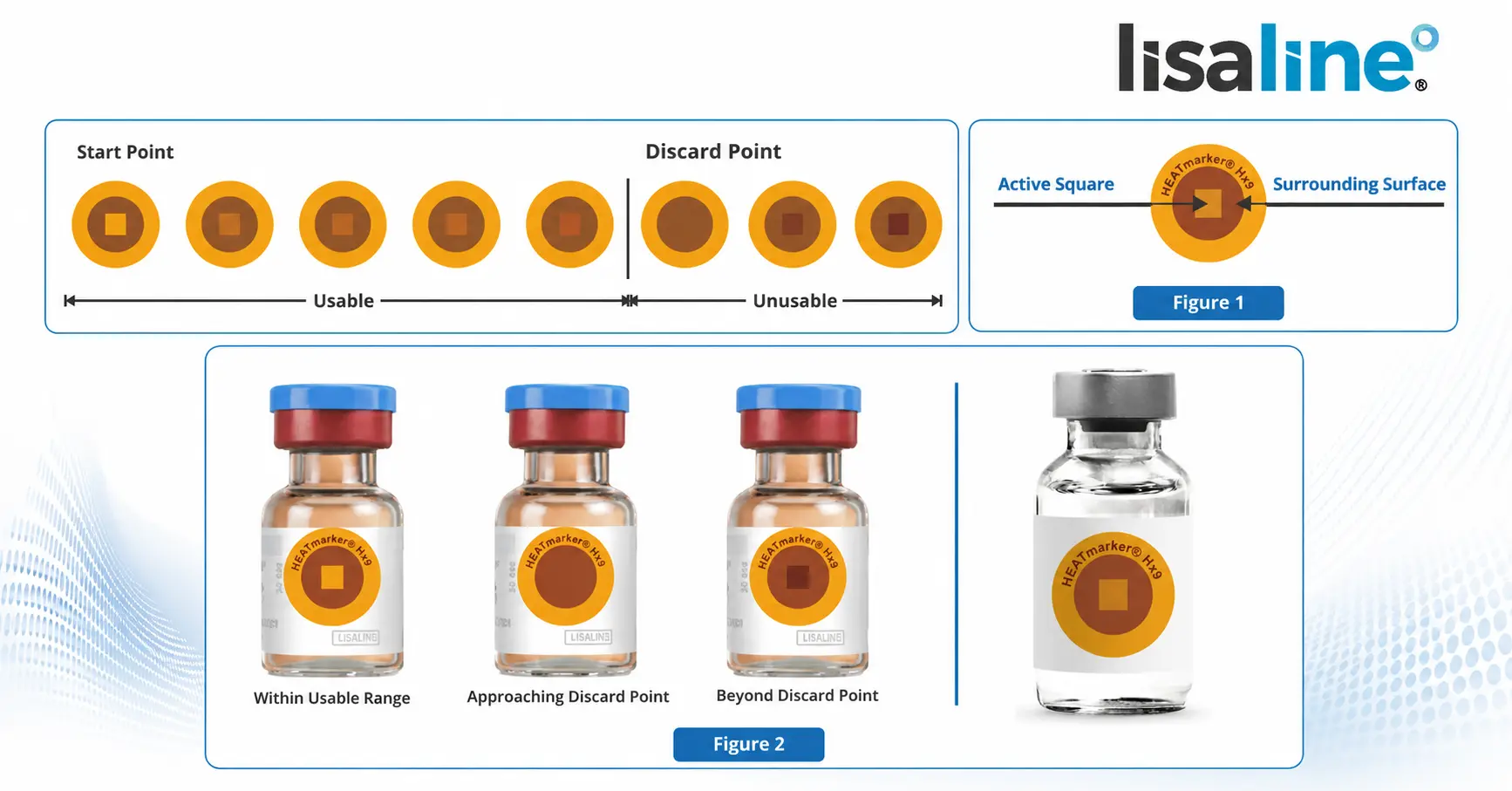
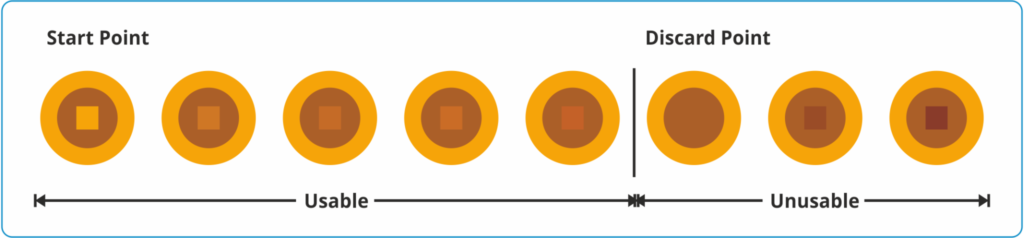
Here’s how it works. Each time the product crosses its safety temperature limit, the square on the label changes colour. This change is permanent. It does not reset to zero on the next exposure. It moves forward, from the last colour to a darker shade.
Once the indicator shade in the time temperature indicator label matches or exceeds the shade of the outer reference ring, the product is considered compromised and cannot be used for patients.
In this blog, we break down the science behind this colour change: why it happens, how it happens, and what causes false triggers. We also cover why this colour change matters for verification, and the benefits it brings to cold chain monitoring.
What is a time temperature indicator label?
A time temperature indicator label measures cumulative heat exposure. This means the total heat a product absorbs over a set period, usually its entire shelf life.
A time temperature indicator label like HEATmarker, supplied by Lisaline Asia, is applied directly to the vaccine vial or medicine bottle. It tracks the extent of heat exposure the product receives throughout its journey.
Every time the product is exposed to heat beyond its safe limit, the colour shade changes and turns darker. This change is permanent. The label never returns to its original colour. It only moves further towards the darkest shade with each new exposure.
Once the label matches its outer reference ring, the colour stops changing. This means the product has been damaged completely and is no longer safe for patient use.
What is the science behind the colour change in a time temperature indicator label?
A time temperature indicator label carries a heat sensitive chemical system inside its indicator square. This is not just a dye that randomly darkens with heat. It is engineered to respond to one specific temperature, called the specification temperature, set to match the safe storage limit of the exact product it protects.
For example, a vaccine that must stay below 8°C gets a label calibrated to that threshold. A medicine that can tolerate storage up to 25°C gets a different calibration. This is why the temperature limit is preset during manufacturing, not something that can be adjusted later.
This calibration happens at the manufacturing stage. Zebra, through its manufacturing partner Temptime, builds each HEATmarker with a factory-set specification temperature and response time. Lisaline Asia, as Zebra’s authorised supplier in India, helps you choose the correct pre-calibrated variant for your product and supplies it, ready to use.
What actually causes the colour change?
Inside the indicator square is a heat-sensitive compound. In most time temperature indicators, this works through one of two established mechanisms. Either a coloured compound diffuses through a porous layer at a rate that depends on temperature, or a colourless compound undergoes a slow chemical reaction, such as polymerisation or oxidation, that produces colour as it progresses.
Zebra’s HEATmarker, which Lisaline Asia supplies, uses its own patented colour-change chemistry built on this same underlying science. The exact formulation is proprietary, but the working principle follows established time-temperature indicator chemistry.
Why heat speeds up the reaction?
The key driver is a basic chemical principle. Reaction rate depends on temperature. The higher the temperature, the faster the reaction or diffusion process runs. This means that at the specification temperature, the colour change happens at a defined, predictable rate. Above that temperature, the same reaction runs faster, and the colour darkens more quickly. Below it, the reaction barely progresses, and the label stays close to its original shade.
This is what makes the label a genuine time-temperature indicator rather than a simple heat sensor. It is not just reacting to whether a threshold was crossed. It is measuring how much time was spent above that threshold, and how far above it the product went.
Why the colour never resets?
The chemical reaction driving the colour change is irreversible. Once the compound reacts or diffuses, it does not reverse when the product cools down again. This is why the colour change is cumulative. Every new exposure adds to the reaction that has already taken place, rather than starting over. The label is, in effect, keeping a running total of heat stress on the product.
Reaching the endpoint
Each time temperature indicator label is manufactured with a reference colour printed on it, usually as an outer ring. The reaction inside the indicator square continues until the developing colour matches or exceeds this reference. At that point, the cumulative time-temperature exposure has reached the limit the product can safely tolerate, and the label has reached its endpoint. The product has been damaged completely and it cannot be sent for patient use.
What can cause a false trigger and colour change in a time temperature indicator label?
A time temperature indicator label is built to be accurate, but it is still a chemical system. A few handling and storage mistakes can trigger a colour change that has nothing to do with how the actual product was treated.
01 Direct Handling
Direct handling of the time temperature indicator label is one of the most common causes. Touching the indication window with bare fingers transfers body heat to the reactive chemistry. For indicators with a threshold close to body temperature, even a few seconds of contact can push the reaction forward. This is why labels should always be handled by their edges, not by the indicator square itself.
02 Improper Storage before application
Storage of the time temperature indicator label before it is even applied is another factor. Most time temperature indicator labels start reacting the moment they are manufactured, not the moment they are attached to a product. If a batch of labels sits in a hot warehouse or a poorly ventilated storage room before use, the chemistry inside starts consuming its response time early. By the time the time temperature indicator label is applied to the actual product, it may already show partial colour change that reflects the storage room, not the product’s cold chain journey.
03 Exposure to a heat source unrelated to the product
Exposure to a heat source unrelated to the product can also cause a false trigger. This includes direct sunlight through a vehicle window during transport, placement near machinery, radiators, or lighting fixtures, or simply resting on a warm surface while waiting to be packed. The time temperature indicator label reacts to whatever temperature it experiences, so anything that heats the label without heating the product will still show up as a colour change.
04 Physical damage to time temperature indicator label
Physical damage to the indicator square is a less common but real cause. Scratching, pressing, or rubbing the reactive area can disturb the chemistry mechanically and produce discolouration that has nothing to do with heat exposure at all.
05 Placement of the time temperature indicator label on the product
Placement of the time temperature indicator label also matters. A label applied to outer packaging rather than the product itself may be exposed to a different microclimate, especially if that packaging surface heats up faster than the product’s actual core temperature. In this case, the label is accurately reporting its own exposure, but that exposure may not represent what the product inside experienced.
06 Expired time temperature indicator label
Finally, an expired or near end-of-shelf-life indicator can cause a misleading reading. Every time temperature indicator label has its own shelf life, since the base chemistry is not completely inert even under ideal storage. A label used well past its rated shelf life may already show partial colour change before it is even applied.
None of these causes represent a fault in the indicator itself. They are handling and storage errors that any team can avoid with a basic understanding of how the label actually works, which is exactly why understanding the mechanism behind the colour change, and not just the colour change itself, matters for anyone using these labels in a cold chain.
How to read the colour change in a time temperature indicator label?
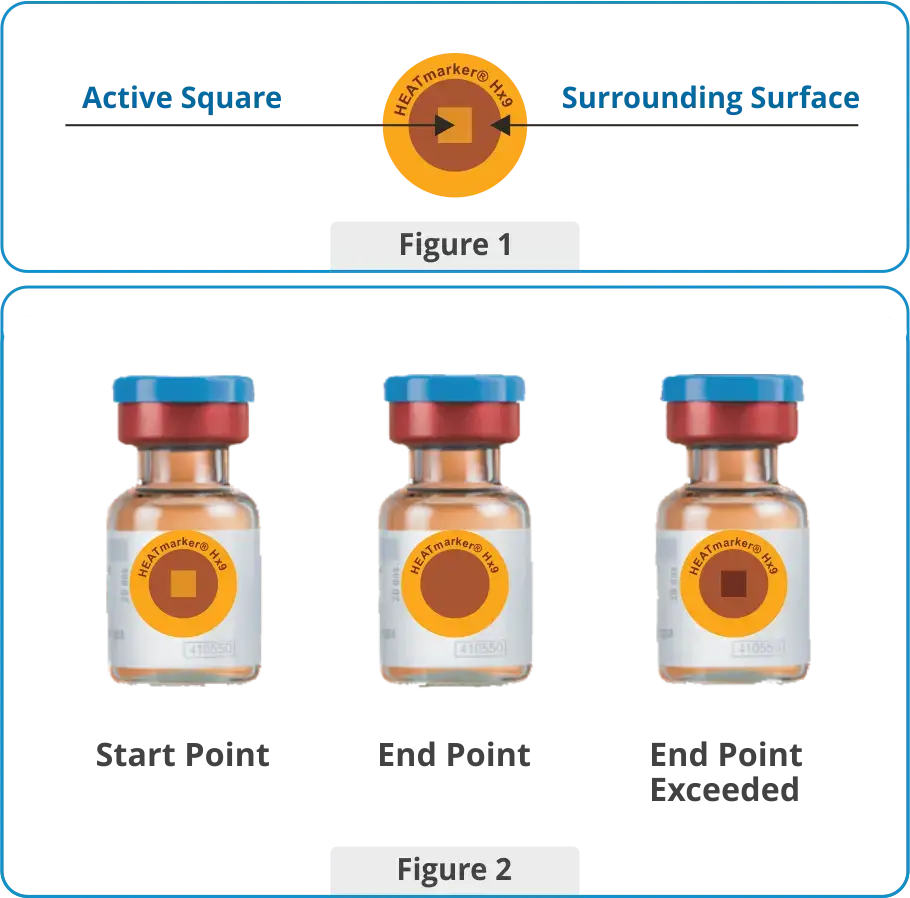
Reading a time temperature indicator label is simple once you know what you are looking at. The HEATmarker label supplied by Lisaline Asia has two parts. There is an inner square of colour-changing material, called the active surface, and an outer ring printed in a fixed reference colour. You read the label by comparing one against the other.
The rule is straightforward. You are always checking whether the inner square is still lighter than the outer ring, or whether it has caught up to it.
When the product is safe to use
At the start of its life, the inner square is clearly lighter than the outer reference ring. This is the reading you want to see. It means the product has not accumulated enough heat exposure to be a concern, and it can be used for patients as normal.
A slightly darkened square is not automatically a rejection. As long as the inner square remains lighter than the ring, the product is still within its safe time-temperature limit. The label is simply showing that some heat exposure has occurred, which is exactly what it is designed to track.
When the product has reached its endpoint
The endpoint is reached when the inner square matches the outer ring, or turns darker than it. This is the reading that tells you to stop. Once the square is as dark as the reference ring or darker, the cumulative heat exposure has crossed the limit the product can safely tolerate. The product is considered compromised and must not be sent for patient use.
Because the colour change is irreversible, this reading is final. The square will not lighten again if the product is moved back into cold storage. A matched or darkened square means the damage has already been recorded.
Reading the label the right way
Always compare the square directly against its own outer ring, not against another label or against your memory of how it looked earlier. The reference ring is printed on each label precisely so you have the correct benchmark right next to the active surface, in the same lighting, at the same moment.
Check the label in good, even light. Poor lighting or a coloured background can make the square look darker or lighter than it really is, which can lead to a wrong call in either direction.
Read the label at the point of use, just before the product is administered or dispensed. This is when the reading matters most, because it reflects the entire time-temperature journey the product has taken up to that moment.
If you are ever unsure whether the square has matched the ring, treat the reading as borderline and follow your organisation’s cold chain protocol for questionable units. The label is built to give a clear signal, but the final decision should always sit within your standard quality process.
What are the benefits of an irreversible colour change in a time temperature indicator label?
The value of a time temperature indicator label comes down to one thing: the colour change. It turns an invisible problem, heat exposure over time, into something anyone can see and act on. Here is what that colour change makes possible.
1. Easy verification at any stage and any point of delivery
The colour change lets teams verify a product at every stage of its journey, not just at the end. At any point in transit or storage, a logistics team can look at the label and see how much heat exposure has built up so far, and whether the product is still safe or has been damaged completely. The same holds at the point of delivery. The receiver does not need paperwork, a reading, or a report. They simply look at the label and confirm on the spot whether to accept the product or reject it. This turns every handover into a checkpoint, so a damaged product can be caught the moment it changes hands rather than after it has already been stored or used.
2. Identifies the gaps in the cold chain
A regular heat indicator label only flags a sudden spike. A time temperature indicator label changes colour every time the product crosses its safe limit, and each change builds on the last. This means the colour is not just a pass or fail signal. It is a record of stress accumulating over the journey. When a team sees the shade moving closer to the endpoint earlier than expected, that is a warning that heat is leaking in somewhere, a weak link in storage, handling, or transport. In effect, the colour change gives you a second chance. You can spot the gap, fix it, and protect the product before the label ever reaches its darkest shade and the product is lost.
3. Shows the extent of heat exposure, not just that it happened
Because the colour change is graded, the darkness of the shade tells you how far along the product is. A slightly darkened square means limited exposure that the product has tolerated. A shade close to the reference ring means the product is near its limit. A matched or darker shade means it is gone. This lets teams distinguish between a product that has taken some heat and survived and one that has been damaged, instead of guessing. That single visual detail supports a much better quality decision.
4. The colour change is permanent and irreversible
The colour change never resets. When the product cools down, the shade does not go back. Each new exposure continues from the last shade, not from the original colour, so the heat stress keeps adding up on a single running scale. This is what makes the reading trustworthy. Nothing can be undone or hidden. The label always reflects the true, total heat history of the product, which makes it far easier to judge exactly how much heat the product has actually absorbed over its life.
5. Easy to read without any technical knowledge, software, or training
The colour change needs no interpretation beyond comparing two shades. Anyone handling the product, at any stage, can read it without technical knowledge, without a device, and without software or a data download. A warehouse worker, a driver, a pharmacist, or the end receiver all read the same label the same way. This keeps cold chain verification simple and consistent right across a supply chain, no matter who is holding the product.
6. Works without power, batteries, or connectivity
The colour change in a time temperature indicator label is driven by a chemical reaction, not electronics. It keeps working in a cold room, inside a shipping box, in a remote clinic, or anywhere with no power and no signal. There is nothing to charge, nothing to connect, and nothing that can fail mid-journey. The product’s heat history is recorded the whole time, silently and continuously, wherever it goes.
Why Choose Lisaline Asia for sourcing time temperature indicator label strips?
Lisaline Asia is the official supplier of HEATmarker time temperature indicator label strips in India. HEATmarker labels are manufactured by Temptime, a Zebra company, and in India they are available only through Lisaline Asia. When you source from us, you are getting the genuine, factory-calibrated product, not a lookalike.
The market has many unofficial suppliers, and this is the real risk. With an unlicensed source, there is no way to confirm whether the label is authentic, correctly calibrated, or stored properly before it reached you. A false or unreliable reading defeats the entire purpose of the label. As the licensed supplier, Lisaline Asia removes that doubt completely. Every label we supply is backed by official documentation and full manufacturer support, so you can trust the reading on the label as much as you trust the product it protects.
We supply HEATmarker labels across India’s pharmaceutical and healthcare ecosystem, including hospitals, healthcare centres, pharmaceutical companies, vaccine centres, and cold chain warehouses. Wherever a heat-sensitive product needs to be monitored from manufacturing right through to the patient, these labels provide an irreversible, visual proof of heat exposure across the product’s entire shelf life.
1. Official, Licensed Supplier in India
Lisaline Asia is the authorised supplier of HEATmarker time temperature indicator label strips in India, so you always receive the genuine product.
2. Labels available only through us
HEATmarker labels from Temptime, a Zebra company, are supplied in India exclusively by Lisaline Asia, and not through any other unofficial channels.
3. Backed by official documentation
Every label comes with proper documentation, giving you verifiable proof of authenticity for your own quality and audit records.
4. Direct manufacturer support
As an authorised supplier, we are backed by Temptime and Zebra, so you get correct product selection, technical guidance, and after-sales support, not just a sale.
5. Guidance in selecting the right variant for your product
With more than 20 standard time temperature label profiles available, we help you choose the pre-calibrated label that exactly matches your product’s heat stability, so the reading is accurate for your specific product.
6. Irreversible proof across the full shelf life
The time temperature label records cumulative heat exposure permanently, from manufacturing to the point of use, giving you a reliable visual signal you can act on at any stage.
7. Self-adhesive roll format for high-speed application
The labels are supplied in self-adhesive rolls designed for automated labelling machines, so they can be applied quickly and consistently at scale, on vials, flip-off seals, prefilled syringes, and more.
8. TransTracker card format for multi-unit packing
For products shipped in cartons or boxes, HEATmarker is also available in the TransTracker card format, which can be placed inside a multi-unit box or fixed to the primary carton.
9. Trusted Across India's Cold Chain
From hospitals and vaccine centres to pharma manufacturers and cold chain warehouses, facilities across the country rely on Lisaline Asia for genuine, ready-to-use time temperature indicator labels.
Conclusion
A time temperature indicator label turns weeks or months of invisible heat exposure into a single glance anyone can act on.
We now know how the colour change actually works. A heat-sensitive chemical system is calibrated at manufacturing to a specific temperature. Heat speeds up the reaction. The change is permanent, and it never resets. Once the shade matches the reference ring, the product is no longer safe for patient use.
We also know what can cause a false trigger. Bad handling, poor storage before application, stray heat sources, physical damage, wrong placement, or an expired label can all change the colour without the product itself being at fault. None of this means the label is unreliable. It means the people handling it need to understand how it actually works, not just what colour to check for.
This is what makes a time temperature indicator label useful across the entire cold chain, from manufacturing to the point the product reaches the patient.
If you need genuine, factory-calibrated HEATmarker labels for your vaccines or medicines, Lisaline Asia is Zebra and Temptime’s official supplier in India. Get in touch with our team to find the right calibration for your product.