
Every blood product in a blood bank has its own temperature to protect. Whole blood, red blood cells, platelets, plasma, and granulocytes each need a specific range to stay usable, and a single degree outside that range can compromise the unit without any visible sign.
This is exactly where blood bank temperature indicators come in. These simple, self-adhesive labels give a clear, permanent proof of whether a blood product stayed safe through storage, transport, and handling.
But here’s the question worth asking before you stock up on them. Do you actually need different blood bank temperature indicators for different blood components, or will one type cover everything? This blog breaks down what these indicators are, the different products they protect, the exact safe temperature range for each one, and which indicator fits which product, so you can make that call with confidence.
What are blood bank temperature indicators?
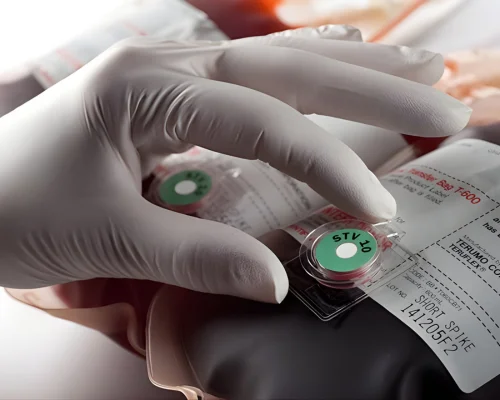
Blood bank temperature indicators are self adhesive labels applied to blood bags or blood storage containers and show if the blood stayed within safe temperature ranges throughout their storage and transport or not. These labels give a visual signal, usually a colour change once the temperature crosses a set threshold. The colour change is permanent and irreversible. It does not change back even when the blood returns to its original temperature.
Blood banks rely on these temperature indicators at multiple points in the supply chain. During refrigerated storage, during transport between blood banks and hospitals, and during temporary storage in coolers and emergency situations.
This gives an honest record of exposure, not just a current reading. It protects patients from receiving compromised blood products, and it protects blood banks from discarding units that were actually stored correctly.
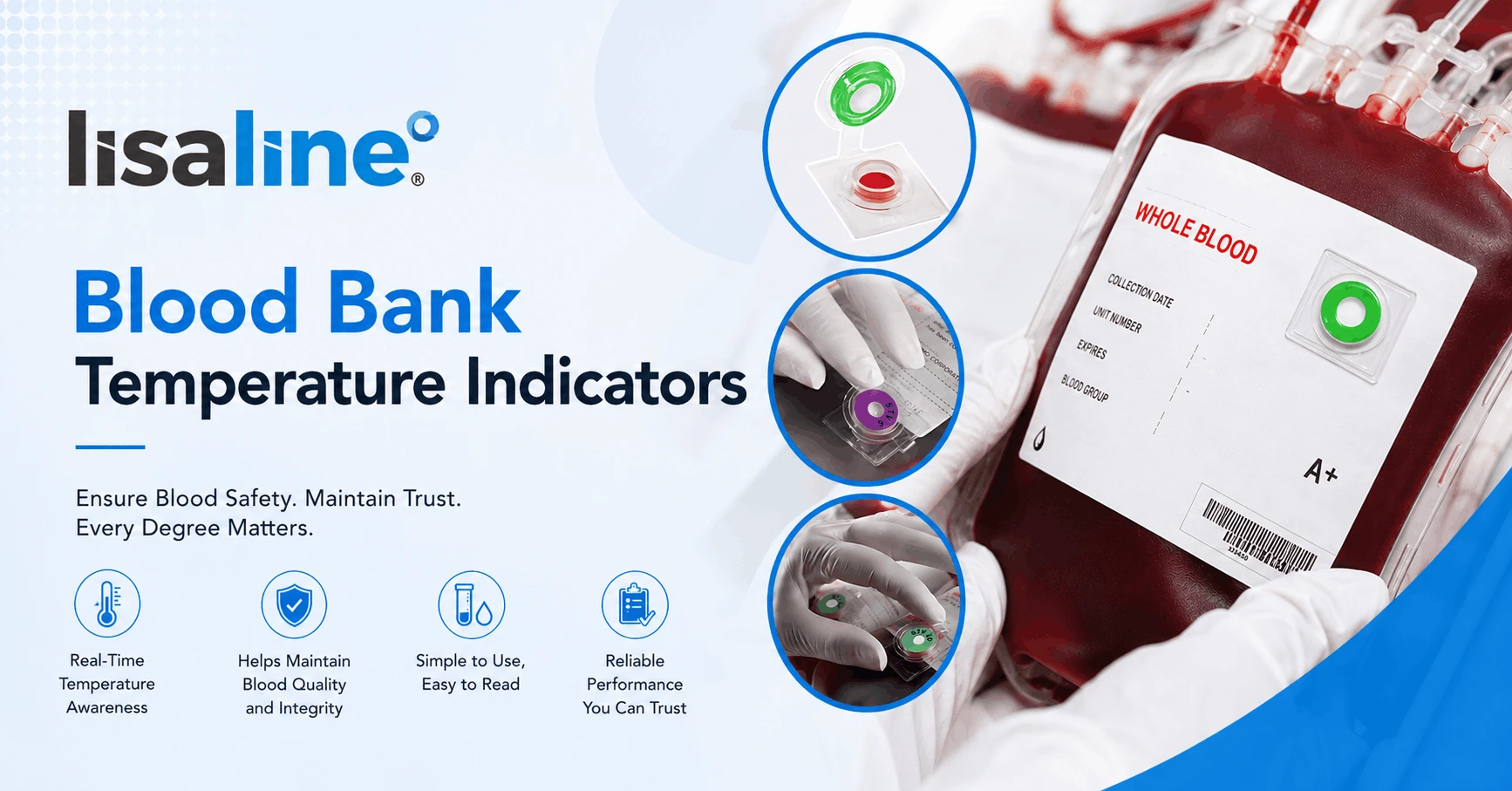
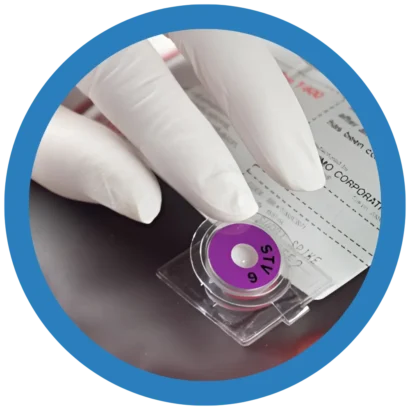
Lisaline Asia supplies the Safe-T-Vue blood bank temperature indicators which are manufactured by Temptime, a Zebra technologies company. These labels are Safe-T-Vue is built to AABB Standards for Blood Banks and Transfusion Services. These labels attach directly to the blood bag and are suited to red blood cells, whole blood, and plasma.
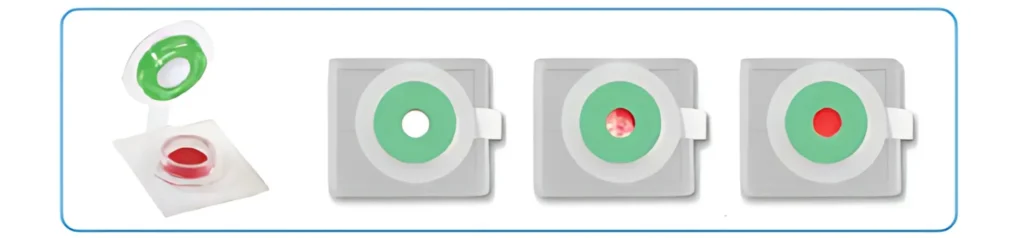
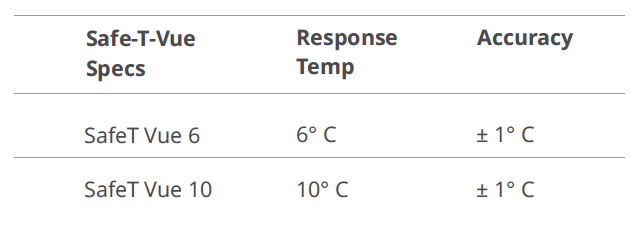
It comes in two indication temperatures: Safe-T-Vue 6 and Safe-T-Vue 10. Safe-T-Vue 6 changes colour from white to red once the blood reaches or exceeds 6°C, and Safe-T-Vue 10 does the same at 10°C. Choose the threshold that matches your blood bank’s storage protocol. At Lisaline, our experts help you choose the right variant.
Why do blood bank temperature indicators actually matter?
Blood products are transfused into patients. Temperature exposure changes the outcome and puts the patient receiving that unit at risk.
Blood does not change colour, texture, or appearance when it’s been exposed to unsafe temperatures. It looks exactly the same whether it’s safe or compromised.
This makes the use of blood bank temperature indicators compulsory not optional. Without a temperature indicator, there are only two options. Trust the unit blindly, or discard it out of suspicion or caution. Neither is good. Discarding a unit that was actually fine wastes a donor’s time and shrinks your blood stock for nothing. Using a unit that was actually compromised puts a patient at risk.
Blood bank temperature indicators solve this with physical proof of whether the blood product is safe or not. If it has changed colour, the product crossed its safety threshold. If it hasn’t, the product is still safe. No guessing either way.
What are the different products monitored in a blood bank?
A blood bank does not just store blood. Whole blood collected from a donor is broken down into separate components, and each one is stored, monitored, and issued differently.
Whole Blood
Whole blood is blood in its original, unseparated form. It carries red blood cells, plasma, platelets, and white blood cells together. It is less commonly transfused today since separated components let hospitals give patients exactly what they need, but it is still used in situations like trauma and massive blood loss where rapid volume replacement matters.
Red Blood Cells (RBCs)
Red blood cells carry oxygen through the body and are the most commonly transfused blood product. They are separated from whole blood and stored under refrigeration for the rest of their shelf life.
Platelets
Platelets help blood clot and stop bleeding. They are collected either by pooling several whole blood donations together, or directly from a single donor through apheresis.
Plasma
Plasma is the liquid part of blood that carries clotting factors, proteins, and antibodies. It is separated and frozen quickly to preserve those clotting factors. Fresh Frozen Plasma, or FFP, is the most common form.
Cryoprecipitate
Cryoprecipitate is a concentrated portion of plasma, rich in specific clotting factors like fibrinogen and Factor VIII. It is prepared from FFP and used when a patient needs a more concentrated dose of clotting factors than plasma alone can give.
Granulocytes
Granulocytes are a type of white blood cell, and this is the one WBC based product actually used in transfusion. They are given to patients with severe infections whose own white blood cell count is too low to fight it off. They do not store well, so they are used quickly after collection.
Each of these products behaves differently in storage. Some need to stay frozen, some need refrigeration, and some need to stay at room temperature. That difference is exactly why you cannot use the same blood bank temperature indicators for different blood components. Every product has its own temperature ranges which is what the next section dives deeper into.
What are the different safe temperature ranges of these blood products?
Each blood product has its own temperature range, and that range is not a suggestion. It is set to protect either the cells, the proteins, or the clotting factors specific to that product.
Whole Blood and Red Blood Cells: Stored at 1°C to 6°C. During transport, this can extend up to 10°C for short periods. Shelf life runs up to 35 to 42 days depending on the storage solution used.
Platelets: Stored at 20°C to 24°C, with continuous gentle agitation. No refrigeration. Shelf life is only 5 to 7 days, which is why platelets are the most time-sensitive product in a blood bank.
Plasma (Fresh Frozen Plasma): Stored frozen at -18°C or below, with a shelf life of up to 12 months. Once thawed, it must be stored at 1°C to 6°C and used within 24 hours. It cannot be refrozen.
Cryoprecipitate: Also stored frozen at -18°C or below, with a shelf life of up to 12 months. Once thawed, it must be transfused quickly, generally within 4 to 6 hours, and it cannot be refrozen either.
Granulocytes: Stored at room temperature, similar to platelets. They do not store well and are typically transfused within 24 hours of collection.
How do Safe-T-Vue blood bank temperature indicators meet these ranges?
Safe-T-Vue blood bank indicators are built specifically for the refrigerated range, which is the range whole blood, red blood cells, and liquid or thawed plasma fall into.
These labels come in two thresholds for exactly this reason. Safe-T-Vue 6 changes colour once the unit reaches or crosses 6°C, matching the upper limit for storage. Safe-T-Vue 10 changes colour at 10°C, matching the upper limit allowed during transport. This lets a blood bank pick the threshold that matches whether the unit is sitting in storage or moving between locations.
Safe-T-Vue blood bank indicators are not built for the frozen range or the room-temperature range. Frozen products like FFP and cryoprecipitate need a freeze indicator instead. Platelets, stored at room temperature, do not need a heat-threshold label at all, since their real risk is getting too cold, not too warm.
The right indicator is the one that matches both the storage range and the direction of risk for that specific product. In the next section we dive into identifying the right label for your blood product.
How to choose the right blood bank temperature indicators?

Blood bank temperature indicator selector
Which blood product are you monitoring?
Every blood product breaks down differently under temperature stress. Pick what you're storing or transporting, and we'll match it to the right indicator.
Where are you monitoring it?
Safe-T-Vue comes in two thresholds, one for storage and one for the short warming allowance during transport.
Why should you choose the blood bank temperature indicators offered by Lisaline Asia?
Lisaline Asia offers the Safe-T-Vue blood bank temperature indicators. These are manufactured by Temptime, a Zebra Technologies company.
Safe-T-Vue attaches directly to the blood bag. Because it works through direct contact with the bag rather than ambient air, it gives a truer picture of what the blood product itself experienced, not just the fridge or the transport box.
Safe-T-Vue is built to AABB Standards for Blood Banks and Transfusion Services, which makes it suitable for hospitals, blood banks, and blood collection centres that need audit-ready proof of correct storage. It also responds at the exact temperatures defined under 21 CFR 640, the FDA’s regulation for blood and blood products, and 21 CFR 600.15, which sets the temperature requirements for shipping biological products. Temptime’s own quality system carries ISO 9001 and ISO 13485 certification, the standards that apply specifically to medical device manufacturing. Together, this gives blood banks a documented compliance trail from manufacturing to the bedside, not just a colour change on a label.
Designed especially to suit the varied safe temperature ranges of different blood products, Safe-T-Vue comes in two variants: Safe-T-Vue 6 and Safe-T-Vue 10. Safe-T-Vue 6 changes colour from white to red once the blood reaches or exceeds 6°C, and Safe-T-Vue 10 does the same at 10°C. This makes them suitable for blood banks that store and handle red blood cells, whole blood, and plasma.
Another major benefit of Safe-T-Vue is its easy application. Peel back the foil to expose the white and red rounds. Fold the white round into the red round and press them together to activate. Attach it to the bag, and it starts monitoring right away.
Each indicator stays accurate for 42 days once activated, covering the full life of the blood product, and it carries an accuracy of +/- 0.4°C. Just with a colour change, Safe-T-Vue gives blood banks visual proof of whether a blood product is safe for patient use or not.
By supplying Safe-T-Vue in India, Lisaline Asia gives blood banks and hospitals a reliable, low-cost, and compliance-ready way to protect their blood supplies and cut down on unnecessary discards.
Conclusion
So this brings us back to our original question. Do you need different blood bank temperature indicators for different blood components? The answer is yes.
Whole blood, red blood cells, platelets, plasma, and granulocytes all sit in different temperature zones, and each one breaks down through a different mechanism if that zone is crossed. One label cannot protect all of them, which is exactly why blood bank temperature indicators come in different types built for different ranges. But your search for the right ones stops here.
For whole blood, red blood cells, and liquid or thawed plasma, Safe-T-Vue does the job. Safe-T-Vue 6 is built for refrigerated storage and changes colour once the unit reaches or crosses 6°C. Safe-T-Vue 10 is built for transport, where a short rise up to 10°C is normal, and changes colour the moment that limit is crossed.
For platelets and granulocytes, both stored at room temperature and both damaged by cold rather than heat, FREEZEmarker is the right fit. It flags the moment a unit drops to or below its freeze threshold, catching an accidental cold exposure before the product is compromised.
Lisaline Asia supplies both these blood bank temperature indicators in India, so whichever blood component you’re monitoring, you don’t have to piece together your cold chain from multiple vendors. Get in touch with our team, and we’ll help you match the right blood bank temperature indicator to your storage and transport needs.