
Temperature monitoring has become critical in the pharmaceutical and healthcare supply chains. A GSM based remote monitoring system offers real time data transmission and alerts for temperature sensitive products. It connects to cellular networks and provides instant notifications when temperature excursions happen. This technology helps cold chain professionals maintain product integrity and ensure regulatory compliance.
Lisaline Asia supplies the Tempmate GS2 and Tempmate GM2 single use and multi use GSM remote based monitoring system manufactured by tempmate. These are advanced monitoring devices built for real world supply chain conditions. They offer worldwide 4G cellular connectivity and seamless integration with the tempmate Cloud platform.
In this blog we will explore in detail what a GSM based remote monitoring system is and how it works. We will also look at its benefits, the types of data loggers offered by Lisaline Asia, how it compares with other wireless technologies, and why it is the right choice for cold chain professionals.
What is a GSM Based Remote Monitoring System?
A GSM based remote monitoring system is an automated environmental monitoring solution that uses the GSM cellular network to transmit recorded data in real time to a cloud platform. GSM stands for Global System for Mobile Communications. It is the same cellular infrastructure used by mobile phones worldwide, which means these systems work wherever there is mobile network coverage.
In cold chain monitoring, a GSM based remote monitoring system consists of a compact cellular data logger that continuously records parameters like temperature and humidity. It then transmits this data over a 4G cellular connection to a cloud dashboard where you can view it from any device, anywhere in the world.
Lisaline Asia supplies the TempMate GS2 and TempMate GM2, which are GSM based remote monitoring systems designed for supply chain monitoring. These devices provide real time temperature tracking for pharmaceutical shipments, medical supplies, and other temperature sensitive goods.
How Does a GSM Based Remote Monitoring System Work?
A GSM based remote monitoring system works by automatically recording environmental parameters at preset intervals and transmitting this data over a cellular network to a cloud platform. Here is a step-by-step look at how it works in practice.
1. Activate the Logger
The installation of GSM based remote monitoring system is easy and requires no IT skills. Turn on the GSM based remote monitoring system before placing it with the shipment or inside a storage facility. Both, the Tempmate GS2 and Tempmate GM2 data loggers are activated with a single button press.
2. Automatic Data Collection Begins
Once active, the device automatically records temperature and humidity at regular intervals you define. The Tempmate GS2 and GM2 both store readings in their onboard internal memory. This ensures that even if the cellular network is temporarily unavailable, no data is lost. The moment connectivity is restored, all stored readings are automatically transmitted to the tempmate Cloud.
3. Real Time Data Transmission Over GSM
The data logger transmits readings wirelessly over a 4G LTE cellular connection with a 2G fallback. This gives the system worldwide coverage. You do not need to set up any local Wi-Fi network, Bluetooth gateway, or LoRa infrastructure. The device connects directly to the cellular network. It is the same cellular infrastructure used by mobile phones worldwide, which means these systems work wherever there is mobile network coverage.
4. Cloud Platform Access
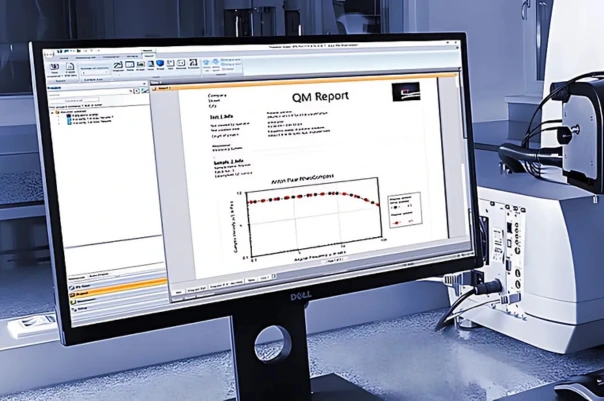
All data is received by the tempmate Cloud platform. From the cloud dashboard you can view real time charts, historical records, alerts, and downloadable reports. You can access this platform from any browser or connected device. Reports are available in PDF format both from the cloud and directly from the device for the Tempmate GS2.
5. Alarms and Notifications
If the temperature or humidity crosses the set thresholds, the cloud platform sends an immediate alarm by SMS or email and GSM based remote monitoring system displays on-device alarms. This allows your team to act quickly and prevent product damage. You do not need to be physically present at the location to receive or respond to an real time alarm.
What are the benefits of a GSM based remote monitoring system?
GSM based remote monitoring systems offer significant advantages for cold chain management. These benefits make them popular in pharmaceutical, healthcare, and logistics industries:
- Real Time Monitoring and Instant Alerts
A GSM based remote monitoring system provides real time visibility. It transmits temperature, humidity and other environmental data continuously. You can monitor multiple shipments as they are occurring, simultaneously from a single web based dashboard. When temperature breaches occur, you receive immediate SMS and email alerts triggered by the cloud platform. This real time capability helps you take corrective action before product damage occurs. You can reroute shipments, adjust storage conditions, or initiate investigations immediately when alarms trigger. This prevents costly product losses.
- Global Connectivity
GSM networks operate globally. A GSM based remote monitoring system works across India and internationally. You do not need to worry about network availability in different regions. The system automatically switches between 4G and 2G networks to maintain connectivity. This global coverage is crucial for pharmaceutical companies that distribute medicines across multiple countries. Your monitoring system works consistently whether a shipment is in Delhi, Mumbai, or abroad.
- No Complex Infrastructure Required
Unlike WiFi based systems, a GSM based remote monitoring system does not require you to set up additional infrastructure. It uses existing built-in cellular networks. There is no need for gateways or special equipment. Installation is simple and can be done within minutes.This simplicity reduces implementation costs and training requirements. Your team can start monitoring shipments quickly without IT involvement. The system is user friendly and does not require technical expertise to operate.
- Continuous monitoring with no extra gaps
The internal memory of devices like the Tempmate GS2 and Tempmate GM2 stores readings locally when the network is unavailable. As soon as the connection is restored, the data is automatically uploaded to the cloud. This means your monitoring records are always complete without any gaps. Tempmate GM2 has an exceptional internal memory and can store up to 50,000 readings in its internal memory.
- Complete Audit Trail and Compliance Documentation
A GSM based remote monitoring system creates a detailed audit trail. All temperature readings are timestamped and stored in the cloud for any period of time. You can download PDF reports from the cloud for any time period you want. This documentation is essential for regulatory compliance in pharmaceutical industries.Regulatory bodies like the FDA and local health authorities require documented proof of proper storage conditions. A GSM based remote monitoring system automatically generates these records. You can access compliance ready reports from tempmate cloud at any time. This eliminates manual documentation and reduces audit risks.
- Data Security and Backup
Your data is securely stored in the data logger’s internal memory up to 50,000 readings as well as in the cloud platform which has unlimited storage. The data is available when you need it, and accessible to everyone in your supply chain. The local storage provides automatic backup. Even if cloud connectivity is lost, no data is lost. When connectivity returns, all stored data is automatically uploaded. This ensures complete data integrity throughout monitoring periods.
What are the types of GSM based remote monitoring systems supplied by Lisaline Asia?
Lisaline Asia supplies both single use and multi use GSM based remote monitoring systems designed for real time tracking of temperature sensitive shipments across local and international supply chains. These GSM data loggers go beyond just temperature monitoring. They continuously track a range of environmental conditions including temperature, humidity, light, shock, tilt and location over a monitoring period of up to 120 days. The data is transmitted over global GSM connectivity to a cloud platform, giving you live access to your shipment’s condition from anywhere in the world with real time alerts when conditions go out of the set range.
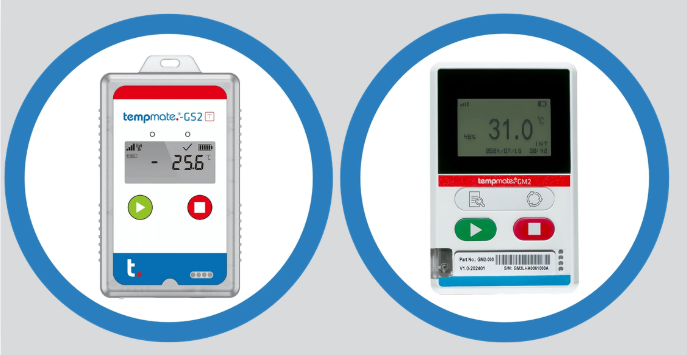
Lisaline Asia supplies two GSM based remote monitoring systems — the Tempmate® GS2, a single use data logger, and the Tempmate® GM2, a rechargeable multi use data logger.
- Tempmate GS2
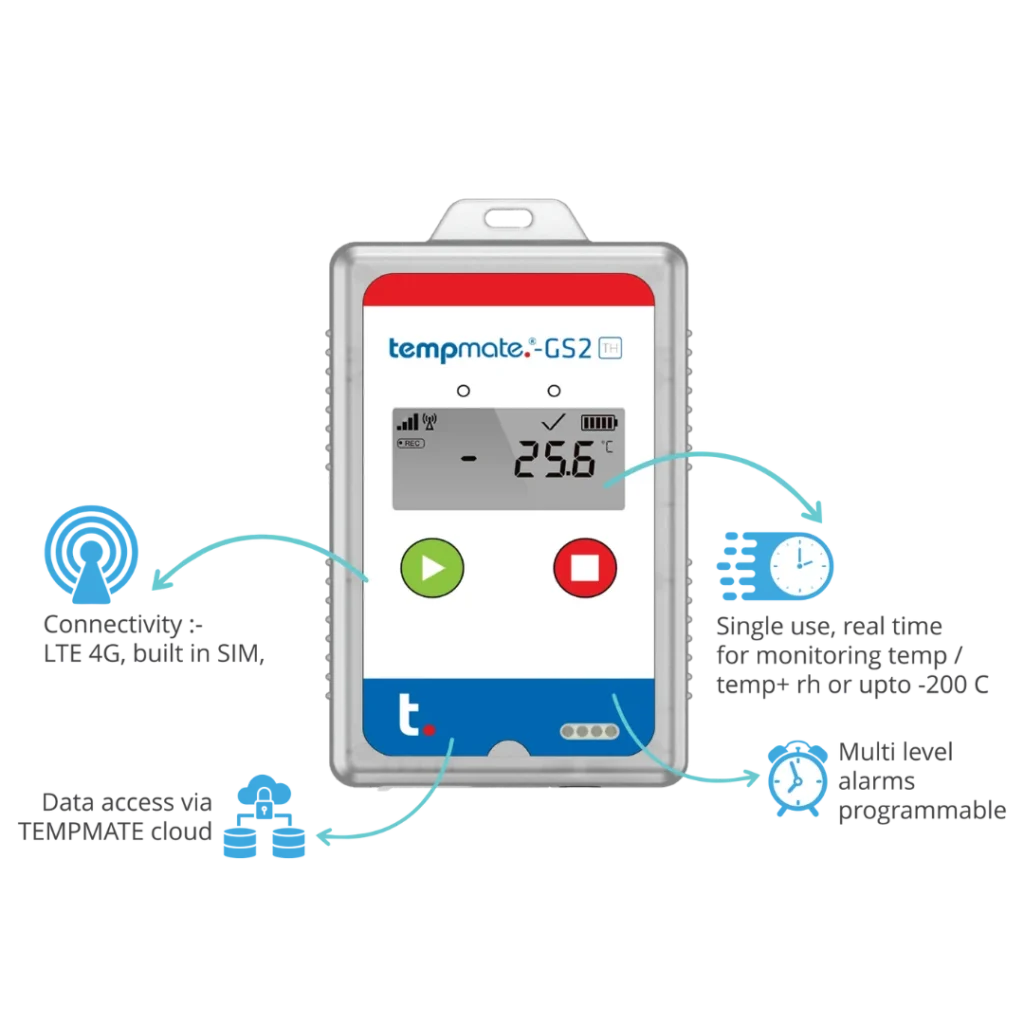
The Tempmate® GS2 is a single use data logger that uses global GSM connectivity for transmitting data. It is designed to provide complete real time visibility into your shipments from the moment it is activated to the moment it reaches its destination. What makes the GS2 stand out is its built-in SIM card that provides worldwide LTE 4G connectivity with a 2G fallback, which means you do not have to worry about network gaps regardless of where your shipment is in the world. Readings are automatically transmitted to the Tempmate Cloud platform at regular intervals, where you can view live data, download advanced cloud reports, and receive real time alarms if the conditions differ from the set thresholds.
The GS2 tracks multiple environmental parameters simultaneously- temperature, humidity, ambient light, shock, tilt, and location, giving you a complete picture of your shipment’s condition throughout transit. It has a clear LCD display and comes with IP65 protection, making it waterproof and probe-free for use in harsh transport environments. The device also features an automatic flight mode, which means it continues to record data locally during air shipments and automatically transmits all readings to the cloud once flight mode is switched off.
Since it is a single use data logger, there is no device return or reprogram logistics to manage after delivery, making it especially practical for one-way or cross-border shipments. The GS2 comes with all-inclusive costs covering hardware, worldwide 4G SIM, and cloud access, so there are no hidden add-ons.
The Tempmate GS2 is available in multiple variants — temperature only (T), temperature and humidity (TH), and with an external temperature sensor (TE), so you can choose the configuration that best suits your specific monitoring requirements.
For technical specifications of this GSM based remote monitoring system visit Tempmate GS2.
- Tempmate GM2
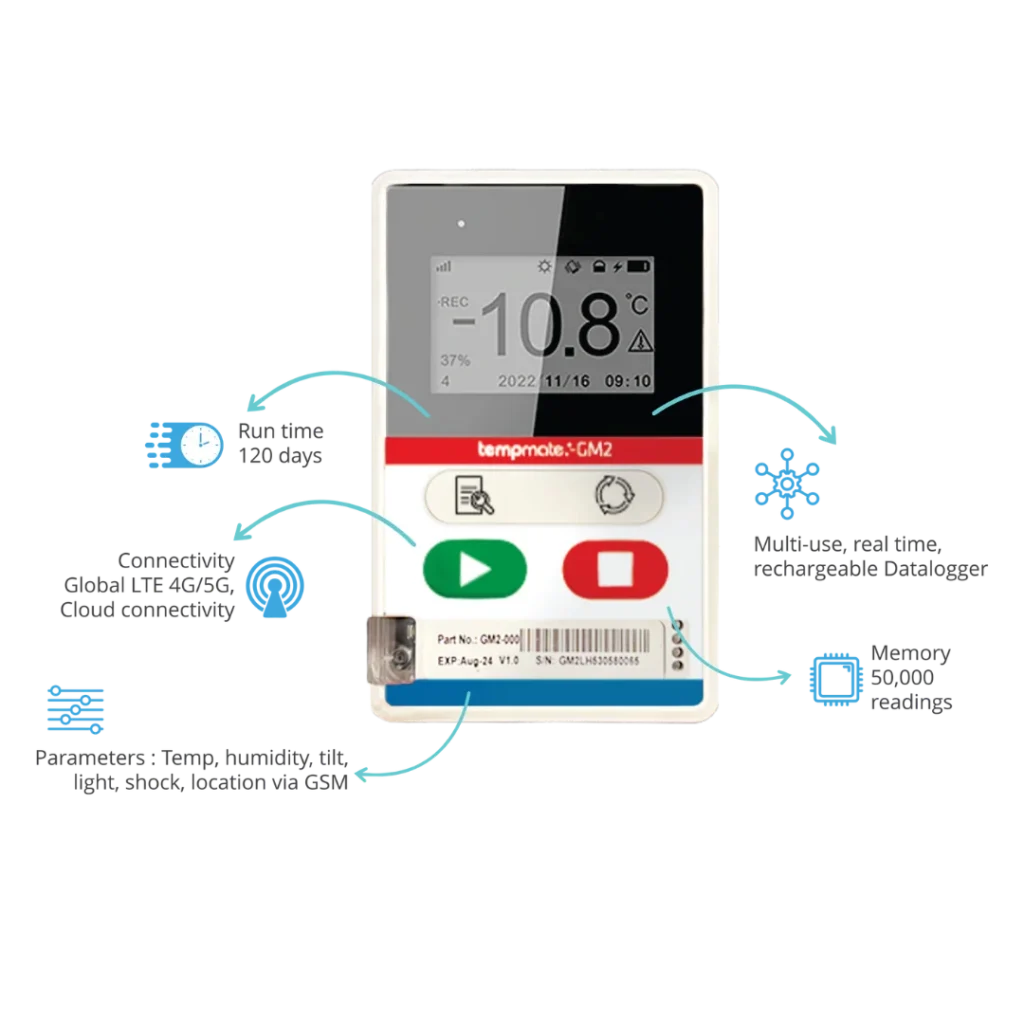
The Tempmate® GM2 is a rechargeable multi use GSM data logger designed for organisations that need a long-term, reusable monitoring solution. Unlike the GS2, the GM2 can be reprogrammed and redeployed multiple times, making it a practical investment for operations with recurring or high-frequency shipments that need continuous monitoring. It uses 4G global connectivity with a 2G fallback to transmit readings to the Tempmate Cloud in real time, where you can access live dashboards, download PDF and CSV reports, and receive real time alerts when conditions go out of range.
The GM2 monitors temperature, humidity, light, shock, tilt, and location simultaneously. It features an internal temperature sensor and supports an optional external probe for extended temperature measurement, giving it flexibility across a variety of monitoring environments. The device also has a multifunction LCD display that shows current temperature, battery status, date and time, network signal, recording status, number of readings recorded, data upload status, and alarm indicators. This gives operators complete on-device visibility without needing to access the cloud.
One of its standout features is the ability to manually download reports via USB directly as PDF or CSV files, with no additional software or IT skills required. This is especially useful in situations where a physical report is needed immediately at the point of receipt.
In terms of data security, the GM2 stores readings in its internal memory when the cellular network is unavailable and automatically transmits all stored data to the cloud once connectivity is restored, so no readings are lost even during network outages. Like the GS2, it also features automatic flight mode for uninterrupted monitoring during air shipments. The GM2 is EN 12830 compliant and GDP compliant, with a validation certificate available, making it suitable for regulated pharmaceutical and food chain environments. It carries an IP67 protection rating, offering slightly stronger environmental protection than the GS2.
For technical specifications of this GSM based remote monitoring system visit Tempmate GM2.
Which GSM based remote monitoring system should you choose among these?
The choice between the Tempmate GS2 and the Tempmate GM2 comes down to one simple question — is this a one-time shipment or a recurring operation?
Choose the Tempmate GS2 when you need a disposable, ready-to-deploy solution for one-way or international shipments. There is no device recovery, no reprogram logistics, and no hidden costs to worry about. The all-inclusive pricing covers hardware, SIM, and cloud access, making it the most straightforward option for single-use monitoring.
Choose the Tempmate GM2 when your operation involves repeated, high-frequency shipments where the same device needs to be reprogrammed and reused across multiple journeys. Its rechargeable battery, USB-based PDF downloads, and compliance-ready documentation make it a strong long-term investment. With GDP compliance, EN 12830 certification, and an IP67 rating, the GM2 is built for regulated pharmaceutical and cold chain environments where reliability and reusability matter.
How does a GSM based remote monitoring system compare with Bluetooth, Wi-fi or LoRaWAN based monitoring systems?
When you are choosing a GSM based remote monitoring system for your cold chain or supply chain operations, the wireless technology behind it makes all the difference. GSM, LoRaWAN, Bluetooth, and Wi-Fi are all capable of transmitting environmental data to a cloud platform, but the way they do it, how far they can reach, and how quickly they alert you are fundamentally different. Understanding these differences helps you choose the right system for your specific monitoring need.
How Data Transmission to the Cloud Works?
In a GSM based remote monitoring system like the Tempmate GS2 or GM2, data is transmitted directly from the device to the cloud over a cellular network, the same network your mobile phone uses. There is no gateway, no router, and no additional infrastructure needed. The data logger connects to the nearest cellular tower and sends readings to the cloud in real time from virtually anywhere in the world where there is mobile network coverage. This makes GSM systems completely self-contained and ideal for shipments that travel across cities, countries, or continents.
LoRaWAN systems work differently. The data logger does not connect to the cloud directly. Instead, it transmits data wirelessly over a long range to a nearby LoRaWAN gateway. That gateway is then connected to the internet, either through Wi-Fi, Ethernet, or cellular, and forwards the data to the cloud platform. This means a LoRaWAN system is only as good as its gateway coverage. Inside a well-configured warehouse or cold storage facility, this works exceptionally well. But the moment your shipment leaves that facility, the LoRaWAN coverage ends and so does the real time data transmission.
Bluetooth based systems have an even shorter data path. The data logger connects to a nearby Bluetooth enabled device, typically a smartphone or a hub, which then forwards the data to the cloud. This works well for short range, proximity based monitoring, like scanning a logger when a shipment arrives or checking readings on the factory floor. However, Bluetooth is not a continuous transmission technology for remote monitoring. If no paired device is nearby, the data is stored locally in the logger and uploaded only when a connection is made.
Wi-Fi based systems follow a similar approach to LoRaWAN in the sense that they require existing infrastructure to function. The data logger connects to a Wi-Fi access point and transmits readings through it to the cloud. Inside a facility with strong Wi-Fi coverage, this offers reliable and fast data transmission. But Wi-Fi is strictly limited to the range of the access point. Once a shipment moves outside that coverage, the logger records data locally and stops transmitting until it reconnects to a network.
How Transmission Range Differs?
GSM has the widest transmission range of all four technologies because it relies on the existing national and international mobile network infrastructure. A GSM data logger can transmit data from a warehouse in Mumbai, a truck on a highway in Rajasthan, a port in Singapore, or a cold room in Frankfurt without any change in setup. The range is essentially wherever your mobile carrier has coverage, which in the case of 4G LTE with 2G fallback, covers most of the inhabited world.
LoRaWAN offers impressive range within its coverage zone, typically several kilometers in open areas and a few hundred meters inside buildings. For fixed facility monitoring, this is more than adequate. But it is a controlled range that depends entirely on where gateways are installed. Bluetooth, by contrast, works within roughly 10 to 30 meters under typical conditions. It is designed for short range communication and is not built for monitoring across large spaces or in transit. Wi-Fi range is similarly limited, usually covering 30 to 100 meters depending on the environment, and is restricted entirely to indoor, infrastructure-dependent spaces.
How Alerts Differ?
This is where the difference between GSM and the other technologies becomes most critical for supply chain monitoring. Because GSM data loggers transmit readings continuously over the cellular network, they can trigger real time alerts the moment a parameter goes out of range, whether the shipment is in a warehouse, on a truck, or midway through an international flight once flight mode is off. You receive an SMS or email alarm immediately, giving you the ability to act before damage occurs.
With LoRaWAN systems, alerts are also near real time, but only within the gateway coverage area. If your shipment has left the facility and is no longer within LoRaWAN range, the data logger records the breach locally but cannot send an alert until it comes back into range. The same limitation applies to Bluetooth and Wi-Fi systems. A Bluetooth logger can only alert you when it is in proximity to a paired device, and a Wi-Fi logger can only push an alert when it is connected to a known access point.
This means that for in-transit monitoring, both Bluetooth and Wi-Fi based systems are not capable of real time alerting. They are better suited for static, facility-based monitoring where network coverage is always present.
Which Technology is Right for You?
GSM based remote monitoring systems are the right choice when your requirement involves shipments that move across locations, cities, or borders and where real time visibility and instant alerts are non-negotiable throughout the journey.
LoRaWAN systems are an excellent fit for fixed facilities like cold rooms, warehouses, and labs where a gateway infrastructure is already in place and long-term, low-power monitoring is the priority. Bluetooth systems are well suited for last-mile verification, spot checks, and short range monitoring at the point of loading or receipt. Wi-Fi systems work best inside facility environments with strong and consistent network infrastructure. In many advanced cold chain operations, these technologies are not mutually exclusive, they are used together at different points of the supply chain to provide end-to-end visibility.
What to look for while choosing a GSM based remote monitoring system?
Choosing the right GSM based remote monitoring system is not just about picking a device that records temperature. The right system needs to work reliably across the entire journey of your shipment, through varying network conditions, different transport modes, long transit durations, and multiple environmental stresses. There are several key features you need to evaluate before choosing a GSM based remote monitoring system for your cold chain or supply chain operations. Here is a detailed look at what to look for and how the Tempmate GS2 and Tempmate GM2 supplied by Lisaline Asia deliver on each of these features.
Cloud Based Integration
The most important feature of any GSM based remote monitoring system is seamless cloud integration. A device that only stores data locally and requires manual retrieval at the end of the journey defeats the purpose of real time monitoring. The cloud platform is where all the value of a GSM system comes together — live dashboards, historical data, downloadable reports, and remote device management. When evaluating a system, look for whether the cloud platform offers real time data access from any device, whether it supports multi-device monitoring from a single account, whether it allows remote configuration of alarm thresholds and logging intervals, and whether it generates compliance-ready reports in standard formats like PDF and CSV.
Both the Tempmate GS2 and GM2 are fully integrated with the Tempmate Cloud platform. The moment either device is activated and connected to the cellular network, it begins transmitting readings directly to the cloud without the need for any gateway or additional hardware.
From the Tempmate Cloud dashboard, you can view live readings from all your active loggers, access historical data, monitor alarm status, track device location, and download detailed reports in PDF and CSV formats. The GM2 goes a step further by also supporting manual USB-based report downloads directly from the device, giving you a physical data backup independent of cloud access. Both devices also support remote configuration through the cloud, meaning alarm limits and logging intervals can be updated even after the shipment is in transit.
Real Time Alerts
A GSM monitoring system that does not alert you the moment something goes wrong is not doing its job. Real time alerting is the feature that transforms a data logging device into an active monitoring system. When evaluating this feature, look for whether the system triggers alerts immediately when a parameter crosses the set threshold, whether alerts are delivered via SMS and email, whether multiple recipients can be configured, whether multiple alarm limits can be set for a single parameter, and whether every alarm event is recorded with a time stamp for audit purposes.
The Tempmate GS2 and GM2 both deliver real time alerts through the Tempmate Cloud. The moment a reading crosses the configured alarm threshold, the device transmits the breach to the cloud over the cellular network and the platform immediately sends SMS and email notifications to all designated recipients. This happens in real time regardless of where the shipment is in the world, as long as cellular coverage is available.
The Tempmate GM2 supports up to 5 alarm limits per parameter, allowing you to define warning and critical thresholds separately so you can respond in stages depending on the severity of the breach. Every alarm event is recorded with a time stamp in the cloud and included in the downloadable reports, providing a complete audit trail of every condition breach during the shipment. The GM2 also displays alarm status directly on its LCD screen, giving handlers at the point of receipt immediate on-device visibility of any breach without needing to access the cloud.
Battery Life and Runtime
Battery life is a critical consideration for any monitoring system used in shipments. A device that runs out of power midway through a long transit leaves you with an incomplete monitoring record and no visibility for the remainder of the journey. When evaluating battery life, look for whether the device can last the full duration of your longest shipment, whether the battery type is suitable for the operating temperature range of your shipment, and whether the device provides a low battery warning before the power runs out.
The Tempmate GS2 is a single use data logger with a built-in battery designed to last up to 120 days under standard logging conditions using the lithium battery version. The non-lithium Ni-MH version offers approximately 90 days of runtime. The 120-day runtime covers the vast majority of local and international supply chain journeys, making the GS2 suitable for even the longest shipments.
The Tempmate GM2 features a rechargeable battery that also supports up to 120 days of runtime under standard logging conditions. Beyond the battery, the GM2 also supports unlimited runtime when connected to a continuous power supply, making it suitable for extended monitoring deployments where the device remains plugged in. Both devices are designed to operate reliably across the temperature ranges typical of cold chain and supply chain environments, ensuring battery performance is not compromised by the very conditions they are monitoring.
Environmental Parameters Monitored
A basic temperature logger tells you only part of the story. In real supply chain conditions, your shipment is exposed to a range of environmental stresses beyond just temperature — humidity that can damage packaging or product integrity, light exposure that can degrade light-sensitive products, physical shocks from rough handling, tilting that can affect the orientation of sensitive cargo, and location data that tracks exactly where your shipment is at any given point. When evaluating a GSM monitoring system, look for how many parameters the device monitors simultaneously and whether those parameters are relevant to the specific nature of your shipment.
Continuous Monitoring When Network Goes Out of Range
One of the most overlooked but critical features of a GSM based remote monitoring system is what happens when the cellular network is unavailable. Network outages, weak signal zones, remote transit routes, and air shipments are all real scenarios where a device may temporarily lose connectivity. A system that simply stops recording when the network goes down is unreliable for serious supply chain monitoring. What you need is a device that continues monitoring without interruption and automatically recovers all data the moment connectivity is restored.
Both the Tempmate GS2 and GM2 GSM based remote monitoring system handle this through robust local memory backup. When cellular connectivity is unavailable, both devices continue recording all parameter readings into their internal memory without any interruption to the monitoring process.
The GS2 can store readings locally throughout its entire 120-day runtime, while the GM2 can hold up to 50,000 readings in its internal memory. The moment cellular connectivity is restored, both devices automatically transmit all stored readings to the Tempmate Cloud, filling the data gap completely with no manual intervention required. This ensures you have an unbroken monitoring record for the entire journey, regardless of how many times the network was unavailable during transit.
Additionally, both the GS2 and GM2 feature automatic flight mode for air shipments. When in flight mode, the devices continue recording locally and automatically upload all flight-period readings to the cloud the moment flight mode is switched off.
Device Durability for Shipment Handling
A GSM based remote monitoring system used in supply chain shipments faces a physically demanding environment. It gets attached to packages, placed inside shipping containers, handled at loading docks, subjected to vibrations on trucks, and exposed to varying levels of humidity and moisture. A device that is not built to withstand these conditions can fail mid-journey, leaving you without monitoring data at the most critical points of the shipment. When evaluating durability, look for the device’s IP rating, its operating temperature range, and whether it is designed to be robust enough for the physical stresses of real-world logistics.
The Tempmate GS2 carries an IP65 protection rating, making it dust-tight and protected against low-pressure water jets from any direction. This makes it suitable for shipments exposed to moisture, rain, or humid environments during handling and transit. The Tempmate GM2 carries an even stronger IP67 protection rating, meaning it is fully dust-tight and can withstand temporary immersion in water, offering a higher level of physical protection for more demanding shipping environments. Both devices are compact and designed for easy attachment to shipments without requiring special tools or complex installation. The GS2 is also probe-free, eliminating the risk of probe damage during handling, which further improves its durability in rough transit conditions.
Global Connectivity and Coverage
For a GSM based remote monitoring system to be truly useful for supply chain monitoring, it needs to work everywhere your shipment goes. A device that only connects to a local network is not suitable for international or cross-border shipments. When evaluating connectivity, look for whether the device supports multi-band cellular connectivity, whether it has a fallback network in case the primary network is unavailable, and whether a SIM card is included or needs to be separately arranged.
The Tempmate GS2 comes with a built-in SIM card that provides worldwide LTE 4G connectivity with a 2G fallback, covering most of the inhabited world without any SIM management on your part. The hardware, SIM, and cloud access are all included in the all-inclusive cost of the device, so there are no separate carrier plans or SIM logistics to manage. The Tempmate GM2 similarly supports 4G worldwide connectivity with a 2G fallback. For both devices, the 2G fallback is a particularly important safety net for shipments passing through remote areas or regions where 4G coverage is limited, ensuring the device maintains connectivity and continues transmitting data even in lower-coverage zones.
Ease of Setup and Use
A GSM based remote monitoring system that requires complex installation, dedicated software, or IT expertise is a practical barrier for many cold chain operations. When evaluating ease of use, look for whether the device requires any external software to activate or configure, whether non-technical staff can operate it reliably, and whether reports can be generated and downloaded without specialist knowledge.
Both the Tempmate GS2 and GM2 GSM based remote monitoring system are designed for simple, straightforward setup with no additional software or IT skills required. The GS2 is activated with a single button press and immediately begins monitoring and transmitting data to the cloud. Configuration and alarm settings can be managed remotely through the Tempmate Cloud portal, which is accessible from any web browser or mobile device.
The GM2 follows the same simple activation process and additionally features a multifunction LCD display that provides on-device visibility of all key parameters including temperature, battery status, recording status, network signal, and alarm indicators, so even a handler with no technical background can immediately understand the device’s status. Reports from both devices can be downloaded directly from the Tempmate Cloud in PDF or CSV formats without any specialist tools, and the GM2 also allows direct USB report downloads from the device itself.
Compliance and Certification
For pharmaceutical logistics, food supply chains, and other regulated industries, a monitoring system needs to meet specific regulatory and quality standards. When evaluating compliance, look for whether the device carries relevant certifications, whether the reports it generates are suitable for regulatory submissions, and whether validation documentation is available.
The Tempmate GM2 is EN 12830 compliant and GDP compliant, meeting the standards required for temperature recording instruments used in the transport of temperature-sensitive goods. A validation certificate is also available for the GM2, which is essential for pharmaceutical and healthcare supply chains that require documented proof of device accuracy and reliability. Both devices generate detailed cloud reports and downloadable PDF and CSV files that are structured for regulatory submissions and internal quality audits. Lisaline Asia, as the official supplier of Tempmate data loggers in India, provides complete compliance support including calibration services and compliance-ready documentation to ensure your monitoring setup meets all applicable regulatory requirements.
Data Storage Capacity
Logging interval and journey duration directly determine how much data a device needs to store. A device with limited local storage capacity may overwrite older readings in the event of a prolonged network outage, leaving gaps in your monitoring record. When evaluating storage, look for how many readings the device can hold locally and whether cloud storage is unlimited.
The Tempmate GM2 can store up to 50,000 readings in its internal local memory, which at a standard 10-minute logging interval covers well over a year of continuous local recording — far beyond any typical shipment duration. On the Tempmate Cloud, storage is unlimited, meaning every reading from every journey is retained indefinitely for historical review and audit purposes. The Tempmate GS2 similarly stores readings locally throughout its entire 120-day runtime without any risk of data loss, and all readings are backed up on the Tempmate Cloud once transmitted.
What services does Lisaline Asia provide for GSM based remote monitoring system?
As the official supplier of Tempmate GS2 and Tempmate GM2 data loggers, Lisaline Asia provides the data logger devices with full manufacturer backing, warranty, and after-sales support.
We offer complete installation and commissioning of GSM data logger systems by expert technicians, ensuring correct device setup, alarm configuration, and cloud integration from day one.
This includes:
- Tempmate Cloud onboarding and setup support, including device registration, alarm limit configuration, report template setup, and multi-user access configuration for your team.
- Calibration services for GSM data loggers with traceable calibration options and ISO/IEC 17025 certified in-house lab services, ensuring device accuracy meets regulatory requirements.
- Validation and PQ/S testing services for GSM data logger systems used in pharmaceutical and healthcare supply chains where documented device validation is a regulatory requirement.
- After-sales service and troubleshooting support for hardware, connectivity, and cloud-related issues, ensuring your monitoring system continues to perform reliably throughout its deployment.
- 24×7 online support for real time datalogging services, providing immediate remote assistance for alarms, connectivity issues, and software-related queries outside normal business hours.
- Compliance-ready documentation including ISO/IEC 17025 calibration certificates, validation reports, and GDP and EN 12830 compliance support to ensure your monitoring setup meets all applicable regulatory requirements for pharmaceutical and food cold chains in India.
Conclusion
A GSM based remote monitoring system is no longer optional for cold chain shipments, it is a necessity. When temperature sensitive pharmaceuticals, vaccines, or biologics are in transit, you need a system that monitors continuously, transmits in real time, alerts you instantly, and keeps a complete record of every reading from start to finish. That is exactly what the Tempmate GS2 and Tempmate GM2 deliver.
Whether you need a disposable, ready-to-deploy solution for one-way shipments or a rechargeable, reusable device for high-frequency operations, Lisaline Asia has the right GSM data logger for your requirement. Both devices offer worldwide 4G connectivity, multi-parameter monitoring, automatic flight mode, seamless Tempmate Cloud integration, and real time alerts, everything you need to keep your cold chain visible, compliant, and in control throughout the journey.
Lisaline Asia backs every device with complete local support — from installation and cloud onboarding to calibration, validation, and 24×7 technical assistance. When you choose Lisaline Asia, you are not just buying a data logger. You are investing in a complete monitoring solution backed by over two decades of cold chain expertise.
Reach out to our team today through the contact form on our website and we will help you find the right GSM based remote monitoring system for your cold chain operations.