
Monitoring the environmental conditions in healthcare facilities is critical. In hospitals, the medicines are kept in shelves, high quality life saving drugs are stored in refrigerators, the vaccines are stored in cold conditions and the blood samples and biologics are kept. These temperature sensitive products require continuous monitoring to ascertain their potency before patient administration and usage.
Hospital data loggers provide continuous monitoring of environmental conditions in hospitals and healthcare facilities. Often with multiple sensors, these data loggers monitor several cold rooms, pharma storage rooms and ensure you get a time stamped record of what your critical healthcare products were exposed to.
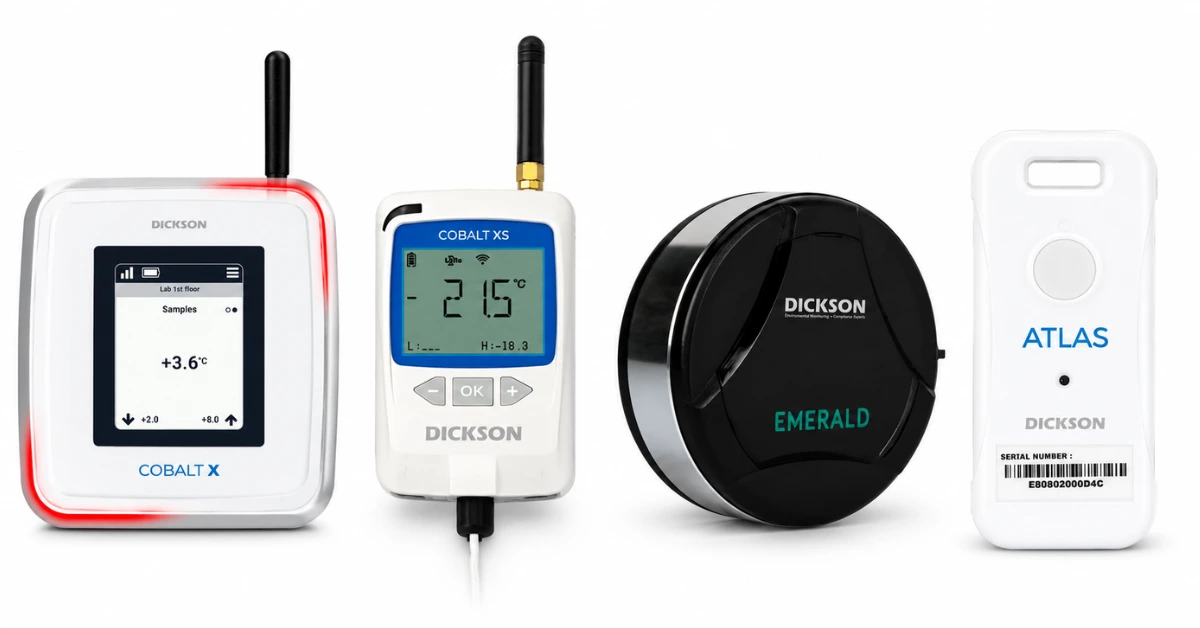
Lisaline Asia supplies fixed storage mounted data loggers from Dickson like Cobalt X and Xs that monitor multiple parameters along with bluetooth data loggers and sensors like Emerald and Atlas for short range facility monitoring. Our data loggers provide continuous monitoring, timestamped readings, real time alerts via SMS, email, cloud platform or app, live data viewing and automatic generation of downloadable PDF/CSV reports for easy audits and inspections.
Why are hospital data loggers important in healthcare facilities?
In healthcare facilities critical life saving items are kept. These include critical medicines and drugs, vaccines, biologics, blood samples kept in controlled environments. These temperature sensitive items should be kept in controlled ranges so that their potency is retained and they are useful for patient administration. If these are exposed to unsafe conditions especially temperature, humidity and other conditions, they can be affected irreversibly without a change in their physical appearance. This is very harmful especially when these are meant to save patients and not harm them more.
Hospital data loggers are important in healthcare facilities because, when kept at critical locations, pharmacy refrigerators, vaccine storage units, blood bank refrigerators and freezers, laboratory cold storage and near cold room entry points, these help identify hotspots where temperature excursions might typically happen. These continuously monitor the environmental conditions these products are exposed to and provide a clear record of the readings timestamped. This helps the teams identify when the temperature excursion happened if it did, whether the products were safe throughout or were affected.
What are the applications of hospital data loggers?
Cold storage of drugs and medicines
Hospital pharmacies store a wide range of temperature sensitive drugs, including insulin, biologics and injectable medicines. Even a short exposure outside the safe range can reduce their effectiveness. Hospital data loggers placed inside pharmacy refrigerators continuously track temperature and send real time alerts if conditions drift outside the set range, so pharmacy staff can act before the stock is compromised. Our Cobalt X and Xs data loggers are built for exactly this kind of fixed, continuous refrigerator monitoring.
Vaccine storage
Vaccines are among the most temperature sensitive products in any hospital. They need to be stored within a narrow range from the moment they arrive until they are administered. Hospital data loggers monitor vaccine refrigerators and cold rooms around the clock, recording every reading with a timestamp. If a vaccine refrigerator door is left open or a cooling unit fails, the alert reaches staff immediately through SMS, email or the app, rather than being discovered during a routine check hours later.
Blood bank storage
Blood and blood components must be stored at precise temperatures to remain safe for transfusion. Blood bank refrigerators and freezers run continuously and any deviation can render a unit unusable. Hospital data loggers with multiple sensors let blood banks monitor several refrigerators and freezers from a single dashboard, with instant alerts the moment any unit drifts out of range. This is also central to meeting blood bank licensing requirements.
Laboratory reagents and biologics storage
Hospital laboratories store reagents, test kits, culture samples and biologics that are sensitive to temperature and humidity. A single excursion can compromise test accuracy or destroy a sample that cannot be replaced. Hospital data loggers placed in lab refrigerators and freezers give lab staff continuous visibility into storage conditions, along with a documented history that supports internal quality checks.
Cold room and walk-in storage
Larger hospitals often maintain dedicated cold rooms for bulk pharmaceutical or vaccine storage. These rooms need multi-point monitoring since temperature can vary between shelves, corners and the door area. Our Cobalt X supports up to four sensors at once, so a single unit can monitor multiple points within the same cold room and flag hotspots that a single sensor would miss.
Blood and sample transport
Blood units and samples often need to move between departments, from a blood bank to an operation theatre, or from a ward to the lab. During this short window, the product is outside its fixed storage and at higher risk of exposure. Compact hospital data loggers like Emerald and Atlas are built for this. They can travel with the blood unit or sample and sync their readings to OCEAView once back in range, giving you a complete, unbroken record from storage to point of use.
How do hospital data loggers ensure compliance during audits and inspections?
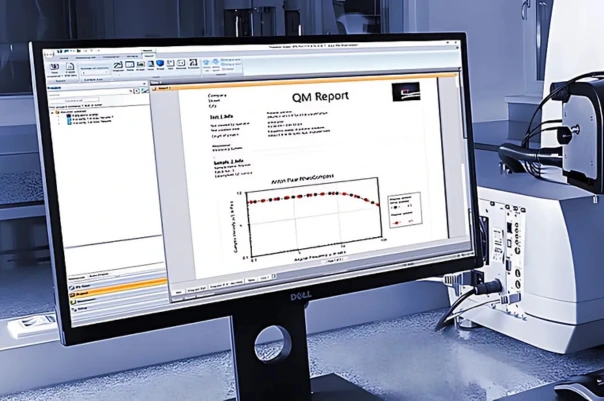
Hospital data loggers connect to a cloud platform that automatically generates an audit ready report of every reading, from every sensor, timestamped from start to finish. Instead of manually compiling logbooks before an inspection, your team can pull a complete, tamper proof record in minutes. When auditors ask for proof that a vaccine refrigerator or blood bank unit stayed within range for the past six months, you have it ready, not reconstructed.
Cobalt X, Cobalt Xs, Emerald and Atlas are all built around this same compliance backbone. Every reading, alarm and user action is logged with a timestamp and stored in a complete audit trail on the OCEAView platform, which is developed to meet FDA 21 CFR Part 11 requirements for electronic records and electronic signatures. This same platform is aligned with GxP, GMP and GDP guidelines, which govern how pharmaceutical and healthcare products must be handled and documented through storage and distribution.
Alongside this, the hospital data loggers are designed in line with EN 12830, the standard that governs temperature recording devices used for sensitive products in storage and transport, and HACCP principles for hazard monitoring. Calibration for these data loggers is carried out under ISO/IEC 17025 accredited standards, giving you NIST traceable calibration certificates that auditors specifically look for during inspections. On the hardware side, Cobalt X and Cobalt Xs also carry CE and FCC Part 15 certification, along with ISO 9001 manufacturing standards, confirming the devices themselves meet recognised safety and quality benchmarks.
Together, this means your hospital staff is not just getting a reading on a screen. You are getting a documented, traceable chain of evidence, from the sensor to the cloud report, built to satisfy FDA, GxP, GDP and EN 12830 requirements without extra manual work from your team.
Which data loggers should you choose for your hospital or healthcare facilities?
Choose fixed storage hospital data loggers with real time monitoring and cloud integration, so hospital staff are alerted the moment conditions start going out of range, not after the fact. Look for data loggers that provide SMS and email alerts, along with web and app based alerts, so the right person is notified no matter where they are.
Your hospital data loggers should also monitor multiple critical conditions, temperature, humidity, light, dry contact and differential pressure, through multiple sensors connected to a single unit. With LoRaWAN or BLE connectivity, these data loggers should support multiple room monitoring and transmit data directly to the cloud platform. LoRaWAN works well for large facilities where readings need to travel across multiple rooms and floors, while BLE is suited for short range monitoring within a single storage unit or nearby area.
Choose hospital data loggers that generate timestamped, audit ready PDF and CSV reports, so your team is never scrambling before an inspection. These should also allow live data access, so hospital staff can check current readings anytime without needing to be physically present. An LCD or touchscreen display on the unit itself is equally useful, since it shows current status and alarm status at a glance, letting staff confirm conditions are safe without opening the storage room and risking a temperature disturbance.
Which data loggers supplied by Lisaline Asia are classified as “Hospital Data Loggers”?
Lisaline Asia supplies Cobalt X, Cobalt Xs, Emerald and Atlas as our core range of hospital data loggers.
Cobalt X
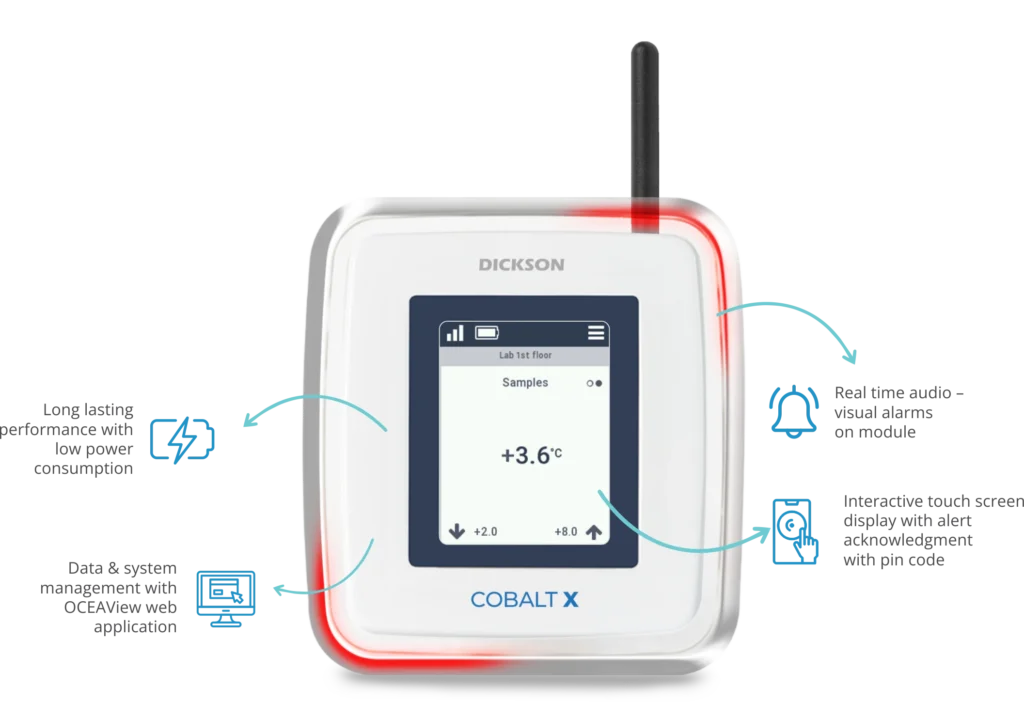
Cobalt X is a fixed, wireless data logger built for continuous monitoring across pharmacy refrigerators, vaccine storage units, blood bank refrigerators and freezers, and cold rooms. It supports up to four wired or Bluetooth sensors at once, covering temperature, humidity, CO2, differential pressure and light from a single unit. This makes it well suited to hospitals that need to monitor several parameters or several points within the same storage area, such as a walk-in cold room with multiple shelves. It comes with a color touchscreen for live readings, on-site alarm acknowledgment with PIN protection, and connects to the OCEAView cloud platform over LoRaWAN, so readings reach your dashboard from anywhere in the facility without relying on Wi-Fi.
Cobalt Xs
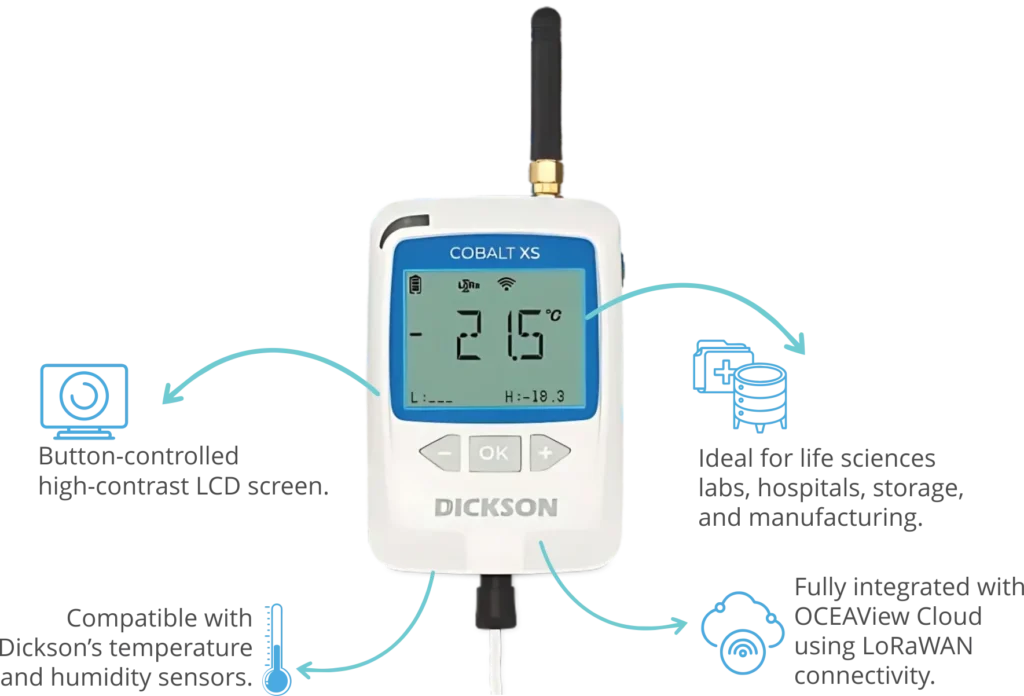
Cobalt Xs is the more compact, cost effective option in the Cobalt series, designed for hospitals that need continuous monitoring in smaller or space constrained storage areas, such as a single pharmacy fridge or a satellite storage unit on a ward. It monitors temperature and humidity through up to two connected sensors and uses the same LoRaWAN connectivity as Cobalt X to send live data to OCEAView. Instead of a touchscreen, it uses a simple button controlled LCD display, keeping day to day checks and alarm acknowledgment straightforward for hospital staff.
Emerald
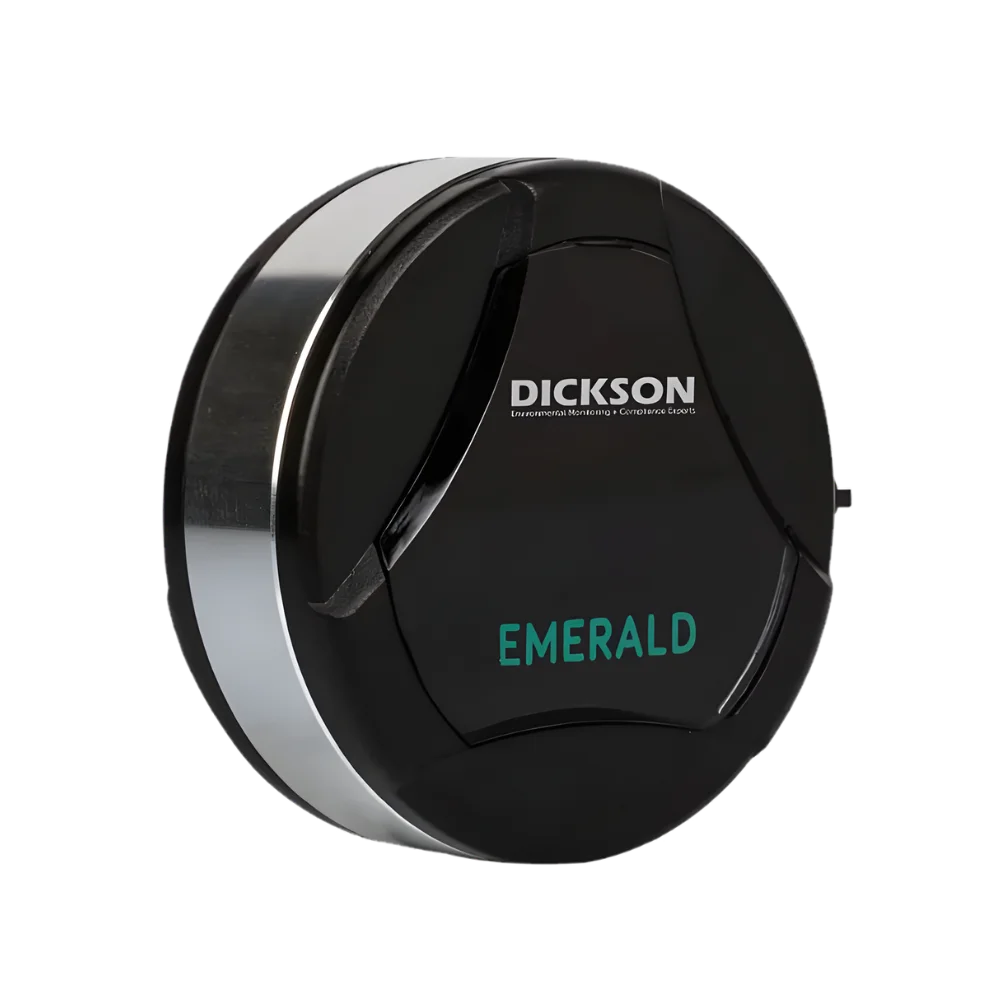
Emerald is a compact Bluetooth data logger that monitors temperature, using either its internal sensor or an external probe. It can work as a standalone logger for a single fridge or storage point, or as a wireless sensor paired with Cobalt X, extending Cobalt X’s monitoring reach without any additional wiring. Its small, shock resistant design makes it easy to place inside individual storage units, or to move with a blood unit or sample as it travels between departments, syncing its readings to OCEAView once it is back within range.
Atlas
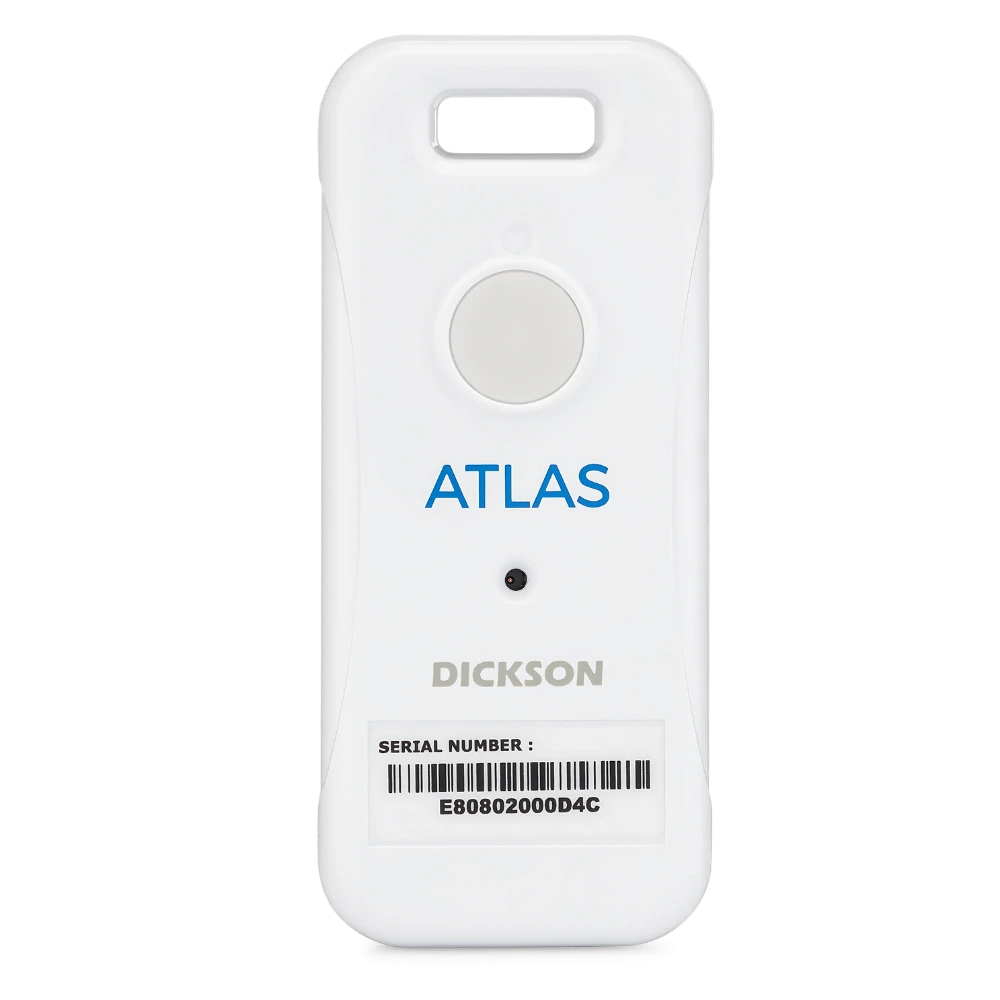
Atlas is Emerald’s counterpart, monitoring temperature, humidity and light exposure through Bluetooth Low Energy connectivity. Like Emerald, it can run as a standalone logger for a storage point, or as a wireless sensor feeding data into Cobalt X. The added light exposure monitoring makes Atlas useful for storage areas or transport situations where light sensitive medicines or biologics need to be tracked alongside temperature and humidity.
Why choose Lisaline Asia for hospital data loggers in India?
Lisaline Asia’s hospital data loggers let you place multiple sensors across different storage points while the main data logger unit stays outside the storage area, so you get full visibility without disturbing the stored products. You receive real time alerts via SMS, email, web and app the moment conditions go beyond safe parameters, along with live data viewing through the cloud dashboard whenever you need it. Every reading is automatically compiled into audit ready, timestamped PDF and CSV reports, so your team is always inspection ready.
Since 1998, Lisaline Asia has been a pioneer in cold chain monitoring in India. We introduced the world’s first miniaturised Vaccine Vial Monitor technology, used to track temperature exposure of vaccine vials during India’s Polio Eradication programme. Over 25 years later, we continue to work closely with hospitals, pharmaceutical companies and life sciences organisations across the country.
Beyond supplying the hospital data loggers, we support your facility through the entire monitoring journey. This includes installation, commissioning, setup and configuration of the cloud platform, along with setting the right recording intervals and alarm thresholds for each application. We calibrate our alarm settings carefully, so short, momentary fluctuations do not trigger false alarms, while genuine excursions are flagged immediately.
Our services also include calibration through our own ISO/IEC 17025 certified, NABL accredited facility, available both in-house and on-site, along with IQ/OQ validation, thermal mapping and WHO PQS testing. Our team provides 24/7 online support and continued after sales support under annual maintenance contracts, so your hospital data loggers keep working exactly as they should, year after year.
Conclusion
Hospitals handle some of the most critical, temperature sensitive products there are, from vaccines and medicines to blood and biologics. Hospital data loggers give you continuous, real time visibility into how these products are stored, along with the documented, audit ready records that regulators expect. With Cobalt X, Cobalt Xs, Emerald and Atlas, along with the OCEAView cloud platform and Lisaline Asia’s calibration and validation support, your hospital gets a complete, dependable monitoring system built for compliance and patient safety.
If you are setting up or upgrading hospital data loggers for your facility, reach out to Lisaline Asia’s team to discuss the right setup for your storage areas.