
Time temperature sensitive labels are only reliable if properly applied. Get the placement wrong, or use the wrong format for your product, and even the most accurate label chemistry gives you a reading that does not reflect the truth.
The good news is that applying these labels correctly is not complicated. There is no special training required, and the process stays largely the same whether you are labelling ten vials by hand or ten thousand units on a production line.
In this blog, we walk through exactly how to apply time temperature sensitive labels correctly, step by step. This covers choosing the right calibration and format, getting the placement right, and fitting the process into manual or automated workflows, so your team gets it right the first time.
What are time temperature sensitive labels?
Time temperature sensitive labels are miniaturised self adhesive labels that react to the heat a product is exposed to across its entire shelf life. The label responds to two things at once. It shows how warm the surrounding environment is (heat exposure) and how long the product stays in that environment. In short, it tracks the cumulative heat exposure, the total heat a product is exposed to in its shelf life. The more heat the product is exposed to, the more it reacts and each time it reacts the colour changes to a darker shade. When it reaches the darkest shade, it shows that the product is completely damaged by heat due to staying in unsafe temperatures for a long period of time.
In short, time temperature sensitive labels are a running record of a product’s thermal history. It doesn’t just tell you the temperature right now. Instead, it tells you the total heat the product has taken on from the moment it was made to the moment it reaches the customer.
Why are these labels called “time temperature sensitive”?
Time temperature sensitive labels are made from a heat reactive material that physically responds to heat in its surroundings. The label itself changes because it is chemically sensitive to heat. This is where the sensitive points to.
The specific trigger to the reaction is heat. The warmer the environment, the faster the reaction runs. The more time the product is exposed to unsafe heat, the faster the label changes colour to a darker shade. This is why the label is said to be temperature sensitive.
The time factor distinguishes a time temperature indicator from a heat indicator or any other temperature indicator label. The heat reaction is not a one off reaction. It is a cumulative reaction. The time temperature sensitive labels effectively add up temperature over time, so what you’re reading is the full exposure history rather than a single heat spike.
Put together, the label is sensitive to the combined effect of time and temperature. The total heat exposure a product carries by the end of its journey.
Another reason why these labels are called time temperature sensitive labels because these monitor products like vaccines, pharmaceuticals, biologics, etc. These products are said to be time temperature sensitive because they lose quality based on how much heat they absorb over time. Time temperature sensitive labels are designed to mirror that exact sensitivity. They age and expire the same way as the product. Therefore, as they share the product’s sensitivity profile, these labels are rightly called time temperature sensitive labels.
HEATmarker: Time Temperature Sensitive Labels offered by Lisaline Asia
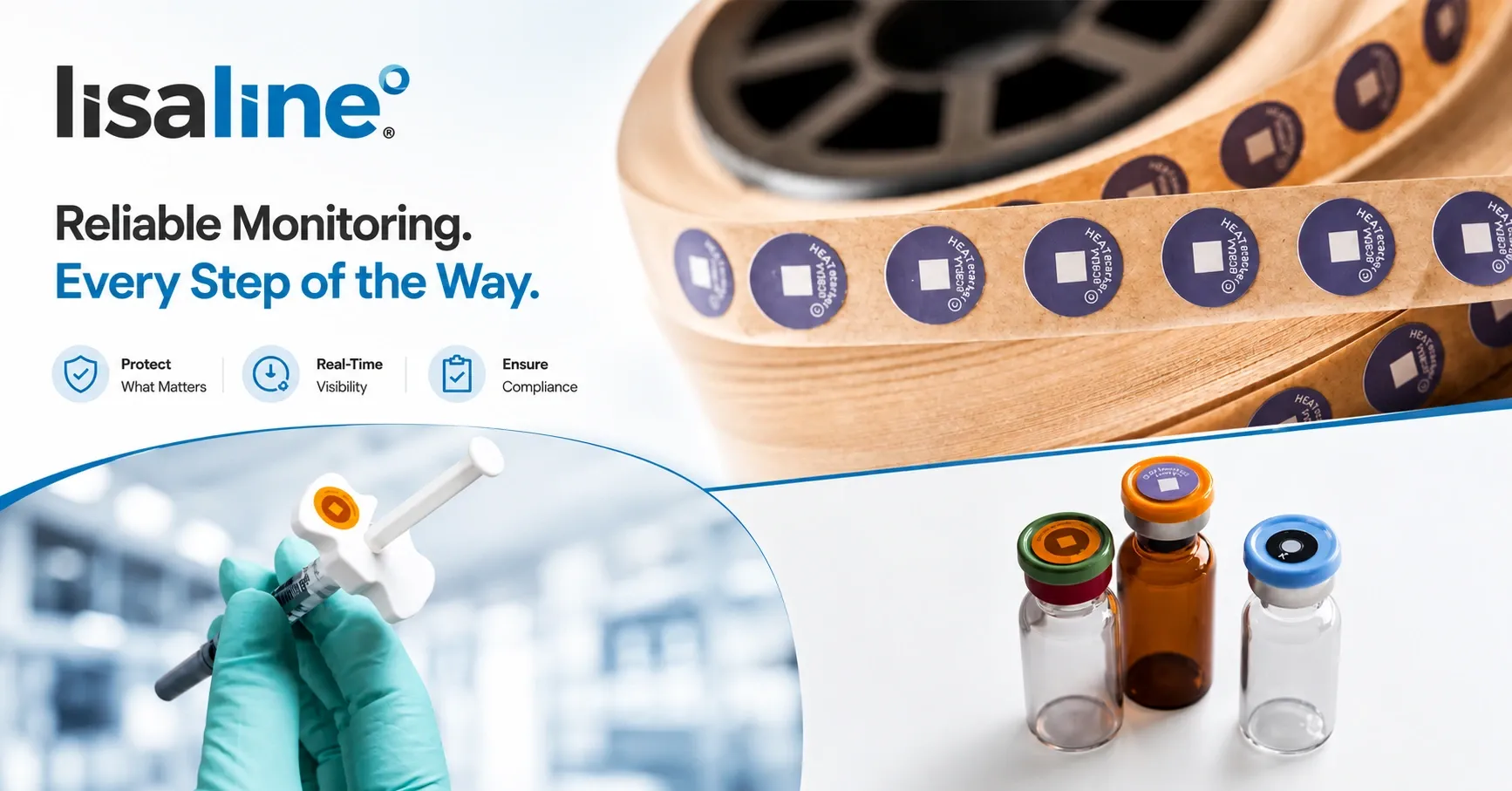
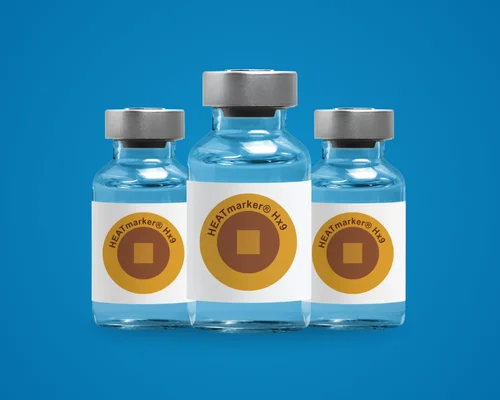
Lisaline Asia supplies time temperature sensitive labels from Temptime, a company under Zebra Technologies, available in both strip and card formats. Known as HEATmarker, these are miniaturised, self-adhesive labels that react to heat exposure and shift to a darker shade each time the product is exposed to heat. Because the reaction accumulates, the final colour reflects the total heat the product has been exposed to throughout its shelf life. This gives a clear, tamper-proof reading of whether the product is still fit for use. These labels come in 20 different variants, and Lisaline Asia helps you choose the right format with the right calibration, matched to the temperature range best suited to the product you are monitoring.
Step by Step Application of Time Temperature Sensitive Labels
Applying time temperature sensitive labels is simple because the labels are self adhesive and need no special tooling. Whether you are running thousands of vials down a production line or placing a few labels by hand, the process stays the same. Peel, position, and press onto the product. What matters most is choosing the right label and placing it in the right spot so the reading stays accurate. Here is how to do it step by step.
Step 1: Choose the right variant and format
Before anything is applied, time temperature sensitive labels have to match the product they protects. Every product has its own heat stability, so the label needs to be calibrated to that limit. HEATmarker comes in more than 20 pre calibrated temperature profiles, each set at the manufacturing stage to a specific safe threshold. Picking the correct profile is what makes the colour change meaningful for that particular product.
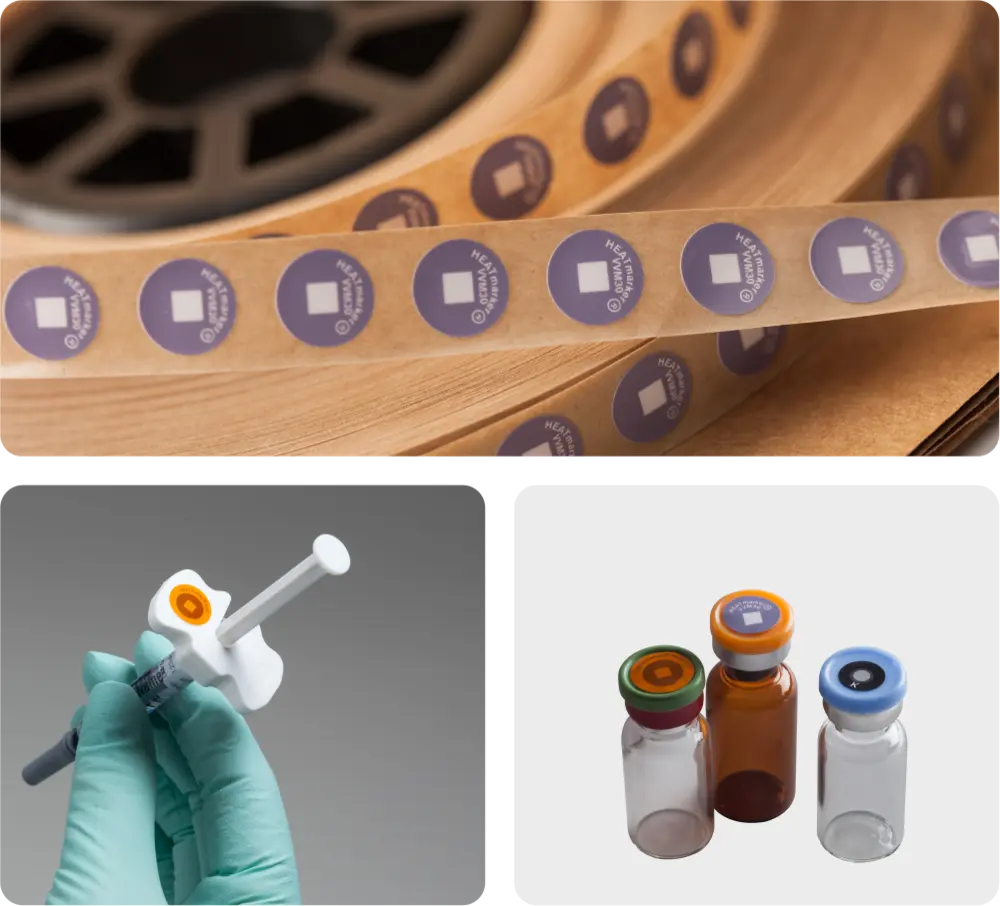
Once the calibration is decided, you choose the physical format. The strip format, supplied on rolls, goes directly onto individual units like vials, bottles, and syringes. Within this format you can pick a full label or a smaller dot. The dot suits tight spaces such as a syringe barrel or a small vial, while the full label works on larger surfaces and lets you add printed text or a barcode alongside the indicator. The card format, known as TransTracker, is made for multi unit packs. It carries the same indicator on a card that sits inside a carton or box, so a whole shipment can be monitored with a single reading.
As the authorised supplier of HEATmarker in India, Lisaline Asia helps you match both the calibration and the format to what you are actually monitoring.
Step 2: Place the label as close to the product as possible
There is a simple rule for the placement of time temperature sensitive labels. The label should sit on the primary unit itself, not on the outer packaging. This matters because the label only reports the heat it feels. If it is stuck on an outer box that warms up faster or slower than the product inside, it records the box and not the product. Applied directly on the vial or bottle, time temperature sensitive labels travel with the product through every stage of the cold chain and absorbs the exact same heat, from the manufacturing line right up to the point of use. Because the time temperature sensitive labels are miniaturised, they sit just as easily on curved surfaces as flat ones, so vials, bottles, and syringes are all handled without any extra effort.
Step 3: Apply manually by hand for smaller volumes
Where volumes are low, the label is peeled off its liner and placed onto the product by hand. Press it down firmly on a clean, visible spot so it stays put and stays easy to read. Manual application of time temperature sensitive labels works well for small batches, pilot runs, or products that are not moving through an automated line.
Step 4: Apply through automated machines for large batches
For high volume production, the self adhesive roll format is built for automatic labelling lines. The time temperature sensitive labels come on a liner designed for roll to roll dispensing at speed, so each unit is labelled consistently as it moves down the line. This removes the variability that comes with placing labels by hand and keeps the application accurate across every single unit. For a manufacturer already running vials or syringes through a line, the label becomes one more routine step in production.
Step 5: Apply the card or label format on cartons and boxes
Not every product is monitored one unit at a time. For items shipped together in a carton or a multi unit box, the card format, known as TransTracker, carries the same HEATmarker indicator on a card that can be dropped inside the box. Alternatively, a self adhesive label can be fixed onto the primary carton itself. Either way, the receiver gets one clear indicator to check the moment the box is opened, which is enough to confirm whether the full pack has stayed within safe conditions in transit.
Where Can Time Temperature Sensitive Labels Be Applied Directly?
Time temperature sensitive labels are designed to be affixed directly on the product by the manufacturer, right at the source. Because they are miniaturised and self adhesive, they fit neatly on small and curved surfaces without any special tooling. These are the most common surfaces they are applied to.
- Vaccine Vials- the time temperature sensitive labels act as vaccine vial monitor and track cumulative heat exposure across the vaccine's full shelf life. This is the same application recommended by the WHO and UNICEF for immunisation programmes.Vaccine Vials- the time temperature sensitive labels act as vaccine vial monitor and track cumulative heat exposure across the vaccine's full shelf life. This is the same application recommended by the WHO and UNICEF for immunisation programmes.
- Medicine bottles and drug vials, for injectables, biologics, and any temperature sensitive medication that degrades gradually with heat over time.Medicine bottles and drug vials, for injectables, biologics, and any temperature sensitive medication that degrades gradually with heat over time.
- Ampoules- The time temperature sensitive labels can be placed on the body or near the neck of the ampoule to monitor the heat the dose has taken.Ampoules- The time temperature sensitive labels can be placed on the body or near the neck of the ampoule to monitor the heat the dose has taken.
- Prefilled syringes- Where the small dot format fits neatly onto the barrel without getting in the way of the graduations or the plunger.Prefilled syringes- Where the small dot format fits neatly onto the barrel without getting in the way of the graduations or the plunger.
- Flip off seals and caps- a clean, visible spot on the top of the vial that is easy for a health worker to read at the point of administration.Flip off seals and caps- a clean, visible spot on the top of the vial that is easy for a health worker to read at the point of administration.
- Diagnostic kits and test kits- where a heat damaged reagent can quietly ruin a result, so a visual heat record on the pack adds a layer of confidence.Diagnostic kits and test kits- where a heat damaged reagent can quietly ruin a result, so a visual heat record on the pack adds a layer of confidence.
What advantages do HEATmarker time temperature sensitive labels provide for application?
No special tools or training needed
The entire process is peel, position, and press. Staff do not need technical training or any equipment beyond the label itself. The only principle to follow is placement, keeping the label as close to the product as possible.
Fits both manual and automated workflows
The same label works whether it is applied by hand for a small batch or run through automated labelling machines on a production line. There is no separate process to learn for scale, just a different application method for the same label.
High speed production
For manufacturers using automated lines, the roll-to-roll format is built for high-speed dispensing. Labelling becomes one more routine step in the line, not a bottleneck that requires the line to slow down or pause.
Works on small and curved surfaces
Because the time temperature sensitive labels are miniaturised and self-adhesive, they sit just as easily on a curved vial or a syringe barrel as they do on a flat carton. This means the same label range covers vials, ampoules, prefilled syringes, and cartons without needing different application methods for each.
Minimal disruption to existing packaging lines
Since the time temperature sensitive labels are self-adhesive with no glue, tape, or extra equipment required, they can be added to an existing production or packing line without redesigning the process around them.
Available in multiple forms
HEATmarker time temperature indicator labels come in roll form, card form, and label form. This gives staff the flexibility to pick the format that fits how their product is packed, whether that is individual vials, prefilled syringes, or multi-unit cartons.
Why choose Lisaline Asia for time temperature sensitive labels in India?
Getting the application right depends as much on who supplies the label as on how it is applied. Lisaline Asia supports you through the entire process, from choosing the correct label to fitting it into your existing workflow.
Conclusion
Applying a time temperature sensitive label correctly comes down to a few decisions made in the right order. Choose the calibration and format that match your product. Place the label as close to the product as possible. Apply it by hand for small batches, or through automated machines when you are working at scale.
Get these steps right, and the label does its job quietly for the rest of the product’s shelf life, recording every bit of heat exposure without any further effort from your team.
If you are choosing time temperature sensitive labels for the first time, or setting up application on a new production line, Lisaline Asia can help you pick the right HEATmarker variant and guide your team through applying it correctly. Get in touch with our team to get started.
Know More through Our Blogs
Data Loggers or Temperature Indicators for Blood Bags: Which Should You Choose?
Blood is one of the most temperature sensitive products a...
Read More
Do you need different blood bank temperature indicators for blood components?
Every blood product in a blood bank has its own...
Read More
Time Temp Indicator or Heat Indicator: Which One Should You Choose for Pharma Shipments?
When it comes to pharma shipments, there is no one...
Read More
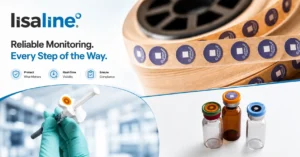
How to Apply Time Temperature Sensitive Labels Correctly? (Step by Step)
Time temperature sensitive labels are only reliable if properly applied....
Read More