
Blood is one of the most temperature sensitive products a...
Read More →Cold Chain Monitoring Decoded to you by India's Leading Supplier.
At Lisaline Asia we combine the expertise of leading manufacturers in the cold chain monitoring industry to provide our clients with the best equipment. The real time data loggers and colour changing temperature indicators that we supply are a gamechanger for businesses who take cold chain monitoring seriously. Know what exactly cold chain monitoring is how you can go about it and the recent trends in this critical industry, simplified for you by India’s best supplier for cold chain monitoring solutions.
What is Cold Chain Monitoring?
Cold Chain Monitoring is the continuous tracking of temperature and sometimes other parameters for temperature sensitive goods during their transportation and storage. The process uses data loggers, sensors and sometimes temperature sensitive stickers for monitoring. Advanced IOT based systems use cloud based dashboards, sensors and network infrastructure. The aim of cold chain monitoring is to track and ensure that the sensitive products like vaccines, biologics, pharmaceuticals and blood products are within their safe conditions from manufacturing to their final consumption by the patient or end user.
At Lisaline Asia we go a step further. We combine the best cold chain monitoring devices from leading manufacturers like Zebra, Dickson and Tempmate. These go beyond just tracking and give you real time visibility into the environmental conditions your products are exposed to. Our real time tracking data loggers help you track excursions early, respond proactively to ensure you have minimum to negligible losses.
For individual product units that are breached and yet go unnoticed due to the limited environmental monitoring of data loggers, we have the temperature indicators that constantly track the temperature of these products.
Why Cold Chain Monitoring is Necessary?
Temperature-sensitive products fail silently. A vaccine that spent three hours too warm looks exactly like one that didn’t. Same vial, same label, no visible clue. By the time the damage shows up, it shows up in a patient or a failed audit, not on the shelf. Cold chain monitoring exists to catch what the eye can’t, at the one point where you can still do something about it.
The amount lost yearly to cold chain failures is
$20 to $ 35 billion
Sourced from Cargo Sense
Vaccines wasted due to temperature excursions
Up to 50%
Sourced from the WHO
Temperature-sensitive pharma shipments spoilt.
~20%
Sourced from IATA and the IQVIA Institute
A few degrees can write off an entire batch
Temperature sensitive products operate within a narrow safety range. Even a brief excursion- a few degrees outside the limit can damage the product, affect its potency and make it harmful for patient use. Even after damage, these products appear exactly normal, as they would if they were safe. Cold Chain Monitoring tracks these excursions, distinguishes the safe products from the damaged ones.
The damage is invisible without proof
A compromised product is often physically identical to a safe product. Without cold chain monitoring and a proper record, you cannot prove if the products you have are safe or have been damaged. It leaves you guessing and you might want to discard the entire stock on the suspicion of excursion. This wastes a massive amount ofmoney and products that were not really affected. A clear record of the readings obtained through cold chain monitoring removes the need for guesswork and clearly confirms what you need to keep and what you need to discard.
Compliance depends on documented proof
When working with temperature sensitive products like vaccines, biologics, pharmaceuticals and blood products, compliance to industry standards is not an option. With cold chain monitoring you get a detailed tamper-proof record, often downloadable in PDF/CSV format with timestamped audit ready readings to easily identify whether there have been excursions or not. This documented proof can be presented as and when required during audits and inspections and allows you to comply with standards like WHO PQS, GDP, EN 12830, and 21 CFR Part 11.
Temperature excursions can be prevented
By tracking temperature and other conditions in real time, you can often spot excursions early before an entire consignment of vaccines of medicines is lost. The teams responsible can be alerted and they can proactively act to minimise the damages. Cold Chain monitoring ensures that negligible damages are caused, the affected products are quarantined and the gaps in your cold chain are identified.
 Free Tool
Cold Chain Monitoring Performance Scorecard
How tight is your cold chain, really?
Answer 12 quick questions across six pillars of cold chain monitoring maturity and get an instant score, recommendations, and where to focus first.
3 minutes
12 questions
Instant, private results
Your Results
Cold Chain Monitoring Score
0/100
Score by pillar
Where to focus first
Share your score
Want to fix the gaps?
Talk to Lisaline Asia about closing the ones this score just found.
Copied to clipboard
What exactly do you need to monitor your cold chain?
Data Loggers
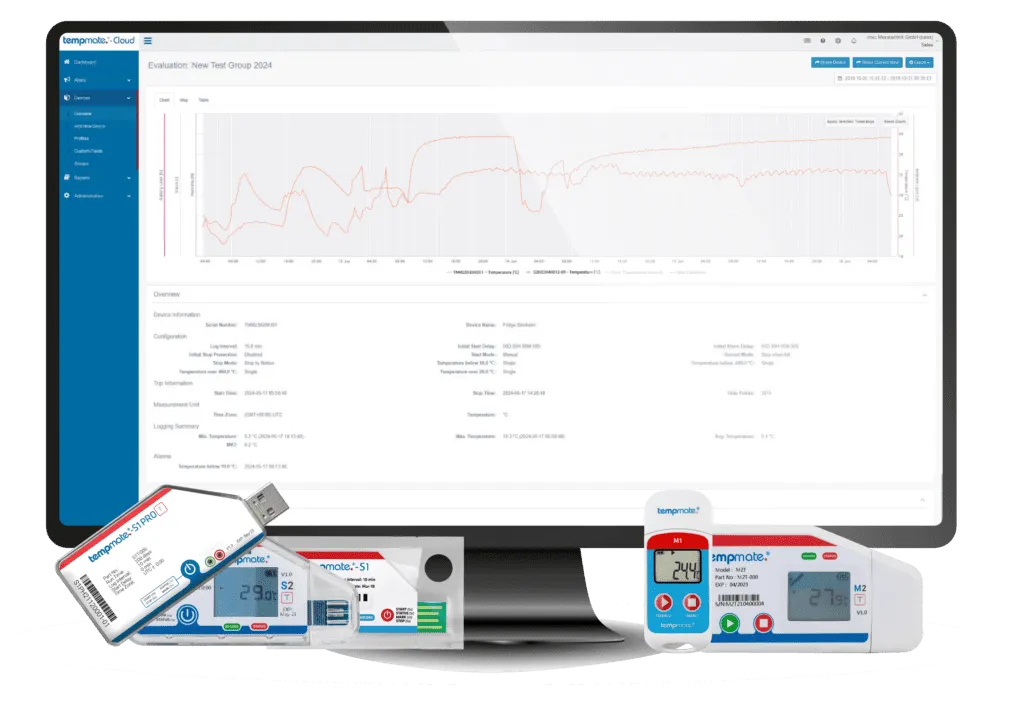
Data loggers are environmental tracking devices placed inside the units where temperature-sensitive products like vaccines, pharmaceuticals, biologics or blood products are stored. These electronic devices monitor environmental conditions and record readings, storing them either in the device’s internal memory or transmitting them over a network to a cloud platform.
Each data logger can support one or multiple sensors depending on the parameters being tracked, and connects via WiFi, GSM, Bluetooth, LoRaWAN or other connectivity options depending on your monitoring setup.
Data loggers that send data to the cloud give you real-time visibility into your cold chain. On the cloud dashboard, you can view live readings, get instant alerts when conditions go out of range, and download audit-ready compliance reports whenever required. A single data logger placed inside the box can monitor multiple temperature-sensitive units at a time.
Lisaline Asia brings together the best data loggers for cold chain monitoring from the leading names in the industry. We supply data loggers from Zebra, Dickson and Tempmate, with official licensing and documentation in India. We also offer ISO 17025 calibration through our NABL accredited facility, available both on-site and in-lab, backed by IQ/OQ validation, WHO certified PQS testing, thermal mapping and other supporting services.
Temperature Indicators
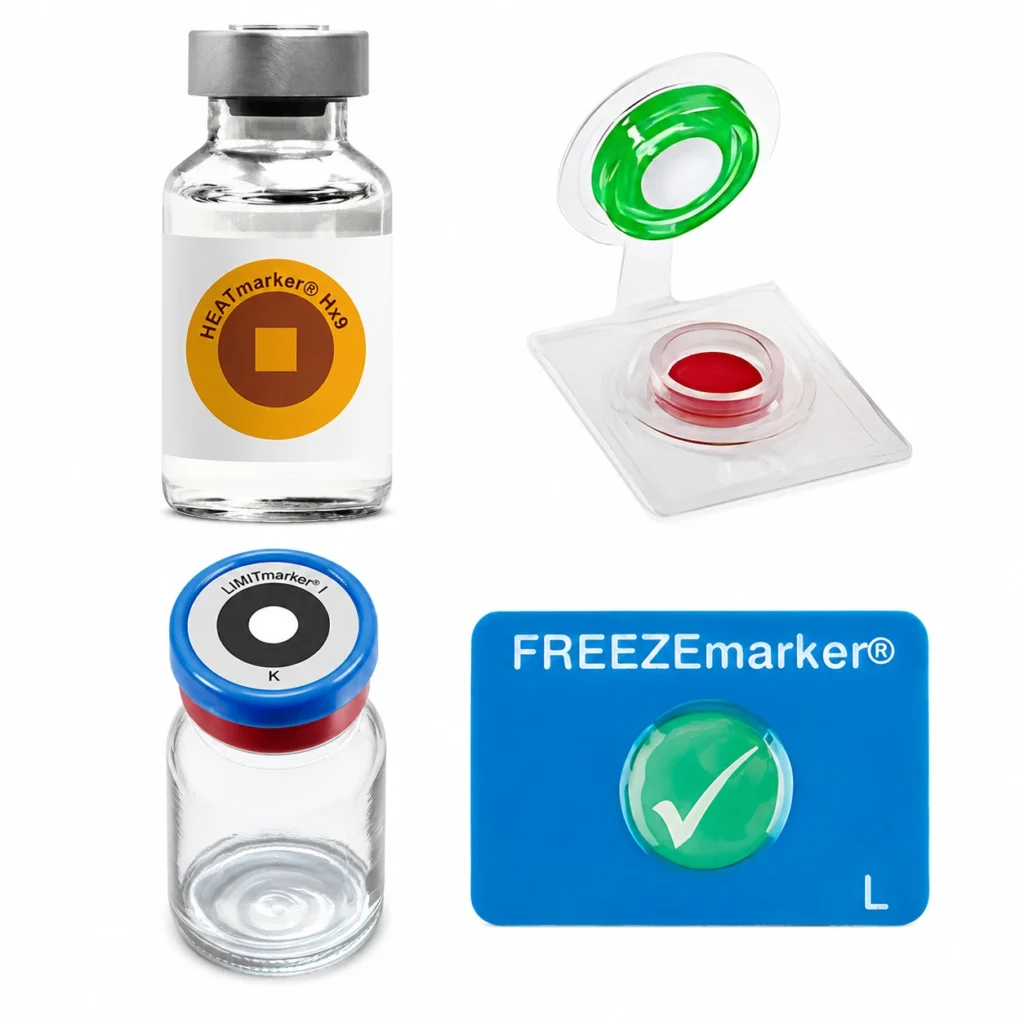
Temperature indicators are temperature sensitive stickers or labels that track the temperature of perishable products like pharmaceuticals, vaccines, blood products, biologics. These labels are directly applied to the vaccine vial, the medicine bottle, or testube where the biologics are kept, blood bags, etc. They square at the center of the label changes colour irreversibly when the product is exposed to temperatures outside the safety limits. The colour does not return back to normal even if the product returns to normal temperature. This provides a clear visual proof at any stage of the supply chain about the safety of the products. If the colour has changed, the teams can immediately discard or quarantine the affected products so that they do not damage any more. These self adhesive labels are very useful to verify product quality at the point of delivery and track individual units not multiple at once so are more accurate.
Lisaline Asia provides temperature indicators from Temptime, a company under Zebra Technologies. These labels monitor cumulative heat exposure, sudden heat spikes, temperature falls, etc in several variants like HEATmarker, LIMITmarker, FREEZEmarker, respectively. They also monitor blood products and vaccines through Safe-T-Vue and VVMs respectively.
How does Cold Chain Monitoring Works?
Sense
A sensor in the data logger records the parameter at regular intervals. It stays with the product during storage and shipment.
Capture
Each reading is timestamped and logged, stored locally creating a digital trail of the product's supply chain.
Transmit
In cloud connected models, the data is transmitted to cloud dashboard through networks, continuously offering real time visibility.
Alert
If a reading crosses a set threshold, the system triggers an automated alert so someone can intervene before the product is compromised.
Analyse and Report
Data is stored locally and in cloud for compliance audits and to spot recurring risk points across the supply chain.
Industries that require Cold Chain Monitoring
Pharmaceutical Industry
Pharmaceuticals, drugs and medicines are highly temperature sensitive. A few degrees outside the safe range can degrade their potency and make them unsafe for patient use, often with no visible sign of damage. This makes continuous monitoring essential across the entire pharma supply chain, from manufacturing to warehousing, distribution and the pharmacy shelf.

Vaccine Manufacturing Industry
Vaccines are among the most temperature sensitive products in healthcare. Most need to stay between +2°C and +8°C, and even a brief exposure outside this range can permanently affect their potency while the vaccine still looks fine from the outside. This makes monitoring critical at every stage, from production to cold storage, transport and immunization.

Lifesciences and Biologics
Biological samples, reagents and clinical trial materials are highly sensitive to temperature change. Even a small deviation can compromise sample integrity, invalidate research data or put an entire clinical trial at risk. This makes continuous monitoring essential across the biologics supply chain, from the laboratory to the biobank, trial supply and the research site.

Blood and Plasma Industry
Blood and plasma units are highly sensitive to temperature change, and every component has its own safe range.. Even a small deviation outside the safe range can damage cellular components and make a unit unfit for transfusion. This makes continuous monitoring essential throughout the blood supply chain, from collection to the blood bank, transport and transfusion.

Common Challenges Without Proper Cold Chain Monitoring
01
Manual temperature logging leaves coverage gaps
A staff member checks a thermometer every few hours and writes down a number. Between those checks, nobody knows what happened. A refrigeration unit can fail at 2 AM and come back on its own before the morning shift arrives. The morning reading looks perfectly normal, so nobody ever finds out the product sat outside its safe range for hours overnight and was already damaged before anyone opened the door.
02
Manual logging errors put shipments at risk
Even when logging happens on time, human error is a major problem. Numbers get transposed. Readings get rounded. Sometimes a busy handler writes down an “acceptable” value without actually checking the thermometer. None of this is deliberate fraud most of the time. It is simply what happens when accuracy depends on a person remembering to look, read, and write correctly, shipment after shipment. But intent does not matter to the product. Whether a bad reading comes from carelessness or dishonesty, the result is the same: a manual record that cannot be trusted.
03
Blind Spots During Multi-Leg Handoffs
A shipment rarely travels in one straight line. It moves from a warehouse to a truck, from a truck to an airport or port, from there to another vehicle, and finally to the delivery point. Every handoff is a moment where responsibility for temperature control changes hands. Delays add another layer to this blind spot. A truck held up in traffic, stuck at a checkpoint, or waiting for customs clearance sits with the same cargo for far longer than planned, often without active cooling running the whole time. Without continuous monitoring, nobody can say for certain which leg of the journey, or which delay, caused a problem. Everyone points to someone else.
04
Delayed alerts turn small deviations into total losses
Manual checks and end-of-route reports tell you about a problem only after it has already happened. A vaccine batch or a diagnostic reagent that spent three hours outside its safe range does not get a second chance once someone finally reads the log. By then there is no chance left to step in and prevent the excursion, only to record it after the fact. The same deviation, caught early with proactive action, could have been corrected before any damage was done.
05
Tropical climate and last-mile challenges
High ambient heat accelerates spoilage the moment cold chain control slips. Monsoon season disrupts transit schedules and stretches exposure windows. Grid power outages affect refrigeration at smaller warehouses and rural distribution points. Last-mile delivery into towns and villages often depends on smaller vehicles and local couriers with no cold chain infrastructure at all. A shipment can pass through several well-controlled legs and still fail in the final few kilometres.
06
No audit trail for compliance
Regulators and quality auditors do not accept “we checked it regularly” or a manual record as proof. Standards like GDP, EN 12830, and WHO PQS expect documented, verifiable temperature data across the full journey. A paper logbook with gaps and rounded numbers rarely holds up during an audit, and a failed audit can mean rejected batches, license cancellations, or a lost contract.
07
No way to pinpoint where an excursion happened
When a shipment arrives out of range, the real question is where it went wrong. Without a continuous digital record, there is no way to know if it was the cold storage facility, the transport vehicle, or the handoff at the airport. Without that answer, the same failure just repeats on the next shipment.
08
Rising cost of spoilage, recalls, and lost trust
All of these gaps add up to the same outcome: wasted product, recalled batches, and clients who start asking hard questions about reliability. For pharma, hospital, vaccine and diagnostic supply chains, that is not just a financial loss. It is a trust problem that is much harder to repair than the shipment itself.
How Lisaline Asia Solves These Cold Chain Monitoring Challenges?
Continuous digital tracking replaces manual logs
Lisaline Asia provides data loggers that monitor the products regularly at set intervals. The recording interval can be set as per your requirement, from every few seconds to several minutes. Therefore, the monitoring is continuous without any gaps that go unnoticed. This removes the risk of missed readings during night shifts, holidays, or staff unavailability. This results in an unbroken record of logs that are digitally recorded, with no need for manual logging from time to time. Continuous monitoring also helps catch short duration excursions that manual checks would otherwise miss.
Automated, tamper-proof data removes human error
Readings are recorded digitally at regular intervals with advanced calibrated sensors. This makes the data accurate and free from human errors, as it completely replaces manual logs. The data cannot be changed or tampered with for any purpose, and only authorised people have access to it through password or login based permissions. Every entry is logged with a timestamp, creating a clear audit trail, and any attempt to access or edit the data is recorded, keeping the trail transparent. This ensures full compliance with data integrity standards like 21 CFR Part 11 , keeping data attributable, legible, and original.
End-to-end visibility across every leg of the journey
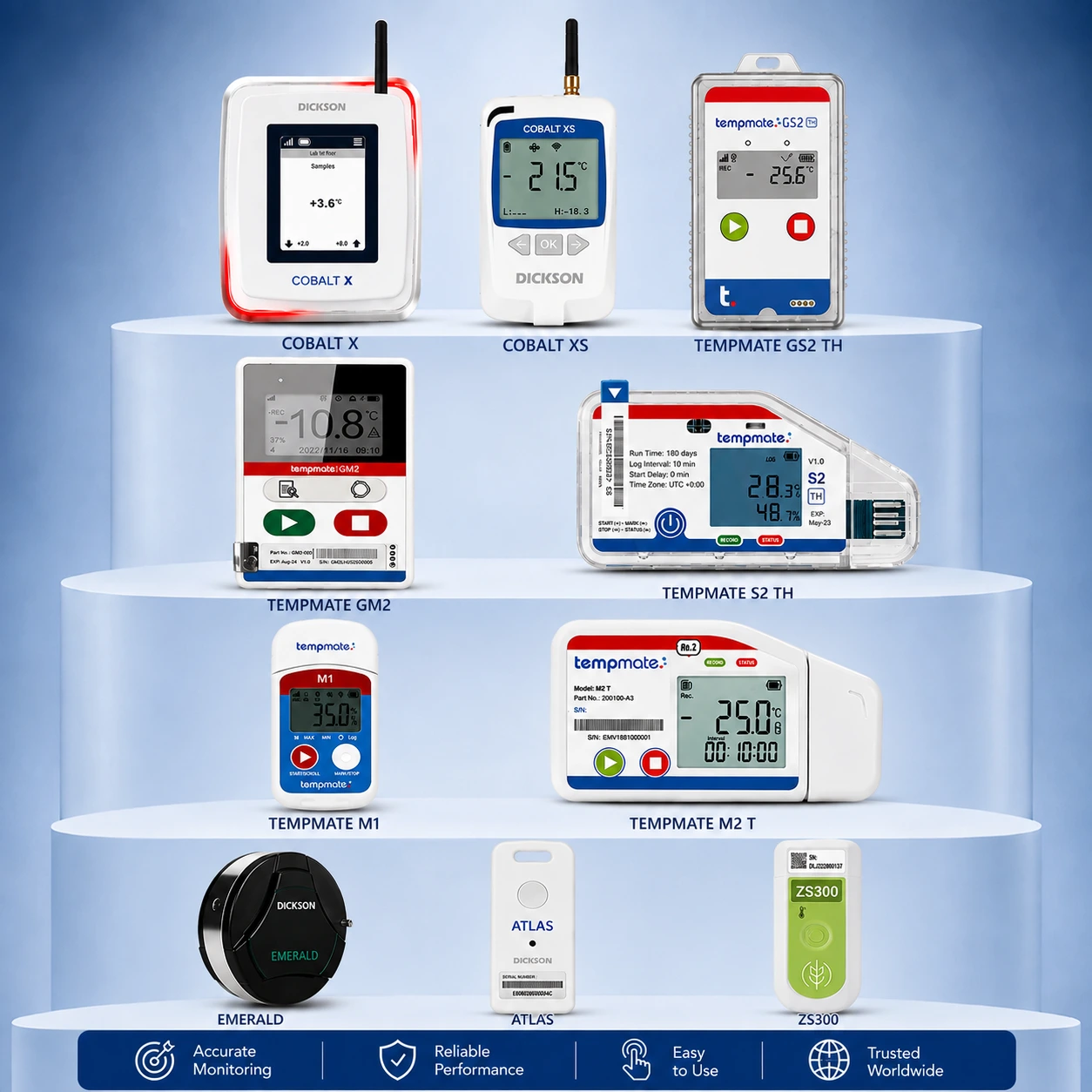
We have data loggers for monitoring at every stage of the journey, from storage data loggers like Cobalt X and Cobalt XS to shipment data loggers like Tempmate GS2 and GM2. This means visibility starts right from the warehouse and continues all the way to the last mile of delivery. These data loggers offer live visibility as readings are continuously shared to the cloud dashboard, where they can be viewed in real time from anywhere. In offline data loggers, the display provides visibility throughout the journey, so the current status is always available on demand. This ensures you get visibility into the data throughout, not just at checkpoints, with no blind spots between the warehouse, the vehicle, and the final delivery point.
Real-time alerts before a deviation becomes a loss
When conditions go outside the set safe ranges, even by a few degrees or measures, the system catches it and triggers an alarm. In data loggers not connected to the cloud, the alarm status is displayed on the screen. In cloud connected models, users receive alerts through SMS, email, app based notifications, and voice calls. This alerts the responsible teams so they can act proactively and minimise excursions. Our data loggers, whichever the model, offer instant alerts, either through the display or through the cloud. Teams no longer have to wait for the shipment to arrive to know if something went wrong, as any deviation can be spotted and addressed while the product is still in transit.
Built for tropical and last-mile conditions
India’s tropical climate, with high heat, humidity, and long monsoon stretches, puts extra strain on cold chain logistics, especially during last-mile delivery to remote or infrastructure-poor areas. Lisaline’s data loggers are engineered to hold up in these conditions, and the range of connectivity options, including GSM, LoRaWAN, WiFi, and Bluetooth, lets businesses choose the right device for each leg of the route, from urban distribution hubs to rural drop points with patchy network coverage. For the final stretch, where consistent refrigeration often can’t be guaranteed, Hemokool cold chain boxes keeping products within safe temperature range for extended periods ensuring safe last mile delivery.
Audit-Ready Reports and Compliance Documentation
The sensors record readings in a timestamped format in the data logger’s internal memory. Cloud connected data loggers store this data in time specified format on the cloud dashboard. For offline data loggers, readings can be downloaded in PDF or CSV format by plugging the device into any laptop or computer via USB. For cloud connected data loggers, reports can be downloaded anytime through the cloud dashboard. This keeps you audit ready, as you can present reports that follow good documentation practices and establish a clear trail of data. This helps you avoid license cancellations, as everything stays open and traceable, leaving no room for breach of trust.
Pin-point where the excursion occurred
The readings are recorded with the time, and sometimes location specified on GSM and GPS enabled models. Therefore, it becomes easy for teams to pinpoint exactly where and when the excursion happened. This helps in root cause analysis while determining and fixing the gaps in the cold chain. The real time alerts help identify where there are possibilities for excursions so that teams can act on them and minimise the excursions.
Lower losses, fewer recalls, stronger trust
Real time alerts allow teams to act immediately and minimise excursions. This keeps losses negligible and shipments intact. Reduced breaches lead to fewer product recalls and more successful deliveries. With a timestamped record showing your products stayed within the safe range throughout the supply chain, you can verify product quality and potency at every stage. When you can easily provide proof through timestamped reports and temperature indicators, clients are assured that they are receiving safe products from you. This builds lasting trust, as patient safety is never compromised.
IOT based cold chain monitoring devices with live visibility at your fingertips
Lisaline Asia delivers IoT based real time cold chain monitoring systems sourced directly from leading manufacturers, backed by proper licensing and documentation for full peace of mind. With regular calibration, our sensors deliver accurate, dependable readings and transmit them to your cloud dashboard over LoRaWAN, WiFi, Bluetooth, or 4G, whichever suits your site best. Get live visibility into every shipment, instant SMS, email, or app based alerts the moment conditions go out of range, and time stamped, audit ready reports ready to download whenever compliance calls for them.
Stop worrying about cold chain breaches and start monitoring with confidence. Contact Lisaline Asia today and simplify your cold chain operations, end to end.
Why Choose Lisaline Asia for Cold Chain Monitoring?
Since 1998, Lisaline Asia has been leading the cold chain monitoring innovation in India. We are one of the leading cold chain monitoring companies that have made a landmark achievement of introducing the world’s first miniaturised Vaccine Vial Monitor (VVM) technology to monitor temperature exposure of vials for the Polio Eradication program in India. Over 25 years later, we continue to lead with trusted cold chain monitoring solutions for the pharmaceutical, logistics, food, and life sciences sectors.
As the official supplier of globally recognised brands, including Zebra Technologies, Dickson, Tempmate, Hemokool, and the manufacturer of our own Made in India product, Degrite S, we bring you the best of both international quality standards and local expertise.
Lisaline Asia provides complete installation and commissioning of data loggers by expert technicians including help with integrating to OCEAView and tempmate cloud platform, alarm setup, traceability and reporting according to your specific operational requirements.
Choosing authorised supplier guarantees authentic cold chain monitoring equipment with proper labelling, backed by trust and used in major cold chain facilities across the world. Get official manufacturer support along with calibration certificate and compliance documentation.
Get ISO 17025 (NABL) accredited calibration both in-lab and on-site, WHO PQS-certified product validation, thermal mapping, installation with IQ/OQ validation, preventive maintenance contracts, and 24/7 online support.
We provide extended product support, after sales service, spare parts coordination, technical assistance and customer service across India, South Asia and Middle East.
We're Here to Help
Get In Touch With Us
We're here for you! Whether you have inquiries about our cold chain monitoring or need assistance, our team is ready to help.
Know More about Our Dickson Data Loggers
FAQs- Cold Chain Monitoring
What is the purpose of a cold chain?
The purpose of a cold chain is to preserve the integrity of temperature-sensitive products across the medical, life sciences, and food sectors throughout every stage of their journey. From the moment these products leave the manufacturing facility to the moment they reach the end customer, they must be maintained within precise environmental parameters: temperature, humidity, and other critical factors specific to the product’s stability requirements. Any deviation, even a brief one, can compromise efficacy, safety, or shelf life, making that single lapse costly, irreversible, and in regulated industries, non-compliant. Cold Chain Monitoring isn’t just about keeping things cold. It’s about maintaining continuous, verifiable control over the environmental conditions a product needs at every handoff production, storage, transit, and final delivery so that what reaches the customer is exactly as effective as what left the factory.
How is temperature monitored in a cold chain?
In cold chain monitoring, temperature is tracked using temperature indicators. These are small self adhesive labels applied directly to the product. When the temperature of the products goes beyond the safety limits, the square inside the label changes colour permanently. The change does not reverse even when the product returns to its original temperature. For detailed time specified readings, you can use data loggers for temperature monitoring. These digital devices are kept with the products that need to be monitored. The sensor tracks temperature at regular intervals and stores the data in a time specified format.
What is IOT based cold chain monitoring?
IOT based cold chain monitoring uses internet connected sensor devices to track temperature, humidity and other environmental conditions in real time. The sensors transmit the data continuously over the internet rather than storing it for retrieval later. IOT connected sensors continuously measure the environmental conditions and transmit the readings to a platform or dashboard via LoRaWAN, wifi, cellular, Bluetooth networks. The stakeholders can view live conditions from anywhere at any point in the journey without needing to open the shipment or wait for it to arrive. This is the evolution over offline data logger devices. Lisaline Asia, a leading supplier of cold chain monitoring devices, offers IOT based cold chain monitoring systems. These include the Cobalt X, Cobalt Xs, Tempmate GS2, GM2, Dickson Emerald, Atlas and Zebra ZS300 that transmit readings to their respective cloud platforms either OCEAView or tempmate cloud where you get a live visibility of the readings in real time, instant alerts when conditions go out of safe ranges through SMS, Email, mobile app and voice calls. You can also download audit ready time stamped PDF/CSV reports at any point in the supply chain.
What is meant by remote cold chain monitoring?
Remote cold chain monitoring lets you track temperature and humidity conditions from anywhere, without physically checking each storage unit or shipment. Data loggers with GSM, 4G, WiFi, or LoRaWAN connectivity send readings straight to a cloud dashboard in real time. Alerts trigger automatically if conditions go out of range. This gives your team instant visibility across multiple sites or shipments, so issues get caught before products are damaged.
Know More through Our Blogs
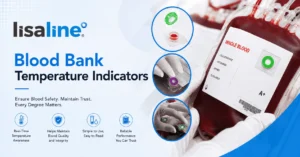
Do you need different blood bank temperature indicators for blood components?
Every blood product in a blood bank has its own...
Read More →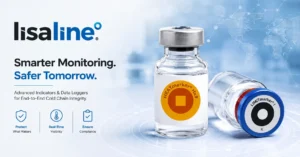
Time Temp Indicator or Heat Indicator: Which One Should You Choose for Pharma Shipments?
When it comes to pharma shipments, there is no one...
Read More →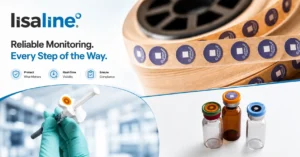
How to Apply Time Temperature Sensitive Labels Correctly? (Step by Step)
Time temperature sensitive labels are only reliable if properly applied....
Read More →
ISO 17025 certified in-house lab services
One Stop Solution for technical support and value added services
For more details on range of value added services CLICK HERE or Mails us : service.support@lisalineasia.com

We’re here to help! Contact us
with any inquiries or support needs,
and we’ll respond promptly.
@2025 All rights reserved. Developed by Sigmaflux.com
@2026 All rights reserved. Developed by Sigmaflux