
A CO2 incubator looks simple from the outside, but inside...
Read More →Cold Chain Monitoring Decoded to you by India's Leading Supplier.
At Lisaline Asia we combine the expertise of leading manufacturers in the cold chain monitoring industry to provide our clients with the best equipment. The real time data loggers and colour changing temperature indicators that we supply are a gamechanger for businesses who take cold chain monitoring seriously. Know what exactly cold chain monitoring is how you can go about it and the recent trends in this critical industry, simplified for you by India’s best supplier for cold chain monitoring solutions.
What is Cold Chain Monitoring?
Cold Chain Monitoring is the continuous tracking of temperature and sometimes other parameters for temperature sensitive goods during their transportation and storage. The process uses data loggers, sensors and sometimes temperature sensitive stickers for monitoring. Advanced IOT based systems use cloud based dashboards, sensors and network infrastructure. The aim of cold chain monitoring is to track and ensure that the sensitive products like vaccines, biologics, pharmaceuticals and blood products are within their safe conditions from manufacturing to their final consumption by the patient or end user.
At Lisaline Asia we go a step further. We combine the best cold chain monitoring devices from leading manufacturers like Zebra, Dickson and Tempmate. These go beyond just tracking and give you real time visibility into the environmental conditions your products are exposed to. Our real time tracking data loggers help you track excursions early, respond proactively to ensure you have minimum to negligible losses.
For individual product units that are breached and yet go unnoticed due to the limited environmental monitoring of data loggers, we have the temperature indicators that constantly track the temperature of these products.
Why Cold Chain Monitoring is Necessary?
Temperature-sensitive products fail silently. A vaccine that spent three hours too warm looks exactly like one that didn’t. Same vial, same label, no visible clue. By the time the damage shows up, it shows up in a patient or a failed audit, not on the shelf. Cold chain monitoring exists to catch what the eye can’t, at the one point where you can still do something about it.
The amount lost yearly to cold chain failures is
$20 to $ 35 billion
Sourced from Cargo Sense
Vaccines wasted due to temperature excursions
Up to 50%
Sourced from the WHO
Temperature-sensitive pharma shipments spoilt.
~20%
Sourced from IATA and the IQVIA Institute
A few degrees can write off an entire batch
Temperature sensitive products operate within a narrow safety range. Even a brief excursion- a few degrees outside the limit can damage the product, affect its potency and make it harmful for patient use. Even after damage, these products appear exactly normal, as they would if they were safe. Cold Chain Monitoring tracks these excursions, distinguishes the safe products from the damaged ones.
The damage is invisible without proof
A compromised product is often physically identical to a safe product. Without cold chain monitoring and a proper record, you cannot prove if the products you have are safe or have been damaged. It leaves you guessing and you might want to discard the entire stock on the suspicion of excursion. This wastes a massive amount ofmoney and products that were not really affected. A clear record of the readings obtained through cold chain monitoring removes the need for guesswork and clearly confirms what you need to keep and what you need to discard.
Compliance depends on documented proof
When working with temperature sensitive products like vaccines, biologics, pharmaceuticals and blood products, compliance to industry standards is not an option. With cold chain monitoring you get a detailed tamper-proof record, often downloadable in PDF/CSV format with timestamped audit ready readings to easily identify whether there have been excursions or not. This documented proof can be presented as and when required during audits and inspections and allows you to comply with standards like WHO PQS, GDP, EN 12830, and 21 CFR Part 11.
Temperature excursions can be prevented
By tracking temperature and other conditions in real time, you can often spot excursions early before an entire consignment of vaccines of medicines is lost. The teams responsible can be alerted and they can proactively act to minimise the damages. Cold Chain monitoring ensures that negligible damages are caused, the affected products are quarantined and the gaps in your cold chain are identified.
 Free Tool
Cold Chain Monitoring Performance Scorecard
How tight is your cold chain, really?
Answer 12 quick questions across six pillars of cold chain monitoring maturity and get an instant score, recommendations, and where to focus first.
3 minutes
12 questions
Instant, private results
Your Results
Cold Chain Monitoring Score
0/100
Score by pillar
Where to focus first
Share your score
Want to fix the gaps?
Talk to Lisaline Asia about closing the ones this score just found.
Copied to clipboard
What exactly do you need to monitor your cold chain?
Data Loggers
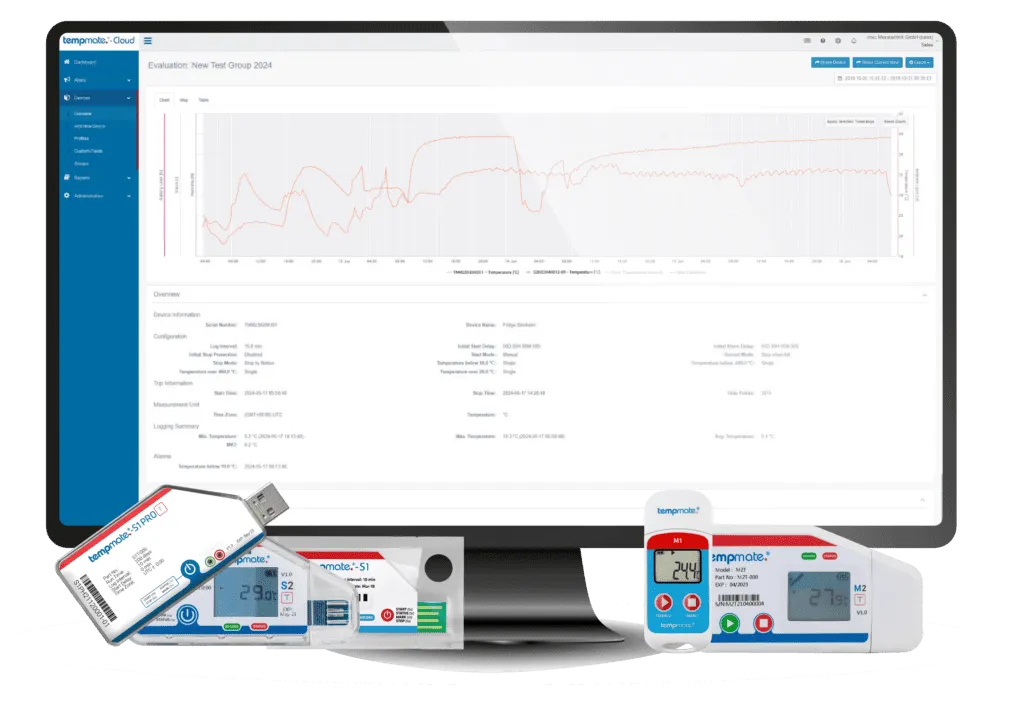
Data loggers are environmental tracking devices placed inside the units where temperature-sensitive products like vaccines, pharmaceuticals, biologics or blood products are stored. These electronic devices monitor environmental conditions and record readings, storing them either in the device’s internal memory or transmitting them over a network to a cloud platform.
Each data logger can support one or multiple sensors depending on the parameters being tracked, and connects via WiFi, GSM, Bluetooth, LoRaWAN or other connectivity options depending on your monitoring setup.
Data loggers that send data to the cloud give you real-time visibility into your cold chain. On the cloud dashboard, you can view live readings, get instant alerts when conditions go out of range, and download audit-ready compliance reports whenever required. A single data logger placed inside the box can monitor multiple temperature-sensitive units at a time.
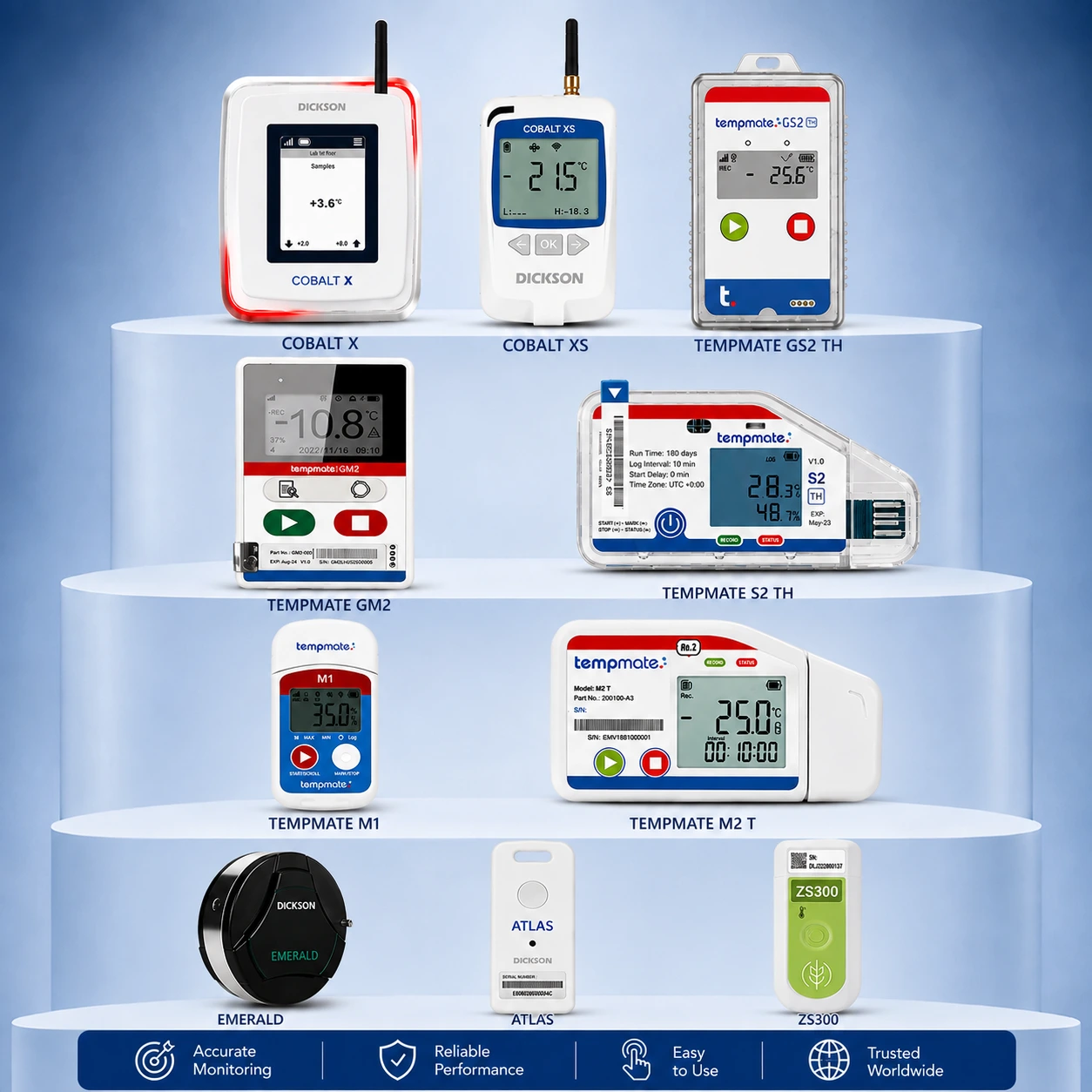
Lisaline Asia brings together the best data loggers for cold chain monitoring from the leading names in the industry. We supply data loggers from Zebra, Dickson and Tempmate, with official licensing and documentation in India. We also offer ISO 17025 calibration through our NABL accredited facility, available both on-site and in-lab, backed by IQ/OQ validation, WHO certified PQS testing, thermal mapping and other supporting services.
Temperature Indicators
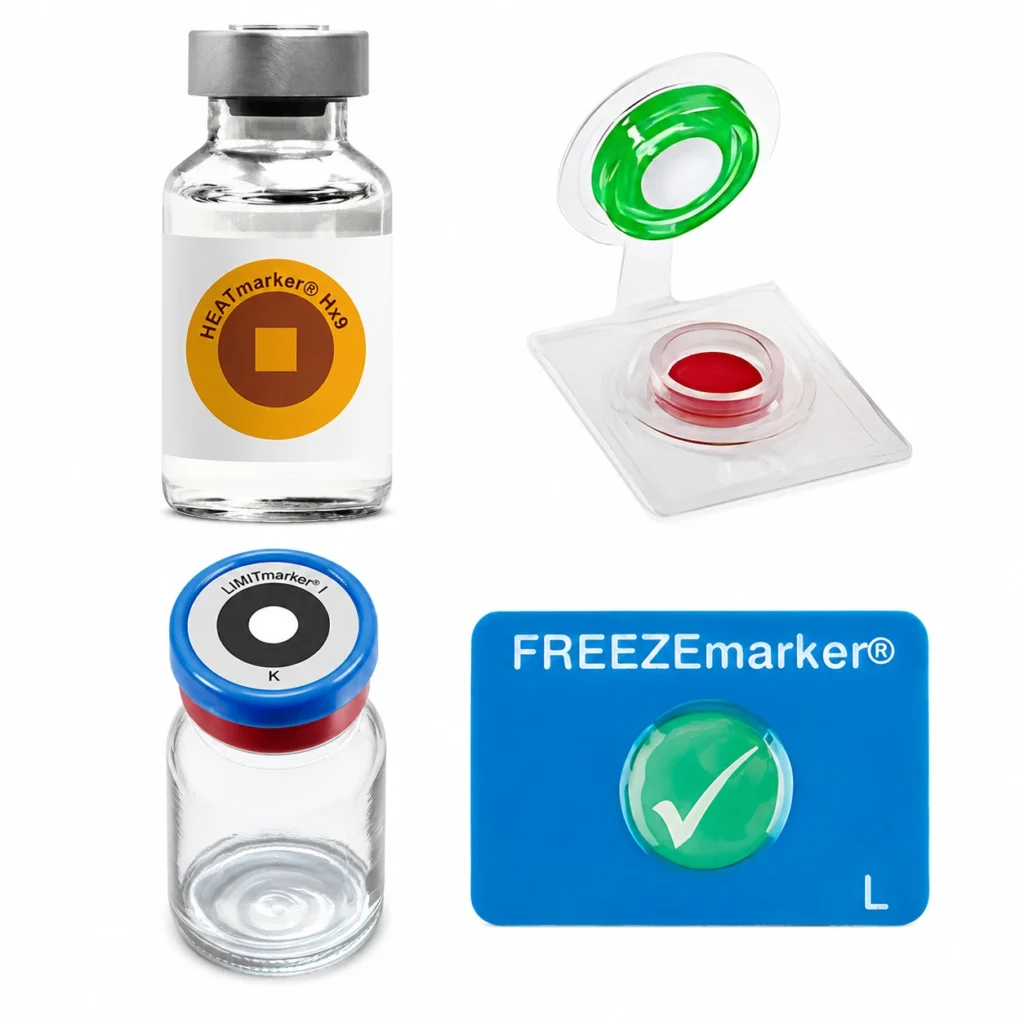
Temperature indicators are temperature sensitive stickers or labels that track the temperature of perishable products like pharmaceuticals, vaccines, blood products, biologics. These labels are directly applied to the vaccine vial, the medicine bottle, or testube where the biologics are kept, blood bags, etc. They square at the center of the label changes colour irreversibly when the product is exposed to temperatures outside the safety limits. The colour does not return back to normal even if the product returns to normal temperature. This provides a clear visual proof at any stage of the supply chain about the safety of the products. If the colour has changed, the teams can immediately discard or quarantine the affected products so that they do not damage any more. These self adhesive labels are very useful to verify product quality at the point of delivery and track individual units not multiple at once so are more accurate.
Lisaline Asia provides temperature indicators from Temptime, a company under Zebra Technologies. These labels monitor cumulative heat exposure, sudden heat spikes, temperature falls, etc in several variants like HEATmarker, LIMITmarker, FREEZEmarker, respectively. They also monitor blood products and vaccines through Safe-T-Vue and VVMs respectively.
How does Cold Chain Monitoring Works?
Sense
A sensor in the data logger records the parameter at regular intervals. It stays with the product during storage and shipment.
Capture
Each reading is timestamped and logged, stored locally creating a digital trail of the product's supply chain.
Transmit
In cloud connected models, the data is transmitted to cloud dashboard through networks, continuously offering real time visibility.
Alert
If a reading crosses a set threshold, the system triggers an automated alert so someone can intervene before the product is compromised.
Analyse and Report
Data is stored locally and in cloud for compliance audits and to spot recurring risk points across the supply chain.
Industries that require Cold Chain Monitoring
Pharmaceutical Industry
Pharmaceuticals, drugs and medicines are highly temperature sensitive. A few degrees outside the safe range can degrade their potency and make them unsafe for patient use, often with no visible sign of damage. This makes continuous monitoring essential across the entire pharma supply chain, from manufacturing to warehousing, distribution and the pharmacy shelf.

Vaccine Manufacturing Industry
Vaccines are among the most temperature sensitive products in healthcare. Most need to stay between +2°C and +8°C, and even a brief exposure outside this range can permanently affect their potency while the vaccine still looks fine from the outside. This makes monitoring critical at every stage, from production to cold storage, transport and immunization.

Lifesciences and Biologics
Biological samples, reagents and clinical trial materials are highly sensitive to temperature change. Even a small deviation can compromise sample integrity, invalidate research data or put an entire clinical trial at risk. This makes continuous monitoring essential across the biologics supply chain, from the laboratory to the biobank, trial supply and the research site.

Blood and Plasma Industry
Blood and plasma units are highly sensitive to temperature change, and every component has its own safe range.. Even a small deviation outside the safe range can damage cellular components and make a unit unfit for transfusion. This makes continuous monitoring essential throughout the blood supply chain, from collection to the blood bank, transport and transfusion.

Common Challenges Without Proper Cold Chain Monitoring
01
Manual temperature logging leaves coverage gaps
A staff member checks a thermometer every few hours and writes down a number. Between those checks, nobody knows what happened. A refrigeration unit can fail at 2 AM and come back on its own before the morning shift arrives. The morning reading looks perfectly normal, so nobody ever finds out the product sat outside its safe range for hours overnight and was already damaged before anyone opened the door.
02
Manual logging errors put shipments at risk
Even when logging happens on time, human error is a major problem. Numbers get transposed. Readings get rounded. Sometimes a busy handler writes down an “acceptable” value without actually checking the thermometer. None of this is deliberate fraud most of the time. It is simply what happens when accuracy depends on a person remembering to look, read, and write correctly, shipment after shipment. But intent does not matter to the product. Whether a bad reading comes from carelessness or dishonesty, the result is the same: a manual record that cannot be trusted.
03
Blind Spots During Multi-Leg Handoffs
A shipment rarely travels in one straight line. It moves from a warehouse to a truck, from a truck to an airport or port, from there to another vehicle, and finally to the delivery point. Every handoff is a moment where responsibility for temperature control changes hands. Delays add another layer to this blind spot. A truck held up in traffic, stuck at a checkpoint, or waiting for customs clearance sits with the same cargo for far longer than planned, often without active cooling running the whole time. Without continuous monitoring, nobody can say for certain which leg of the journey, or which delay, caused a problem. Everyone points to someone else.
04
Delayed alerts turn small deviations into total losses
Manual checks and end-of-route reports tell you about a problem only after it has already happened. A vaccine batch or a diagnostic reagent that spent three hours outside its safe range does not get a second chance once someone finally reads the log. By then there is no chance left to step in and prevent the excursion, only to record it after the fact. The same deviation, caught early with proactive action, could have been corrected before any damage was done.
05
Tropical climate and last-mile challenges
High ambient heat accelerates spoilage the moment cold chain control slips. Monsoon season disrupts transit schedules and stretches exposure windows. Grid power outages affect refrigeration at smaller warehouses and rural distribution points. Last-mile delivery into towns and villages often depends on smaller vehicles and local couriers with no cold chain infrastructure at all. A shipment can pass through several well-controlled legs and still fail in the final few kilometres.
06
No audit trail for compliance
Regulators and quality auditors do not accept “we checked it regularly” or a manual record as proof. Standards like GDP, EN 12830, and WHO PQS expect documented, verifiable temperature data across the full journey. A paper logbook with gaps and rounded numbers rarely holds up during an audit, and a failed audit can mean rejected batches, license cancellations, or a lost contract.
07
No way to pinpoint where an excursion happened
When a shipment arrives out of range, the real question is where it went wrong. Without a continuous digital record, there is no way to know if it was the cold storage facility, the transport vehicle, or the handoff at the airport. Without that answer, the same failure just repeats on the next shipment.
08
Rising cost of spoilage, recalls, and lost trust
All of these gaps add up to the same outcome: wasted product, recalled batches, and clients who start asking hard questions about reliability. For pharma, hospital, vaccine and diagnostic supply chains, that is not just a financial loss. It is a trust problem that is much harder to repair than the shipment itself.
How Lisaline Asia Solves These Cold Chain Monitoring Challenges?
Continuous digital tracking replaces manual logs
Lisaline Asia provides data loggers that monitor the products regularly at set intervals. The recording interval can be set as per your requirement, from every few seconds to several minutes. Therefore, the monitoring is continuous without any gaps that go unnoticed. This removes the risk of missed readings during night shifts, holidays, or staff unavailability. This results in an unbroken record of logs that are digitally recorded, with no need for manual logging from time to time. Continuous monitoring also helps catch short duration excursions that manual checks would otherwise miss.
Automated, tamper-proof data removes human error
Readings are recorded digitally at regular intervals with advanced calibrated sensors. This makes the data accurate and free from human errors, as it completely replaces manual logs. The data cannot be changed or tampered with for any purpose, and only authorised people have access to it through password or login based permissions. Every entry is logged with a timestamp, creating a clear audit trail, and any attempt to access or edit the data is recorded, keeping the trail transparent. This ensures full compliance with data integrity standards like 21 CFR Part 11 , keeping data attributable, legible, and original.
End-to-end visibility across every leg of the journey
We have data loggers for monitoring at every stage of the journey, from storage data loggers like Cobalt X and Cobalt XS to shipment data loggers like Tempmate GS2 and GM2. This means visibility starts right from the warehouse and continues all the way to the last mile of delivery. These data loggers offer live visibility as readings are continuously shared to the cloud dashboard, where they can be viewed in real time from anywhere. In offline data loggers, the display provides visibility throughout the journey, so the current status is always available on demand. This ensures you get visibility into the data throughout, not just at checkpoints, with no blind spots between the warehouse, the vehicle, and the final delivery point.
Real-time alerts before a deviation becomes a loss
When conditions go outside the set safe ranges, even by a few degrees or measures, the system catches it and triggers an alarm. In data loggers not connected to the cloud, the alarm status is displayed on the screen. In cloud connected models, users receive alerts through SMS, email, app based notifications, and voice calls. This alerts the responsible teams so they can act proactively and minimise excursions. Our data loggers, whichever the model, offer instant alerts, either through the display or through the cloud. Teams no longer have to wait for the shipment to arrive to know if something went wrong, as any deviation can be spotted and addressed while the product is still in transit.
Built for tropical and last-mile conditions
India’s tropical climate, with high heat, humidity, and long monsoon stretches, puts extra strain on cold chain logistics, especially during last-mile delivery to remote or infrastructure-poor areas. Lisaline’s data loggers are engineered to hold up in these conditions, and the range of connectivity options, including GSM, LoRaWAN, WiFi, and Bluetooth, lets businesses choose the right device for each leg of the route, from urban distribution hubs to rural drop points with patchy network coverage. For the final stretch, where consistent refrigeration often can’t be guaranteed, Hemokool cold chain boxes keeping products within safe temperature range for extended periods ensuring safe last mile delivery.
Audit-Ready Reports and Compliance Documentation
The sensors record readings in a timestamped format in the data logger’s internal memory. Cloud connected data loggers store this data in time specified format on the cloud dashboard. For offline data loggers, readings can be downloaded in PDF or CSV format by plugging the device into any laptop or computer via USB. For cloud connected data loggers, reports can be downloaded anytime through the cloud dashboard. This keeps you audit ready, as you can present reports that follow good documentation practices and establish a clear trail of data. This helps you avoid license cancellations, as everything stays open and traceable, leaving no room for breach of trust.
Pin-point where the excursion occurred
The readings are recorded with the time, and sometimes location specified on GSM and GPS enabled models. Therefore, it becomes easy for teams to pinpoint exactly where and when the excursion happened. This helps in root cause analysis while determining and fixing the gaps in the cold chain. The real time alerts help identify where there are possibilities for excursions so that teams can act on them and minimise the excursions.
Lower losses, fewer recalls, stronger trust
Real time alerts allow teams to act immediately and minimise excursions. This keeps losses negligible and shipments intact. Reduced breaches lead to fewer product recalls and more successful deliveries. With a timestamped record showing your products stayed within the safe range throughout the supply chain, you can verify product quality and potency at every stage. When you can easily provide proof through timestamped reports and temperature indicators, clients are assured that they are receiving safe products from you. This builds lasting trust, as patient safety is never compromised.
IOT based cold chain monitoring devices with live visibility at your fingertips
Lisaline Asia delivers IoT based real time cold chain monitoring systems sourced directly from leading manufacturers, backed by proper licensing and documentation for full peace of mind. With regular calibration, our sensors deliver accurate, dependable readings and transmit them to your cloud dashboard over LoRaWAN, WiFi, Bluetooth, or 4G, whichever suits your site best. Get live visibility into every shipment, instant SMS, email, or app based alerts the moment conditions go out of range, and time stamped, audit ready reports ready to download whenever compliance calls for them.
Stop worrying about cold chain breaches and start monitoring with confidence. Contact Lisaline Asia today and simplify your cold chain operations, end to end.
Standards and Certifications
Compliance Standards Our Cold Chain Monitoring Meets
Compliance is the reason most teams start monitoring in the first place. An auditor does not ask whether you kept the product cold. They ask you to prove it, with records that cannot be edited and devices whose accuracy can be traced back to a national standard.
Every device we supply is built and tested against a specific standard. Some standards govern the device itself, like how accurate the sensor has to be. Some govern the record, like who can change a reading and whether the change leaves a trail. Some govern the whole system, like how a cold box has to perform in Indian summer heat.
Here is what each standard actually asks for, and which of our data loggers, cold chain boxes and temperature indicators meet it.
What the standard is
21 CFR Part 11 is the US FDA rule that decides when an electronic record can legally replace a paper one. It applies to any regulated company that keeps temperature data on a computer or a cloud platform instead of in a logbook.
The rule asks for four things. Records must be protected so nobody can silently change a reading. Every action must be tied to a named user through a login. Every change must be captured in a time stamped audit trail that cannot be deleted. And the system itself must be validated, which means you document that it works the way you say it works.
One point is often missed. Part 11 applies to the software that holds the record, not just the sensor that takes it. A logger on its own does not make you compliant. The platform behind it does.
Which of our equipment meets it
- Cobalt X1 and Cobalt X2 wireless data loggers, when used with the OCEAView platform. OCEAView is developed to 21 CFR Part 11 requirements and records every reading, alarm, user action, acknowledgment and system event.
- Cobalt Xs and Cobalt Xs WiFi, on the same OCEAView platform.
- Emerald and Atlas Bluetooth data loggers, whether they run standalone or as wireless sensors feeding the Cobalt X.
- Tempmate GS2 and Tempmate GM2, through the tempmate Cloud, which supports GxP workflows with tamper evident records and audit ready reporting aligned to Part 11 and EU GMP Annex 11 expectations.
Alarm acknowledgment on the Cobalt X touchscreen needs a PIN code, so even an action taken at the fridge door is attributable to a person. That is the level of detail Part 11 is written for.
What the standard is
EN 12830:2018 is the European standard that defines what a temperature recorder must do before it can be called one. It covers devices working anywhere between minus 80 degrees Celsius and plus 85 degrees Celsius, which takes in everything from ultra low freezers to ambient shipments.
It sets the accuracy the device must hold, the test methods used to prove it, and where the sensor has to sit for transport, storage and distribution use. It also sets rules for the record itself. Data has to be protected from manipulation, it has to carry an audit trail, and it has to stay accessible and readable for the required retention period.
Importantly, the standard applies to the whole recording system, not just the probe. The sensor, the recorder and the report are all in scope.
Which of our equipment meets it
- Tempmate GS2 single use 4G shipment logger. Conformity: EN 12830, CE, RoHS, RTCA DO-160, MSDS, EMC, FCC.
- Tempmate GM2 rechargeable multi use 4G logger. Conformity: EN 12830, CE, RoHS, RTCA DO-160, MSDS.
- Tempmate S2 single use logger with display. Conformity: EN 12830, CE, RoHS, RTCA DO-160, MSDS.
- Tempmate M1 and Tempmate M2 multi use loggers with display. Conformity: EN 12830, CE, RoHS, RTCA DO-160, MSDS.
- Degrite S, our own USB temperature data logger, designed in Germany and manufactured in India. EN 12830 compliant and GDP compliant, supplied with a traceable calibration certificate.
- The OCEAView platform used with Cobalt X, Cobalt Xs, Emerald and Atlas meets EN NF 12830 alongside its other compliance commitments.
What the standard is
EN 13486 is the companion standard to EN 12830. EN 12830 proves the device was accurate when it was built. EN 13486 covers what happens after that.
Every sensor drifts. A probe that read correctly two years ago may be half a degree out today, and half a degree is the difference between a passed batch and a rejected one. EN 13486 sets out how recorders and thermometers are verified at regular intervals so that drift is caught and corrected.
This is why a calibration certificate has an expiry date, and why auditors ask for the current one rather than the original.
Which of our equipment meets it
This one is about service, not just hardware. Lisaline Asia runs an in house ISO 17025, NABL accredited calibration facility, and offers both in lab and on site calibration for temperature, humidity and CO2 sensors.
Periodic verification is available across the range, including Cobalt X1, Cobalt X2, Cobalt Xs, Cobalt Xs WiFi, Emerald, Atlas, the Tempmate shipment and storage loggers and Degrite S.
For the Cobalt range, Dickson's Smart Sensor technology stores calibration data inside the sensor itself. You swap the sensor for a freshly calibrated one and the logger picks up the new calibration automatically. No downtime on the monitoring point.
What the standard is
ISO/IEC 17025 is the international standard for calibration laboratories. It does not certify a product. It certifies the lab that checks the product.
A lab accredited to ISO 17025 has proved its technical competence, its measurement uncertainty, its reference standards and its traceability chain. In practice it means the certificate you hand to an auditor carries weight, because the number on it can be traced back to a national measurement standard.
In India this accreditation is granted by NABL. In the United States it is A2LA and NIST traceability. In France it is COFRAC.
Which of our equipment meets it
- Cobalt X1, Cobalt X2 and Cobalt Xs offer ISO/IEC 17025 accredited calibration, certified non accredited calibration, or NIST traceable calibration.
- Emerald and Atlas offer ISO/IEC 17025 accredited calibration through the Dickson laboratory, plus certified and NIST traceable options.
- Tempmate GS2 and GM2 carry a validation certificate available as a PDF through the tempmate Cloud.
- Tempmate S2, M1 and M2 ship with a 6 point validation certificate, supplied both as a hard copy and as a PDF held in device memory.
- Degrite S ships with a traceable calibration certificate from the manufacturer.
On top of this, Lisaline Asia's own ISO 17025 NABL accredited lab recalibrates devices from every brand we supply, on site or in lab, so your compliance documentation stays current after the first year.
What the standard is
WHO PQS E006 is the World Health Organization's prequalification category for temperature monitoring devices used in immunisation programmes. A product does not simply claim to meet it. It is independently type tested against a published performance specification and a verification protocol, then listed by WHO with its own PQS code and a validity date.
For government immunisation supply, UNICEF supply and Gavi funded procurement, a PQS listing is usually not optional. If the device is not on the list, it cannot be bought.
E006 covers vaccine vial monitors, freeze indicators, threshold indicators and electronic thermometers used at every level of the vaccine cold chain.
Which of our equipment meets it
Temperature indicators from Temptime, a Zebra Technologies company:
| Product | Description | PQS code |
|---|---|---|
| HEATmarker VVM 1 | Vaccine Vial Monitor Type 1 | E006-071 |
| HEATmarker VVM 11 | Vaccine Vial Monitor Type 11 | E006-052 |
| HEATmarker VVM 30 | Vaccine Vial Monitor Type 30 | E006-050 |
| HEATmarker VVM 250 | Vaccine Vial Monitor Type 250 | E006-058 |
| HEATmarker VVM+ 30 | Combined VVM30 and Threshold Indicator 40 | E006-072 |
| HEATmarker VVM+ 250 | Combined VVM250 and Threshold Indicator 40 | E006-059 |
| FREEZEmarker L | Chemical freeze indicator | E006-067 |
The VVM number tells you the vaccine profile the monitor is matched to. A VVM30 reaches its end point after 30 days at 37 degrees Celsius. A VVM250 takes 250 days at the same temperature. The stability of the vaccine decides which one is applied.
There is a detail here worth knowing. The independent verification work behind several of these PQS listings was carried out in India by Lisaline Lifescience Technologies. We do not only supply PQS listed devices. We are one of the labs that tests them and submits the reports to WHO.
What the standard is
WHO PQS E004 is the prequalification category for passive insulated containers. These are non powered boxes that hold temperature using ice packs, gel packs or other phase change material rather than a compressor.
The specification measures one thing above all others. Cold life. That is the time from the moment the lid closes until the warmest point inside the vaccine compartment first reaches plus 10 degrees Celsius, measured at a constant ambient temperature of plus 43 degrees Celsius. The testing protocol also covers drop tests, vibration tests, coolant pack robustness and the requirement that the storage compartment never falls below zero degrees Celsius.
The 43 degree test condition matters for Indian buyers. It is written for hot zone climates, which is exactly what a May afternoon in most of the country looks like.
Which of our equipment is built to it
- Hemokool Passive Cooling Boxes, our thermal carry bags, are built on the same cold life principle. They hold plus 2 to plus 8 degrees Celsius for more than 12 to 16 hours at an ambient temperature of plus 30 degrees Celsius, using KOOLGEL frozen packs inside PE foam insulation with a removable PVC liner. Available in multiple sizes, including the 4 litre model 7001 and the 8 litre model 1215 with a temperature display.
- Hemokool Active Cooling Boxes solve the same last mile problem with power. Single and dual chamber options, AC and DC operation with battery backup, refrigerant based temperature control, an LCD display and internal LED lighting.
Where a programme requires a PQS listed container specifically, talk to our team. Lisaline Asia carries out PQS validation and box testing in house, so we can tell you exactly where a product stands before you commit to a tender.
What the standard is
Good Distribution Practice governs everything that happens to a medicine after it leaves the factory and before it reaches the patient. The two reference documents are the EU GDP Guidelines 2013/C 343/01 and WHO Good Distribution Practices, TRS 957 Annex 5.
GDP asks distributors to qualify their storage areas through temperature mapping, monitor conditions continuously with calibrated equipment, keep the records available for inspection, and investigate every excursion rather than quietly writing off the stock.
The word calibrated is doing a lot of work in that sentence. Under GDP, an uncalibrated sensor produces a record that is worth nothing.
Which of our equipment meets it
Every logger we supply is built for GDP reporting.
- Degrite S, Tempmate S2 and Tempmate GS2 for single use, one way shipments, all EN 12830 and GDP compliant.
- Tempmate M1, Tempmate M2 and Tempmate GM2 for multi use and return leg shipments.
- Cobalt X1, Cobalt X2, Cobalt Xs, Cobalt Xs WiFi, Emerald and Atlas for storage areas, cold rooms, refrigerators and warehouses, with OCEAView meeting GxP, GMP, GDP, HACCP and FSMA expectations.
We support the rest of the GDP picture too. Thermal mapping of cold rooms, labs and warehouses using certified protocols. Installation with IQ and OQ validation. Calibration certificates and device validation reports that you can put straight in front of an inspector.
What the standards are
ISO 9001 is the general quality management system standard. It tells you the manufacturer has documented processes, controls its suppliers, handles non conformances properly and improves on a cycle rather than on a whim.
ISO 13485 is the stricter medical device version. It adds device specific requirements around design controls, risk management, traceability of every batch and post market surveillance.
For a temperature indicator this matters more than it first appears. The indicator is a chemical product. Two labels from two different batches have to respond at exactly the same temperature, or the visual proof means nothing.
Which of our equipment meets it
- HEATmarker VVM, HEATmarker VVM+ and FREEZEmarker indicators are manufactured under Temptime's quality system, listed with WHO as ISO 13485 and ISO 9001:2015.
- Temptime's quality management system is also consistent with FDA Quality System Requirements under 21 CFR Part 820, the GMP rule for medical devices.
- LIMITmarker and Safe-T-Vue indicators come from the same Temptime manufacturing quality system.
- Tempmate devices are built under an integrated quality management system certified to ISO 9001 and audited annually.
Each box of Safe-T-Vue indicators also carries QA documentation for that specific lot, with the lot number and expiry date printed on the box.
What the standards are
Blood has its own rulebook, and it is tighter than the one for pharmaceuticals.
The AABB Standards for Blood Banks and Transfusion Services set the accepted practice for handling blood at every step from collection to transfusion. 21 CFR 600.15 sets the temperature limits during shipment of biological products, and 21 CFR 640 adds the specific standards for human blood and blood components.
The practical requirement is this. Red blood cells in transit must stay between plus 1 and plus 10 degrees Celsius. If a unit crosses 10 degrees, it cannot go back into inventory. The whole question is whether you can tell which units crossed the line and which did not.
In India the same ground is covered by the National Blood Transfusion Council and NACO guidelines, with blood products regulated by CDSCO under the Drugs and Cosmetics Act.
Which of our equipment meets it
- Safe-T-Vue 10 is the blood bag temperature indicator built specifically against these standards. It sticks directly to the bag and turns from white to red permanently once 10 degrees Celsius is reached or crossed. Accuracy is plus or minus 0.4 degrees Celsius. It stays viable for 42 days after application, which is the full life of a red cell unit.
- Safe-T-Vue 6 covers the same job at a 6 degree Celsius indication temperature.
Because the change is irreversible, a unit that was warmed and then put back in the fridge still shows red. That is the entire point. A thermometer on the shelf tells you the temperature now. Safe-T-Vue tells you what happened to that individual bag while nobody was watching.
For the transport leg itself, pair the indicators with Hemokool Passive Cooling Boxes and a Degrite S or Tempmate logger to hold the record for the full journey.
What they cover
Not every product fails from cumulative heat. Some fail the moment they cross a line once.
LIMITmarker is a single use heat threshold indicator. It works on heat fusible materials that melt at a set temperature, turning the window from white to red or pink. Variants respond after a delay of about 2 hours, quickly in about 15 minutes, or almost immediately, depending on how sensitive the product is.
FREEZEmarker covers the opposite failure. Freezing damages many vaccines and biologics permanently, and unlike heat damage it often happens inside the cold chain rather than outside it, when a fridge runs too cold or an unconditioned ice pack sits against a vial.
FREEZEmarker response temperatures are 0, minus 1 and minus 6 degrees Celsius, with accuracy of plus or minus 1 degree Celsius and a response time within 30 minutes. The green circle with the white tick turns opaque white once a freeze event happens, and it does not turn back.
Which of our equipment meets it
- LIMITmarker for heat threshold events on individual units.
- FREEZEmarker for freeze events, with FREEZEmarker L carrying WHO PQS prequalification under code E006-067.
- Both are available on TransTracker backing cards for placement inside secondary packaging and shipping cartons, not only on the product itself.
What they cover
CE marking is the manufacturer's declaration that a product meets the applicable EU health, safety and environmental requirements. For electronic monitoring devices this brings in the EMC Directive for electromagnetic compatibility and the Radio Equipment Directive for anything transmitting over Bluetooth, WiFi, LoRaWAN or cellular.
RoHS restricts hazardous substances such as lead, mercury and cadmium in electrical equipment. It matters at disposal, and for single use loggers that get discarded in volume it matters a lot.
Which of our equipment meets it
- Tempmate GS2, GM2, S2, M1 and M2 are all CE marked and RoHS compliant. The GS2 additionally carries EMC and FCC conformity for its 4G radio.
- HEATmarker VVM, HEATmarker VVM+ and FREEZEmarker L are CE marked, as recorded on their WHO PQS listings.
What the standard is
RTCA DO-160 is the environmental test standard for equipment carried on aircraft. It covers temperature and altitude, vibration, humidity, shock, and electromagnetic interference with aircraft systems.
If your shipment flies, and most pharmaceutical exports do, the logger inside the box is airborne equipment. Airlines and freight forwarders will ask about it, especially for devices that transmit.
Which of our equipment meets it
- Tempmate GS2, GM2, S2, M1 and M2 all carry RTCA DO-160 conformity.
- The GS2 and GM2 add automatic flight detection. The device recognises that it is airborne and stops transmitting, then resumes once it lands. Airline approvals are available on request.
Lithium and non lithium battery versions of the GS2 are both available, which matters when a carrier or a destination restricts lithium cells in air cargo.
What the standard is
IEC 60529 defines the IP code, the two digit rating that tells you how well an enclosure keeps out dust and water. The first digit is solids. The second is liquids.
IP65 means fully dust tight and protected against low pressure water jets from any direction. IP67 means dust tight and able to survive temporary immersion in water.
In an Indian cold chain this is not a detail. Condensation forms every time a box moves from a cold room to a loading bay in July. Monsoon transit means water on the outside of the carton. A logger that fails from moisture takes the record with it.
Which of our equipment meets it
| Device | Protection class |
|---|---|
| Tempmate GS2 | IP65 |
| Tempmate GM2 | IP65 |
| Tempmate S2 T | IP65 |
| Tempmate S2 TH | IP52 |
| Tempmate M1 | IP67 |
| Degrite S | IP67 |
The S2 TH sits at IP52 because a humidity sensor needs air exchange to read at all. That is a design trade off, not a weakness.
What applies here
International standards set the bar for the device. Indian regulation decides whether your facility passes inspection.
The revised Schedule M of the Drugs and Cosmetics Rules, 1945, notified in December 2023 and phased in from 2024, brings Indian GMP much closer to WHO GMP and PIC/S. It adds explicit expectations around computerised systems, data integrity, quality risk management and lifecycle validation. In plain terms, manual temperature logbooks are no longer a comfortable answer during a CDSCO inspection.
For vaccines moving through the government immunisation programme, WHO PQS listing and the eVIN system govern the equipment and the reporting. For blood, the National Blood Transfusion Council and NACO guidelines apply alongside CDSCO licensing.
For calibration, NABL accreditation to ISO/IEC 17025 is what Indian inspectors recognise. A certificate from an unaccredited lab will be questioned.
How we support it
Lisaline Asia holds an in house ISO 17025, NABL accredited calibration facility, offering calibration both in lab and on site across India. We handle installation and commissioning with IQ and OQ validation, thermal mapping of cold rooms, labs and warehouses, WHO PQS validation and box testing, annual maintenance contracts and 24x7 online support.
Every device comes through an official supply route with proper labelling, manufacturer support and the compliance documentation to match.
No standards in this category. Choose another filter.
Which Standard Applies to You
A short way to think about it.
Shipping and exports
Moving pharmaceuticals by air or sea and need an audit ready report at the other end. EN 12830 and GDP apply.
Degrite S, Tempmate S2, M1, M2, GS2, GM2
Storage and facilities
Monitoring cold rooms, warehouses, labs or pharmacy refrigerators under GMP or GDP inspection. 21 CFR Part 11, GDP and ISO 17025 apply.
Cobalt X1, X2, Cobalt Xs, Cobalt Xs WiFi, Emerald, Atlas on OCEAView
Immunisation programmes
Government, UNICEF or Gavi funded vaccine supply. WHO PQS E006 and E004 apply.
HEATmarker VVM, VVM+, FREEZEmarker L, Hemokool cold chain boxes
Blood and plasma
Handling blood or blood components. AABB Standards, 21 CFR 600.15 and NBTC guidelines apply.
Safe-T-Vue 10, Safe-T-Vue 6, Hemokool Passive Cooling Boxes
Single unit protection
Protecting individual units against one threshold breach, either heat or freeze.
LIMITmarker, FREEZEmarker
Not sure which combination fits your operation? Tell us what you move, where it goes and who audits you. Our team will map the right devices to the right standard.
Talk to Our Compliance Team
Budgeting
How Much Would Cold Chain Monitoring Actually Cost You?
This is the question every pharmacy owner, hospital administrator, warehouse manager and quality head asks before anything else. And it is usually asked the wrong way round.
Cold chain monitoring is not an expense you weigh against zero. You weigh it against what happens when you do not monitor your cold chain at all. So before we work out what your facility needs, look at the number on the other side of the page.
Start With What an Excursion Costs
A temperature excursion does not cost you one consignment. It costs you the consignment, plus everything that follows it.
The product
Quarantined at best, destroyed at worst. Vaccines, biologics and blood products cannot be reworked. Once the protein is denatured, it is gone.
The replacement
A fresh batch, manufactured or purchased again, usually shipped express because someone is waiting for it.
The investigation
Every excursion triggers a deviation report. Your QA team reconstructs the record, interviews staff, assesses impact and writes it up. That is days of senior time pulled off other work.
The stock you discard on suspicion
This is the one nobody budgets for. Without a record, you cannot tell which units were affected. So you write off the whole lot, including the large part of it that was perfectly fine.
The audit consequence
A gap in your records during an inspection can mean rejected batches, a licence question or a lost contract. That cost does not appear on any invoice, which is exactly why it gets underestimated.
The patient
A vaccine that lost potency still looks like a vaccine. It gets administered. The person walks away believing they are protected. This is the cost that has no rupee value and the only one that actually matters.
Industry research puts global losses from temperature related failures at around 35 billion dollars a year, with roughly 20 percent of temperature sensitive healthcare products damaged somewhere in distribution. A single spoilt pharmaceutical consignment is commonly valued in tens of lakhs. Set against that, the monitoring is rarely the expensive part.
What Decides Your Cold Chain Monitoring Cost
There is no single price, because no two facilities monitor the same thing. A retail pharmacy and a vaccine manufacturer both need a record they can stand behind, but almost nothing else about their setup is alike. Five factors move the number.
01
How many zones you monitor
Not floor area. Zones. Each fridge, each freezer, each cold room, each ambient store is its own zone with its own sensor.
02
Storage or shipment
Storage devices are bought once and reused for years. Shipment devices are bought per consignment, so volume drives that line entirely.
03
Real time or download later
Live visibility needs a network, a cloud platform and a licence. Reviewing the record on arrival needs none of that and costs a fraction.
04
Single use or multi use
A single use device is cheaper per unit and gone after one trip. A multi use device costs more upfront and pays back over dozens of runs.
05
What compliance you answer to
A pharmacy and a WHO PQS vaccine programme are not buying the same cold chain monitoring equipment. Accredited calibration, validation documentation and audit ready reporting all sit on this line.
Beyond the devices themselves, budget for the running costs too. Calibration on cycle, an annual cloud platform licence where real time visibility is needed, repeat thermal mapping after any significant change, and IQ and OQ documentation at installation. Regulated sites need the paperwork as much as the working device.
How Many Data Loggers Do You Actually Need?
Most people guess this by floor area. That is the wrong unit. Monitoring is counted in zones, and a zone is any space that can fail on its own.
A pharmacy with two fridges has two zones, even if both sit in the same small room. A warehouse with one cold room and one ambient store has two zones, even though it covers a thousand square metres. If one space can go out of range while the space next to it stays fine, it is a separate zone and it needs its own sensor.
Thermal mapping decides the real number
Here is the part most buyers skip, and it is the part that decides whether the rest of the spend was worth anything.
No storage space holds one temperature throughout. Near the door is warmer. Near the cooling unit is colder. The top shelf and the bottom shelf are different environments. Thermal mapping places sensors in a grid across the space, runs it through a full cycle including door openings and a power failure, and produces a report showing exactly where the warmest and coldest points are.
That report tells you two things. How many permanent sensors you need, and where they go. A mapping study on a small chamber typically uses nine or more measurement points. A large cold room or warehouse uses considerably more, spread across three dimensions.
The permanent sensors then sit at the worst spots the study found. That is the whole point. A sensor placed in the geometric centre of a cold room because it looked sensible will pass you every single day while product two metres away quietly spoils.
Mapping is done once at installation, then repeated after any major change to the space, the racking or the cooling equipment. Many facilities repeat it annually as part of their qualification cycle.
The Comparison That Actually Matters
Put the two numbers side by side and the decision usually makes itself.
Without cold chain monitoring
- You find out after the product has already failed
- You cannot tell good stock from damaged stock, so you discard both
- You cannot prove which leg of the journey went wrong
- You cannot show an auditor a record you can stand behind
- A patient receives something that has been damaged already
With cold chain monitoring
- You are alerted while there is still time to act
- You release the stock that stayed safe and quarantine only what did not
- You pinpoint the leg, the vehicle and the hour
- You hand over a timestamped report and move on with the inspection
- You know, rather than hope, that what you dispensed was good
Cold chain monitoring does not make your cold chain perfect. It makes it visible. And visibility is the difference between losing one carton and writing off a consignment, between a deviation you closed properly and an audit finding you cannot answer, between believing your products are safe and being able to prove it.
Want a figure for your own facility? Tell us what you store, how many units you run and who audits you. We will map the zones, recommend the right cold chain monitoring devices and give you a costed proposal, including calibration and thermal mapping.
Get a Costed ProposalWhy Choose Lisaline Asia for Cold Chain Monitoring?
Since 1998, Lisaline Asia has been leading the cold chain monitoring innovation in India. We are one of the leading cold chain monitoring companies that have made a landmark achievement of introducing the world’s first miniaturised Vaccine Vial Monitor (VVM) technology to monitor temperature exposure of vials for the Polio Eradication program in India. Over 25 years later, we continue to lead with trusted cold chain monitoring solutions for the pharmaceutical, logistics, food, and life sciences sectors.
As the official supplier of globally recognised brands, including Zebra Technologies, Dickson, Tempmate, Hemokool, and the manufacturer of our own Made in India product, Degrite S, we bring you the best of both international quality standards and local expertise.
Lisaline Asia provides complete installation and commissioning of data loggers by expert technicians including help with integrating to OCEAView and tempmate cloud platform, alarm setup, traceability and reporting according to your specific operational requirements.
Choosing authorised supplier guarantees authentic cold chain monitoring equipment with proper labelling, backed by trust and used in major cold chain facilities across the world. Get official manufacturer support along with calibration certificate and compliance documentation.
Get ISO 17025 (NABL) accredited calibration both in-lab and on-site, WHO PQS-certified product validation, thermal mapping, installation with IQ/OQ validation, preventive maintenance contracts, and 24/7 online support.
We provide extended product support, after sales service, spare parts coordination, technical assistance and customer service across India, South Asia and Middle East.
We're Here to Help
Get In Touch With Us
We're here for you! Whether you have inquiries about our cold chain monitoring or need assistance, our team is ready to help.
Glossary
Cold Chain Monitoring Terms You Should Know
Whether you run a pharmacy, manage a hospital, handle dispatch at a warehouse or work on the floor of a blood bank, these are the cold chain monitoring terms you will hear in your work.
Here is what each one actually means, in plain language.
Temperature Indicator
A small sticker that watches one product and tells you if it got too warm or too cold. The square in the middle changes colour once the limit is crossed, and it never changes back. You do not need a reader, a battery or an app. You look at the label and you know. Because it sits on the individual vial or bag, it catches the one unit that failed while everything around it stayed safe.
Data Logger
An electronic device that sits with your products and takes a reading at a fixed gap, minute after minute, for the whole storage period or the whole journey. Each reading is stamped with the time. Some hold the data inside until you plug them in. Some send it to a cloud dashboard as they go. One logger covers the space it sits in, so it tells you about the box or the room, not about a single vial.
Vaccine Vial Monitor (VVM)
A specific kind of temperature indicator made for vaccine vials. It does not watch for one hot moment. It adds up every bit of heat the vial has absorbed since it left the factory. The inner square starts light and slowly darkens. Once it matches or goes past the outer ring, that vial is finished, whatever the expiry date on the label says. It is the reason a health worker in a village with no thermometer can still tell a good vial from a spoilt one.
Digital Sensor
The part that actually measures. A digital sensor turns the temperature into a number inside the sensor itself, then passes that number on. An older analogue sensor passes a signal that something else has to convert, and the signal can pick up noise on the way. Digital sensors give you a cleaner reading, and the better ones carry their own calibration data, so swapping a sensor does not mean recalibrating the whole device.
Probe and External Sensor
A sensor on a cable, sitting away from the device body. You use one when the thing you need to measure is not where the device can go. A probe inside a freezer with the display outside the door. A probe in a glycol bottle so it reads like the product does, not like the air. A logger measuring its own surroundings tells you about the air. A probe tells you about the product.
USB Data Logger
A logger with a USB plug built into it. When the shipment lands, you pull it out, plug it into any computer and the report opens on its own. No software to install, no cable to hunt for, no account to log into. It holds the data inside until you ask for it, so you get the full history at the end rather than a live view during.
Bluetooth Data Logger
A logger you read from your phone when you are standing near it. Bluetooth reaches a short distance, roughly the size of a room, so it suits fridges, small stores and spot checks during a stop. You walk past, the readings come across, you move on. No cables and no gateway on the wall.
GSM and 4G Data Logger
A logger with a mobile connection inside it. It sends readings over the same network your phone uses, so it keeps reporting from a truck, a port or another country without anything else nearby. This is what people mean when they say they can see a shipment live.
LoRaWAN
A long range radio built for sending very small amounts of data very cheaply. A reading is a few numbers, so it does not need broadband. LoRaWAN pushes those numbers through thick walls, cold room insulation and across a large site, on a battery that lasts years. It suits a warehouse with a hundred monitoring points far better than WiFi does.
Gateway
The box on the wall that collects readings from the loggers around it and passes them on to the internet. The loggers talk to the gateway over radio. The gateway talks to the cloud over WiFi, ethernet or a mobile connection. One gateway serves many loggers, which is what keeps a large site affordable to monitor.
Freeze Indicator
An indicator that watches for the opposite problem. Many vaccines and biologics are ruined by freezing, and freezing usually happens inside your cold chain rather than outside it, when a fridge runs too cold or an unconditioned ice pack touches a vial. Once a freeze event happens, the window clouds over permanently, even if the product warms back up.
Threshold Indicator
An indicator that responds to one line being crossed rather than to heat building up over time. Some products fail the moment they touch a certain temperature, even briefly. A threshold indicator changes colour at that point and holds the change. Response speed varies, from a couple of hours down to a few seconds, depending on how sensitive the product is.
Blood Bag Temperature Indicator
A temperature indicator made to stick straight onto a blood bag and stay there for the full life of the unit. Blood has a tighter limit than most products and the decision is binary. If the bag crossed the line, it cannot go back into inventory. The indicator makes that call visible on the bag itself, so nobody has to guess which units in a returned box are still usable.
Mean Kinetic Temperature (MKT)
A single number that sums up what a stretch of temperature readings did to a product. A plain average treats an hour at 30 degrees the same as an hour at 10 degrees, and the product does not. Heat damage speeds up sharply as temperature rises, so MKT weights the warm readings much more heavily. That is why a batch can sit within range on average and still fail on MKT. It is the calculation quality teams use to decide whether a series of small excursions has quietly added up to a real problem.
Temperature Excursion
Any period where the temperature went outside the safe range for the product. It is not a synonym for damage. A brief excursion may leave the product perfectly fine, and a long one may destroy it. What matters is how far outside, for how long, and what the product's stability data allows. An excursion is a question you now have to answer, not a verdict.
Logging Interval
How often the device takes a reading. Every minute, every five minutes, every hour. A short interval catches brief problems and fills memory faster. A long interval stretches the battery but can miss a thirty minute compressor failure entirely. For most pharmaceutical storage, somewhere between five and fifteen minutes is the working balance.
Alarm Limits
The upper and lower numbers you set, and the point at which the system tells someone. Good systems let you set more than one level, so a small drift raises a warning and a serious breach raises an alarm. They also let you set a delay, so opening a fridge door for twenty seconds does not wake anybody at two in the morning. Limits set too tight get ignored. Limits set too loose miss the failure.
Audit Trail
The record of who did what to the data and when. Not the temperature readings themselves, but everything around them. Who logged in, who acknowledged an alarm, who changed a setting, who downloaded a report. An auditor is often less interested in your readings than in whether anyone could have altered them without leaving a mark.
Data Integrity
The idea that a record can be trusted. In practice it comes down to a short checklist. The record is tied to a named person. It can be read. It was made at the time, not written up later. It is the original, not a retyped copy. And it is accurate. A handwritten logbook filled in at the end of a shift fails on at least two of those.
Real Time Monitoring
Readings you can see while the product is still in the fridge or still on the road, rather than after it arrives. The value is not the live screen. It is the window it gives you. A problem you learn about while the truck is moving can still be fixed. The same problem in a report you open on Monday can only be recorded.
Cloud Dashboard
The web platform where the readings land. It holds the history, draws the graphs, sends the alerts and produces the reports you hand to an auditor. This is also where compliance actually lives. The logger takes the reading, but the platform is what proves the reading was never tampered with.
Audit Ready Report
A report you can hand over without preparing anything first. Every reading with its timestamp, the limits that were set, every alarm that fired, and the device and its calibration identified on the document. Usually a PDF for reading and a CSV for analysis. If someone has to reformat it, retype it or explain a gap in it, it is not audit ready.
Calibration
Checking your device against a reference whose accuracy is known and traceable, then correcting it if it has drifted. Every sensor drifts with time and use. A probe that was exact two years ago may be half a degree out today, and half a degree can be the difference between a released batch and a rejected one. The certificate carries a date because the check has to be repeated.
Traceability
The chain that connects your reading to a national measurement standard. Your sensor was checked against a reference. That reference was checked against a better one. And so on, up to a national laboratory. Traceability is what makes a calibration certificate mean something to an auditor instead of being a number on a page.
Thermal Mapping
Placing sensors throughout a cold room, warehouse or reefer to find out where it is actually warmest and coldest. No storage space holds one temperature everywhere. Near the door is warmer. Near the cooling unit is colder. The top shelf is not the bottom shelf. Mapping finds those spots, and the results tell you where your permanent sensors belong. Put a sensor in the wrong place and it will pass you every day while product spoils two metres away.
IQ, OQ and PQ Validation
Three documented checks carried out when equipment is installed. IQ confirms the right equipment was installed correctly. OQ confirms it works across its full operating range, including the alarms. PQ confirms it performs under your real conditions with your real load. Together they form the paperwork that proves your system works, rather than you simply saying it does.
PQS Prequalification
A World Health Organization listing for equipment used in immunisation programmes. A product is independently tested against a published specification, then listed with its own code and a validity date. For government, UNICEF and Gavi funded supply this is usually the gate. If a device is not on the list, it cannot be bought, however good it is.
Validation Certificate
The document that comes with a new device, confirming its sensor was checked at several known temperature points before it shipped. Usually a few points spread across the operating range rather than a single reading. It tells you the device left the factory accurate. It does not replace recalibration later.
Cold Chain
The unbroken run of controlled temperature from the factory to the patient. Every fridge, every truck, every warehouse, every handover in between. The word chain is doing real work here. The product is only as safe as the weakest leg, and one bad hour on a loading dock undoes a month of careful storage on either side of it.
Passive and Active Cold Chain Boxes
Two ways to hold temperature in transit. A passive box has no power. It uses insulation and frozen gel packs, and it holds for a set number of hours before it gives up. An active box runs on electricity or a battery and controls temperature the way a fridge does, so it holds as long as it has power. Passive suits short runs and last mile delivery. Active suits long journeys and temporary storage.
Cold Life
How long a passive box holds the safe range before the warmest point inside crosses the limit. It is always quoted with an outside temperature, because the same box behaves very differently in a Mumbai May and a Shimla December. A cold life figure without an ambient temperature attached to it tells you nothing.
Conditioning
Letting a frozen ice pack sit out until the ice starts to melt and water appears, before it goes in the box. Straight from the freezer an ice pack is far below zero, and a vial resting against it can freeze even though the box reads fine. Conditioning takes a few minutes and prevents a failure most people never connect back to the ice pack.
Single Use and Multi Use Loggers
A single use logger runs one journey and is not recovered. It suits one way shipments and exports, where chasing the device back would cost more than the device. A multi use logger has a replaceable or rechargeable battery and runs again and again. It suits storage, internal routes and any journey where the box comes home.
Last Mile
The final stretch, from the last proper cold store to the clinic, the pharmacy or the patient. It is usually the shortest leg and almost always the riskiest one. Smaller vehicles, local couriers, no refrigeration and no monitoring. Plenty of consignments pass through several well controlled legs and then fail in the final few kilometres.
Ultra Low Temperature
Storage far below normal freezing, usually around minus 70 degrees or colder, used for certain vaccines, cell therapies and biological samples. It needs its own equipment. An ordinary probe will not read reliably down there, and an ordinary logger battery loses most of its life in that cold.
Ambient Temperature
The temperature of the air around the box or the room, as opposed to the temperature of the product inside it. Nearly every performance figure in cold chain is quoted against an ambient condition, because that is what the equipment is working against. When you compare two products, check that both figures were measured at the same ambient temperature.
No term matches that search. Try another word.
Came across a term that is not on this list? Ask us. Our team has been working in Indian cold chain since 1998, and there is no such thing as a basic question when a consignment is on the line.
Ask Our TeamKnow More about Our Dickson Data Loggers
FAQs- Cold Chain Monitoring
What is the purpose of a cold chain?
The purpose of a cold chain is to preserve the integrity of temperature-sensitive products across the medical, life sciences, and food sectors throughout every stage of their journey. From the moment these products leave the manufacturing facility to the moment they reach the end customer, they must be maintained within precise environmental parameters: temperature, humidity, and other critical factors specific to the product’s stability requirements. Any deviation, even a brief one, can compromise efficacy, safety, or shelf life, making that single lapse costly, irreversible, and in regulated industries, non-compliant. Cold Chain Monitoring isn’t just about keeping things cold. It’s about maintaining continuous, verifiable control over the environmental conditions a product needs at every handoff production, storage, transit, and final delivery so that what reaches the customer is exactly as effective as what left the factory.
How is temperature monitored in a cold chain?
In cold chain monitoring, temperature is tracked using temperature indicators. These are small self adhesive labels applied directly to the product. When the temperature of the products goes beyond the safety limits, the square inside the label changes colour permanently. The change does not reverse even when the product returns to its original temperature. For detailed time specified readings, you can use data loggers for temperature monitoring. These digital devices are kept with the products that need to be monitored. The sensor tracks temperature at regular intervals and stores the data in a time specified format.
What is IOT based cold chain monitoring?
IOT based cold chain monitoring uses internet connected sensor devices to track temperature, humidity and other environmental conditions in real time. The sensors transmit the data continuously over the internet rather than storing it for retrieval later. IOT connected sensors continuously measure the environmental conditions and transmit the readings to a platform or dashboard via LoRaWAN, wifi, cellular, Bluetooth networks. The stakeholders can view live conditions from anywhere at any point in the journey without needing to open the shipment or wait for it to arrive. This is the evolution over offline data logger devices. Lisaline Asia, a leading supplier of cold chain monitoring devices, offers IOT based cold chain monitoring systems. These include the Cobalt X, Cobalt Xs, Tempmate GS2, GM2, Dickson Emerald, Atlas and Zebra ZS300 that transmit readings to their respective cloud platforms either OCEAView or tempmate cloud where you get a live visibility of the readings in real time, instant alerts when conditions go out of safe ranges through SMS, Email, mobile app and voice calls. You can also download audit ready time stamped PDF/CSV reports at any point in the supply chain.
What is meant by remote cold chain monitoring?
Remote cold chain monitoring lets you track temperature and humidity conditions from anywhere, without physically checking each storage unit or shipment. Data loggers with GSM, 4G, WiFi, or LoRaWAN connectivity send readings straight to a cloud dashboard in real time. Alerts trigger automatically if conditions go out of range. This gives your team instant visibility across multiple sites or shipments, so issues get caught before products are damaged.
Know More through Our Blogs
How to Set Up a Data Logger System in Your Cold Storage Facility with Lisaline Asia?
When you think of monitoring temperature sensitive products in a...
Read More →
Remote Temperature Data Logger for Shipment and Storage Monitoring
Vaccines, medicines, blood and lab samples are rarely in front...
Read More →
What Is a WiFi Temperature Data Logger and How Does It Work?
Cold rooms, lab refrigerators and pharmacy stores need constant watching....
Read More →
ISO 17025 certified in-house lab services
One Stop Solution for technical support and value added services
For more details on range of value added services CLICK HERE or Mails us : service.support@lisalineasia.com

We’re here to help! Contact us
with any inquiries or support needs,
and we’ll respond promptly.
@2025 All rights reserved. Developed by Sigmaflux.com
@2026 All rights reserved. Developed by Sigmaflux